Pattye Benson

Community Matters

Tredyffrin Easttown School District

TESD Finance Committee Meeting Last Night . . . Notes from Malvern Resident Ray Clarke

I attended the Board of Supervisors meeting last night — once again, reality TV was alive and well in Tredyffrin Township. I will write about the BOS meeting later, presenting some of the highlights and, unfortunately lowlights of the evening. As a result of attending the BOS meeting, I counted on my friend Ray Clarke to attend the school district’s Finance Committee Meeting. Below are Ray’s notes from last night . . .

Moving to the TESD Finance Committee tonight, I must admit to much disappointment, as the past couple of months have brought little clarity and some regression. Analysis seems to have stalled.

Of the $1.5 million in “Strategy #2” expense items, I think that fully 50% must be discounted, at least in part, because:
– The idea does not account for all associated costs or qualifications (eg not all JV and Varsity sports teams can be bussed together)
– There are difficulties with the concept (eg selling advertising for extra-curricular activities/events)
– The notion is fundamentally vague (eg reduce utility costs, reduce legal costs)
– And last but not least, the strategy is thought of as unfair to some employees. Chairman Kevin Mahoney believes that the proposed salary freeze and adjustments for non-unionized staff are inequitable, and has asked for a rethink of the idea. Estimated impact: $445,000. Debbie Bookstaber took the position that taxpayers don’t have the money for these increases. Note that in any event, these pay freeze strategies are noted in the written descriptions as “one time”, implying that the amount was to be made up in subsequent years anyway.

It is coming to be accepted that there will have to be a larger draw down of the fund balance than has been discussed so far – another $0.5 million at least is my guess.

Noteworthy discussion: general support (with some clarification needed) for a fee of $20 per extra-curricular activity for middle and high school students and for a $100/year parking fee for students (only) at CHS (up from $10). These rates were thought to be low relative to other districts. The process for converting to self-insurance for health care is moving ahead – it will be important to keep a close eye on utilization.

There was another bond issuance discussion. The District is moving from funding capital projects from general funds (paid by past tax payers) to funding them from bond proceeds (to be repaid by future taxpayers). By necessity really – the capital fund has just $1.7 million, and there are plans to spend $16.7 million over the next three years. Now, the accounting rules let you capitalize the interest on the bonds for the first two years, so the day of reckoning can be pushed out even more.

All the more reason to actually move this discussion forward by:
a) quickly coming up with fully thought-through deficit reduction proposals for the upcoming year, and
b) presenting an accessible multi-year operating projection which includes:
– Adding back all one time expense reductions
– Adding all bond principal and interest costs
– Consideration of the likely base level of capital spending and bond issuance strategy (Will the district spend $15 million in capital every three years? Are there options?)
– Adding a best guess of medium term strategies that save real dollars (eg the changes to the CHS program)
– Adding the contracted increases in compensation and benefits costs

The size of the resulting multi-year deficit will show that it’s not going to be good enough to keep pushing off the discussion of all the options for both expenses and revenues. Again, tonight there was no discussion of an EIT, beyond two pages handed out that detail the difference between Act 511 and Act 1. My summary: only the former seems relevant, the Townships do not have to claim any of the revenue (but may), additional gaming revenue may allow TESD to claim some taxes paid to Philadelphia, and implementation would be subject to a voter referendum at a May primary, for earliest implementation on July 1, 2011. There was no quantification of the impact.

To my mind, it’s time for the district to show that it truly has a grasp of the big picture, and move on from reducing $10,000 in landscaping expenses to addressing the fundamental problem of managing and funding escalating educational requirements and employee/capital costs, in a largely developed community and a non-bubble economy.
A Perfect Storm for Chester County’s 2010-11 School District Budgets

On the eve of TESD’s important Finance Committee Meeting, I found this timely article by Mary Jean Curley, PR director for the Chester County Intermediate Unit particularly apropos. We are focused on our District’s budget; can we take solace in knowing that we are not alone?

In the past, readers have taken issue with my reference to the current school budget situation as a crisis, but I believe this is just the beginning. Read Mary Jean’s article and look at the statistics . . . at a minimum, we are on the brink of a crisis. Dramatic cuts were required to balance the township budget for 2010; and I think tomorrow night we will see the school district forced to likewise make some difficult decisions on programming cuts. Whether it is the township budget or the school district budget, as difficult as this year has been for budgets and necessary cuts, it’s going to be 2011-12 budget situation that is going to challenge all of us. Creative suggestions and visionary ideas will be required from both the township and school boards.

Chesco schools struggling to balance budgets with needs

By Mary Jeanne Curley is public relations director for the Chester County Intermediate Unit.

From Avon Grove to West Chester and everywhere in between, Chester County school districts are struggling to balance students’ needs and state mandates with taxpayers’ pocketbooks.

“There are a number of factors that are contributing to the shortfall in school budgets across the county and, in fact, the state,” said Joseph P. Lubitsky, director of administrative services for the Chester County Intermediate Unit. “The economy is a major factor; both interest revenue and tax revenue are down as a result of the recession and the bottoming out of the housing market.”Controlling health care costs, which even in a good economy is a challenge, is exacerbated in this economy, and now we are also contending with dramatic increases in the school employee retirement system,” he continued.

While local school districts all have unique situations, this year they share their budget woes and the cause of those woes, namely increased contributions to the Pennsylvania School Employees Retirement System, higher health care costs, reduced interest earnings, declines in real estate taxes and the costs of unfunded state mandates.

At the top of every district’s list is the increase to the employee retirement system contribution. The local contribution will increase 72 percent this year and continue to increase every year until 2015. According to the retirement system’s projected employer rate, Pennsylvania school districts’ contribution rates will go from 8.22 percent this year to 10.59 percent next year and to 29.55 percent in 2012. The rates will then level off at 33.6 percent in 2015 and remain above 30 percent until 2020. For the Intermediate Unit, this means going from $2.5 million this year to $4.4 million next year and to $20.5 million in 2015.

The Great Valley School District, which recently passed a resolution urging legislative action for school employee pension reform, estimates pension contributions will cost the district an additional $12 million over the next five years, beginning with a $1.3 million increase next year.

The Great Valley School Board also voted not to apply to the state for an exception to raise taxes above the 2.9 percent index allotted under state Act 1. Contributions to the employee pension fund and special education are two costs for which school districts are allowed to apply for an exception.

The Great Valley School District is not alone in voting to remain within the confines of the Act 1 index. Avon Grove, Coatesville Area, Downingtown Area, Oxford Area, Tredyffrin/Easttown and other school districts have taken similar positions. The Chester County Intermediate Unit lacks taxing powers of its own and relies on its funding from its member school districts.

Health care costs also continue to spiral out of control. For example, medical renewal costs in the Kennett Consolidated School District are expected to increase by 40 percent, in Owen J. Roberts by 39 percent and in Phoenixville Area schools by 27 percent.

In addition, while special education costs continue to rise, state and federal support for the mandated programs has steadily decreased as an overall percentage of support. Special education costs have risen at the Great Valley School District from $2.8 million in 1999 to a projected $10.1 million next year. Meanwhile, state and federal funding rose from $1.1 million in 1999 to $1.5 million for 2010-11.

State support has gone from nearly 40 percent to less than 15 percent of the district’s total budget.These costs alone would strain a district’s budget, but coupled with decreased interest and tax revenue, they have created a perfect storm for school district budgets in the 2010-11 school year.

The tax base in Chester County has steadily eroded over the past seven years, decreasing by $12 million in the past school year alone. School districts hardest hit include Avon Grove, Downingtown Area, Great Valley, Kennett, Oxford Area, Tredyffrin/Easttown, Unionville and West Chester Area. Tax revenue has decreased $654,023 for Kennett, $218,898 for Great Valley, $184,000 for Octorara and $180,442 for Oxford.

Interest earnings are down as well. The Intermediate Unit’s interest earnings are down from $1.2 million in 2007 to a projected $627,991 next year.

Similarly, Great Valley predicts interest revenue for 2010-11 will fall from $1.9 million in 2007 to only $90,000 next school year, or an annual loss of nearly $2 million in revenue. The decline has been sharp over the past three years, with last year’s interest only generating $390,169, a net loss of $640,182 from 2008-09.

All of these factors are leaving school districts with three options: cuts costs, raise taxes, or find alternative sources of revenue. With many county schools boards opting not to petition the state for exceptions that would allow them to raise taxes above the state-approved index, all districts are looking at a combination of these three options.

For example, to close a $4.9 million budget gap, the West Chester Area School District eliminated 19 staff positions and put stadium lights on hold, and it may change school bell schedules, consolidate bus routes, raise student parking fees and increase taxes 2.9 percent.Several school districts are looking at charging facility rental rates for the first time or increasing existing rates.

In the Great Valley School District for the 2009-10 school year, the school board eliminated nine full-time positions and 12 teacher extra-duty positions and reduced summer workers by 50 percent, theme readers by 50 percent and instructional aide by 3,500 hours.

For the 2010-11 budget, just to maintain the status quo, Great Valley officials will need to cut expenditures by $1,645,933 and raise taxes 2.9 percent. The Chester County Intermediate Unit has deferred hiring staff and has eliminated 18 positions. It has reduced energy and operational costs by $268,000 a year. In addition, the Intermediate Unit continues to work with the school districts to save money through joint purchasing, in which participating schools realize an annual cost reduction of $2 million by bidding for supplies jointly.

The Intermediate Unit’s self-insured medical program continues to contain health care costs, and while the Blue Cross fully insured program saw an average rate increase of 30.88 percent, the Intermediate Unit’s rate increase is projected to rise just 2 percent next year.

Although not bound by the Act 1 index, the Intermediate Unit has made a commitment to its member school districts not to raise costs above the average county index and has kept its member core contribution rate unchanged. The Intermediate Unit is also working with school districts to find alternative funding sources. It recovered $2.9 million in costs for Chester County school districts through medical reimbursements for services provided to special education students. Districts are responsible for these costs as part of the students’ educational programs.

Many school districts are requesting community input to help them through this fiscal crisis and have extensive budget information on their Web sites. To find out more about a school district’s budget process, visit the district’s individual Web site. A link to all Chester County school district Web sites can be found at www.cciu.org (click on the “Find Your School District” link).

Mary Jeanne Curley is public relations director for the Chester County Intermediate Unit.

North Penn, Montgomery County Teachers Set to Strike Monday . . . Could this be a sign of the times?

Many of the area school districts are in their final discussions for the 2010-11 budget, include Tredyffrin Easttown School District. As the school year is starting to wind down, there is news that the North Penn teacher’s union in Montgomery County has made the decision to strike starting at 7 AM this Monday. North Penn School District is a large sprawling district with over 13,000 students. Are the actions of the North Penn School District’s teachers a sign of the times?

If I understand the teacher union’s case correctly, the teachers told the North Penn school board what they were willing to accept in the contract negotiations. However, the school board voted unanimously to reject an arbitration award from the arbitration panel mediating between the district and the teachers.

The teacher union and the school board put a spin on the proposed contract differently. The teachers union report that their proposal included a $43.4 million salary increase, 23.5% annual payroll increase over the next five years of the contract. According to the school board, the proposed teacher contract ignored the fact that the proposed teacher’s contract would increase the current district budget by over 17.3% and as a result require residents to pay an approximate 25.4% increase in property taxes over the five years of the contract. The teacher union is disputing these tax hike numbers presented by the school board. North Penn union president Alan Malachowski argued, “The salary increase in the first year was a 0, which our teachers overwhelmingly said was OK, and beyond that were yearly increases of 2.5, 2.5, 2.8 and 2.8 percent, very modest salary increases that they know they can afford.”

For comparison sake, the current North Penn salary schedules for 2009-10 starts at $42,870 and ends at a maximum salary of $93,948 (the same as in the base year of 2008-09). The proposed increase allows for a starting salary of $49,518 to maximum salary of $104,410 in 2013-14. How do North Penn’s teachers salaries compare to T/E School District?

______________________________________________________________

From our own school district . . . the TESD Finance Committee Meeting is scheduled for this Monday, April 19, 7:30 PM at Conestoga High School auditorium. Here is the Finance Committee Meeting agenda— interesting to note that the Earned Income Tax (EIT) is listed as an agenda item.

Is Decision of Middle School Principals on Posting Diversity Signs Regressive?

Award-winning Conestoga High School’s newspaper ‘The Spoke’ recently ran an anonymous op-ed Letter to the Editor, titled ‘A Sign of Intolerance’. An interesting editorial, the writer discussed the recent decision by TESD middle school principals not to post the sign,“This classroom [or office] is a safe learning environment for all students regardless of ability, gender, ethnicity, race, religion, sexual orientation.”

This diversity sign is found in all of the high school classrooms and offices but the two middle school principals (T/E and Valley Forge) decided against posting the sign in their school classrooms. I’m not quite sure why? Manuevering through the early teen years can be difficult for many children, and for their parents. Peer pressure of the middle school years can be overwhelming; our children are acutely aware of what their friends think, and that can affect their self-perception and values. Not that I think a posted sign in middle school classrooms would automatically change attitudes and create acceptance, but what is wrong with reinforcement that school is a safe enviroment regardless of your differences?

The School Board has a Diversity Committee so I wonder why this decision to ‘not post’ the signage was left to the middle school principals; and further why did the middle schoold educators made this choice? Or, does the school board not make this type of district policy decision? For those that may better understand the rationale for this decision, I’d appreciate your comments. Below is the editorial that appears in the recent edition of The Spoke.

A Sign of Intolerance
Anonymous Letter to the Editor
The Spoke, Conestoga High School

As they walk through the halls of Conestoga, students of different ethnicities, sexual orientations, religions and races can feel like they have the chance to be accepted. They know that once they enter any classroom, their teacher will offer them a safe environment in which they can grow and develop.

This automatic sense of security is provided in each high school classroom by a sign bearing the words, “This classroom [or office] is a safe learning environment for all students regardless of ability, gender, ethnicity, race, religion, sexual orientation.”

On Dec. 9, the school board’s diversity committee recommended that these signs be included in both T/E and Valley Forge Middle Schools, where they would have provided assurance to those in fifth through eighth grades. When the decision was brought to the education committee, however, the middle school principals were given the final say as to whether or not to include the signs in the schools. Here, they ultimately decided to reverse this forward-thinking protocol.

This decision directly followed a diversity committee meeting where parents and students in attendance spoke out in favor of the sign. Regardless of a Conestoga student’s first-hand testimony about her harsh middle school career as an openly-bisexual student, the middle school principals decided to ban the signs, thereby restricting openness among their students.

Despite any reasoning that these administrators might offer, we on The Spoke’s editorial board believe that the middle school principals’ actions only serve to limit progress in the areas of tolerance and acceptance for students.

Let us be clear that we make no presumptions that such a sign can prevent the formation of personal prejudices that many students already hold. We recognize the need for further initiatives to help instill this greater sense of acceptance yet, as a starting point, the sign is a step in the right direction. It is one of the simplest ways for students to gain a better understanding of the diversity that exists in our society.

The educators that made this decision must realize that the sign, though it may simply be a piece of paper bearing inspirational words, is also a symbol of the tolerance that students of all ages deserve. By removing this emblem, the district shows a decided lack of interest in the development of diversity and acceptance of various groups of individuals.

In light of recent budget cuts, T/E has been forced to make tough decisions for the future. Throughout this process, the district’s rationale has been linked to a desire to “develop students who will be prepared to excel in the 21st century.” However, there is little chance of this happening if administrators continue to implement such regressive policies.

The school district leaves us with no other option but this: we, as students, have to do what those signs will not. We have to make sure that our fellow students feel safe and accepted when they walk into a classroom. We have to reject the indifference of our higher ups and counter it with acceptance, tolerance and belief. Belief that we can be the change that they refuse to give us.

TESD’s Finance Meeting Looms . . . What will be the resolution on the school district’s budget deficit?

The school district’s Finance Meeting was changed from this week to next Monday, April 19. The timeline for final resolution on the 2010-11 school district budget is counting down. Where do we stand with the budget discussion? The TESD 2010-11 budget has a substantial deficit — salaries and escalating pensions and health care benefits are driving the expenses upwards. The District has some hard decisions to make about these current and future District benefits.

At the March Budget Meeting, there was EIT vs. PIT (Earned Income Tax vs. Personal Income Tax) discussion. It was agreed there would be follow-up information provided at the April 19 Finance Committee Meeting. If I recall correctly, PIT is not a possible solution but Earned Income Tax is under consideration. Previously, on Community Matters, there was much discussion about the teacher unions and their contracts. Opening the teacher contracts as part of the budget discussion, is not possible, correct? Administration salaries are also off-limits, correct? This upcoming finance meeting could present one of the last opportunities for the community to weigh in; I know that several of the school board members follow this forum and your comments, so I suggest that we get some discussion going . . .

As an aside to the school budget discussion, I want to include the following Philadelphia Inquirer article. About a month ago, Inquirer writer Dan Hardy called me about the FLES program (foreign language in the elementary schools). He was writing an article on the program and how school districts reportedly were cutting this program to help reduce budget deficits. Dan’s article appeared in the Philadelphia Inquirer this week and I have posted it below.

Grade schools consider cutting foreign language classes

By Dan Hardy
Inquirer Staff Writer

Students in Madame Maria Wells’ fifth-grade class at Cynwyd Elementary School were having great fun Thursday morning – while learning French at the same time.

Through songs, games, and discussion, mostly in French, Wells taught anatomy vocabulary words to the Lower Merion district children, now in their fourth year of instruction. The class, which meets three days a week, also talked about English words that have their origins in French terms.

“The connections between French and those words helps me remember them and know what they mean,” student Benjamin Nagle said.

“It’s great to be able to speak French,” said classmate Belle LeBow.

Not many public school elementary children in Philadelphia and its Pennsylvania suburbs get that experience.
Fewer than 10 of the 64 districts teach foreign language in the primary grades. Some programs are very limited, with only a few minutes a week or only a few grades.

Now, more districts are getting ready to say au revoir to those classes. Tredyffrin/Easttown; Springfield, Delaware County; and Great Valley are tentatively planning to drop them next year.

The Unionville Chadds-Ford district had intended to start a full program in its grade schools this year. But the recession forced it to shelve the plan in favor of one that uses teachers and parent volunteers a few times a month. Three districts – Haverford, Wallingford-Swarthmore, and West Chester – eliminated elementary language classes in the last few years.

Few contest the key role elementary education can have in foreign-language proficiency. Classes in lower grades are vital to achieving good pronunciation and fluency by the end of high school, experts say. Studies show that foreign-language instruction correlates with increased English language ability and general academic performance.

But nationally, the percentage of schools with elementary level language programs fell from 24 in 1997 to 15 in 2008, according to the Center for Applied Linguistics, a Washington-based nonprofit. Pennsylvania officials do not have an exact count, but said the number of districts with some kind of elementary language instruction is holding fairly steady at between 150 and 175.

For area high schools, The Inquirer’s Report Card on the Schools, released Sunday, found that nine suburban districts dropped one or more languages and six others added them since 2007-08. In Philadelphia, about half a dozen high schools dropped at least one language and about the same number added one.

New Jersey is one of only 19 states that has a foreign language high school graduation requirement; Pennsylvania does not. New Jersey also requires that every elementary school teach foreign language.

The three Pennsylvania districts proposing to cut their elementary programs all cited the same reasons: time and money. Tredyffrin/Easttown, Springfield, and Great Valley officials said that it was impossible to spend enough time on them to make it worthwhile, and they could realize savings by starting the instruction in the higher grades. In the Tredyffrin/Easttown school district in Chester County, the elementary language program, started in 1998, has been a signature program. “We believe that learning a foreign language in the elementary school is an essential part of a child’s education and development,” the district’s Web site says.

But the program – with 45 minutes of class time for first through fourth graders twice every six days – is likely to be cut. “If we want proficiency, we would have to increase instruction, and we don’t feel we could do that at this time,” said curriculum director Richard Gusick, citing competing demands from other subjects.

The district will beef up its program in grades five to 12, Gusick added, saying that “language proficiency remains a goal.”

Another factor for the proposed cuts is a $9.25 million budget deficit the district faces for next school year. Dropping the program would save $378,000, he said. That proposal brought hundreds of parents out to board meetings; more than 600 signed an online petition asking that the program be spared.

One was Tredyffrin resident Cristina McLachlan, the mother of three elementary schoolchildren and a Spanish teacher at a private school. “Everybody is trying to become more global and countless studies have showed that the earlier children are exposed to a foreign language, the easier it is for them to learn it,” she said. “When you go to Europe or South America, every educated person speaks two languages, or three or four – we’re the exception. . . . It’s a huge step backward in a school district that everyone considers to be so good – it’s absurd . . . it’s a mistake.”

In the Lower Merion District, support for the program remains strong, said Jack Maguire, supervisor of Humanities programs. “The educational benefits and the intellectual benefits for the kids are immense,” he said. “There is no need to justify this to the community – they understand the importance of this to their children’s education. . . . There’s never been a whisper that the program is in trouble.”

Some Community Updates . . .

Some Community Matters updates . . .

1. Local Job Fair: State Representative Paul Drucker’s Job Fair yesterday in Phoenixville was an enormous success . . . over 400 job seekers attended! Rep. Drucker reported that people were lined up outside the convention center and down the street prior to opening of the event. Over 40 companies participated in the Job Fair including the Pennsylvania Department of Labor and Industry, Social Security Administration, Cosi, Chesterbrook Academy, Wegmans, Northwestern Mutual, TD Bank, to name a few. Rep. Drucker told me that he knows of one employer who hired 5 people yesterday! Sounds like it was a good day for employers and prospective employees. Great job Paul!

2. Fire Company Funding: Supervisor Paul Olson called me yesterday to provide an update on the status of the ‘cardboard check’ to the fire companies — yes, he referred to it as a cardboard check. In December at a Board of Supervisors meeting, the supervisors unveiled a cardboard check in the amount of $23,200 which was to make up the fire company deficit that was removed in the 2010 township budget. Through supervisor fundraising efforts by Supervisors Lamina, Kampf and Olson, Olson explained that they had exceeded the dollar amount of the cardboard check. The total collected of approximately $25,000 was turned over to Rip Tilden of the Berwyn Fire Company for distribution to the fire companies. No information was provided as to the actual source of the contributions. However, one of the individual contributors told me that she received a thank-you from all 3 fire companies so presumably the money has been distributed.

3. TESD 2010-11 Budget: Malvern resident Ray Clarke took the advice of Community Matters readers. Based on posts and comments, Ray has a letter to the TESD School Board with the following list of questions. Here’s hoping that the School Board will consider these questions as they prepare for the important upcoming Finance meeting on April 19. Thanks Ray.

  • Can the school district impose a PIT on the residents?
  • Does Act 511 permit the District imposing PIT?
  • Would imposing PIT require voter referendum?
  • Would the imposition of PIT reduce property taxes?
  • Is a voter referendum required for EIT?
  • If there was an EIT, how would the split of revenue work between Tredyffrin and Easttown Townships?
  • Does an EIT reduce the property tax bill?
  • Would both townships be required to have an EIT in place to receive the revenue? Or, would the townships receive their portion of the school district’s EIT revenue?
  • Would there be a difference to the teacher unions in regards to an EIT or PIT?
  • Does the rate have to be the same for both townships?
  • What are the options for splitting the revenues between townships and school district, and does the split have to be the same in each township?
  • What is the exact nature of the reciprocity arrangements with neighboring jurisdictions, particularly Philadelphia
  • What will be the estimated financial impact to townships and school district, under various likely scenarios of rate and split, on the following dimensions:
    a) Incremental taxes paid by township residents
    b) Taxes currently paid by township residents to other municipalities that will stay in T/E
    c) Taxes paid by non-residents
    d) The total of the above

I’m glad to provide updates to ongoing community issues; let me know if you have anything new to report.

Important Decisions Await TESD School Board . . . Finance Committee Meeting Date Changed . . . EIT vs PIT . . .Teacher Contracts . . . Many issues, where does this leave the taxpayers?

Community Matters has been focused on Mt. Pleasant and sidewalks lately, but I think it is probably time to re-focus attention on TESD and the 2010-11 budget. The Finance Committee Meeting has been changed from April 12 to April 19, 7:30 PM at Conestoga HS, please note the change. Click here for the District’s update on the March 22 School Board Meeting.

At the District Budget Meeting held earlier this month, there was EIT vs. PIT (Earned Income Tax vs. Personal Income Tax) discussion. School Board member Debbie Bookstaber asked whether a PIT could be considered under Act 511 – a personal income tax that taxes all income, earned and unearned with social security and pension income exempt. Debbie was a member of the Tax Study Commission and sees the PIT as a fairer tax if an income-based tax were adopted. It was agreed there would be follow-up information provided at the April 19 Finance Committee Meeting. I wonder if the District solicitor has weighed in on the discussion. Here are some questions that might generate discussion:

  • Can the school district impose a PIT on the residents?
  • Does Act 511 permit the District imposing PIT?
  • Would imposing PIT require voter referendum?
  • Would the imposition of PIT reduce property taxes?
  • Is a voter referendum required for EIT?
  • If there was an EIT, how would the split of revenue work between Tredyffrin and Easttown Townships?
  • Does an EIT reduce the property tax bill?
  • Would both townships be required to have an EIT in place to receive the revenue? Or, would the townships receive their portion of the school district’s EIT revenue?
  • Would there be a difference to the teacher unions in regards to an EIT or PIT?

Remember, the TESD 2010-11 budget has a substantial deficit — salaries and escalating pensions and health care benefits are driving the expenses upwards. The District has some hard decisions to make about these current and future District benefits. I recently received an email from Malvern resident Ray Clarke, which offers interesting information:

” . . In many NJ school districts the unions have accepted salary freezes and contributions to health benefits costs. The Governor has piled on, calling on unions in all districts to do so. At the state level the NJEA is resisting the call, framing Christie as “the rich man’s governor” because he is not imposing a surtax on incomes over $400,000. Locally, though, 64% of districts are talking to their teachers about re-opening contracts, while nearly all the rest are at the end of contracts and negotiating new ones. . . “

  • Where does our School Board stand on the issue of the teacher’s contract?
  • Should the TEEA (Tredyffrin Easttown Education Association) teachers union be asked to help with the budget resolution?
  • Has the TEEA made formal suggestions to the School Board on ways to help reduce teacher-related expenses?
  • What about the state, . . . does the Governor have an obligation to the school districts and their residents?

Tredyffrin’s Sidewalk Project Underway — How are the homeowners on the sidewalk route effected by the project?

The sidewalk project is now in full swing on Conestoga Road and Old Lancaster Ave by Conestoga HS and T-E Middle School. The series of pedestrian sidewalks were made possible by various grant funds, including $2.8 million from the American Recovery and Reinvestment Act (federal stimulus funds). To read further about the sidewalk plan, budget, and updates on the township website, click here.

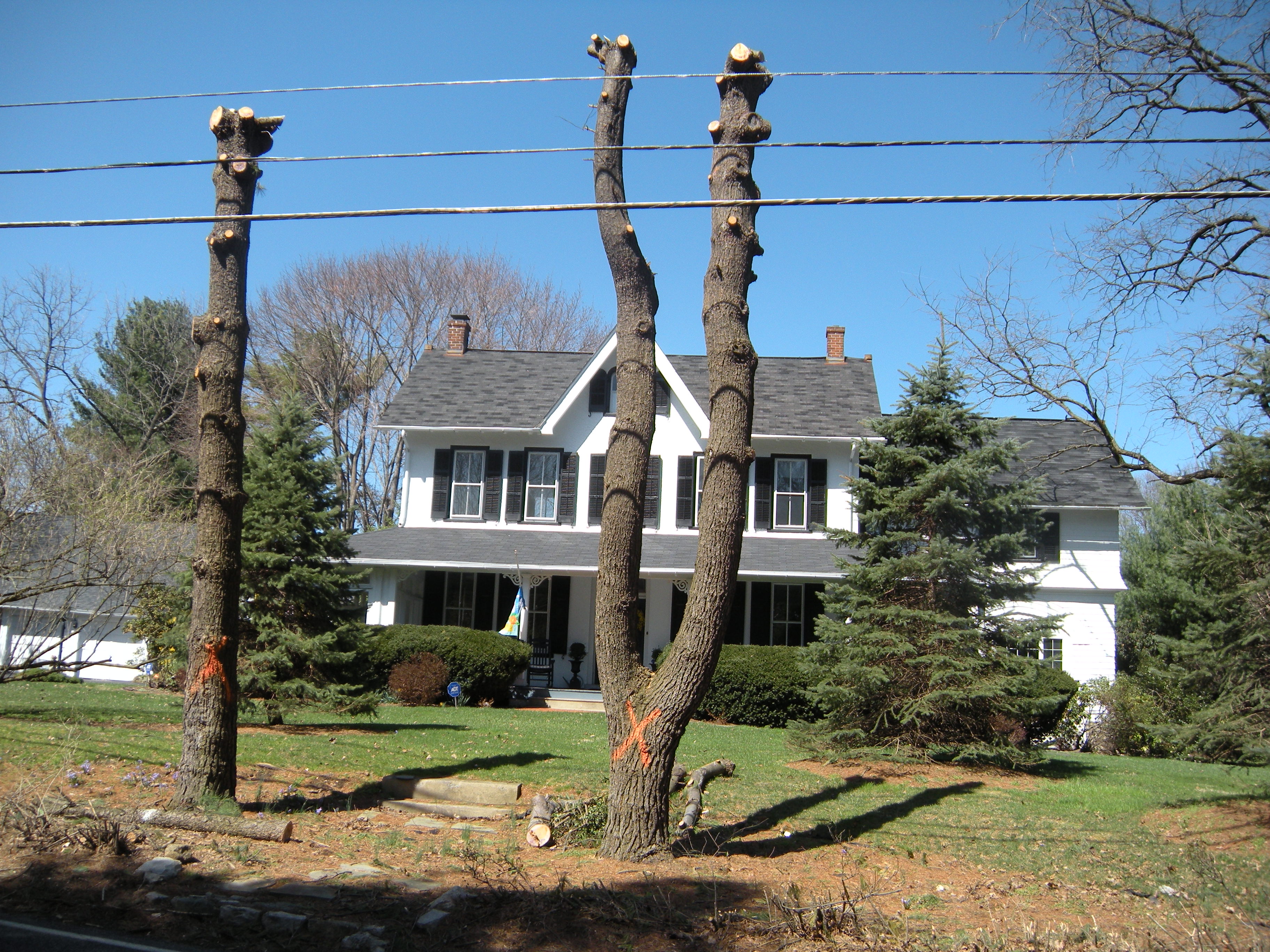
It is true that change and progress sometimes comes with a personal price. In the case of the sidewalks, some would suggest that there has been a very real economic and personal price tag paid for by the homeowners whose property has been effected by the sidewalk project. As I drove down Conestoga Road last week, I stopped to take photos of examples of tree removal. One of the beautiful historic houses that lost its front coverage was on Tredyffrin Historic Preservation Trust’s 1st Annual Historic House Tour, 6 years ago. The house has lost trees, shrubs and plantings. Here is a photo of the way the homeowner’s front yard currently looks:

Before anyone jumps in and suggests that I don’t care about the safety of the children who walk along Conestoga Road to school — that simply isn’t true; I care about everyone’s safety. But it still saddens me to see the neighborhood along the north side of Conestoga Road so dramatically changed by this construction project. I feel for the homeowners whose property has been forever altered. Although the homeowners will not be compensated financially; it is my understanding that the sidewalk plan calls for replanting of all trees and landscaping that have been removed for the sidewalk project.

Everyone should know that the upkeep of the sidewalks will becomes the responsibility of the individual homeowners. I wondered what would happen if there was an elderly homeowner or an owner who wintered in Florida and was gone during one of our Pennsylvania snowstorms? Who would be responsible for clearing their sidewalk? I was told that the clearing and upkeep remains the responsibility of the homeowner . . . guess he/she better make those arrangements before heading south for the winter! As wonderful as it may be to make our community more walkable . . . for some there is an additional personal price tag that goes along with progress and change.

Erica, a homeowner on Old Lancaster Ave. has provided her personal experience with the tree and landscaping removal as a result of the sidewalk project. Erica created a power point presentation which passionately details the specifics, click here to review the ‘before’ and ‘after’ photos taken of her property on Old Lancaster Avenue. Erica provides her personal remarks below on the sidewalk project from her vantage point as a homeowner on Old Lancaster.

No Gravatar, on March 26th, 2010 at 1:37 PM Said: Comment

Five years ago, I was going through a bad time. One day, I drove down Old Lancaster and saw that a house that I had admired for years was on the market. I was so excited that I put an offer in that day. Being English, I did the customary thing and named my house. Without hesitation, it became “HoHi” (after the “Hall of Intense Happiness – a building in I toured on a visit to China.)

My portion of Old Lancaster has old houses (most were build in the 20’s), no garages (converted years ago to extra living space), short driveways, and mature vegetation. We (had) a wide shoulder which left ample room for parking, walking & biking. My row of brick Tudors was “the” development of the time, I’m sure!

Anyway, long story short. Soon after moving in, I learned about the sidewalk project. Because the section of Old Lancaster is state owned, there is a 50’ easement — meaning , from the center of the road, the State controls 25 feet in each direction. I learned that Tredyffrin decided to go take all 25’ from the South side of the road – the side with no garages, no parking and mature vegetation. Because it’s a state road, extra ‘safety’ precautions were required i.e. EXTRA wide sidewalk plus “bump outs” to create a buffer between the pedestrians and the cars.

Residents banned together and formed a “Yard for a Yard” petition earning nearly every signature in the area. We contacted the TE historical society, the TE BoS, anyone that we thought might actually care, and we simply asked that the project be shifted 3 feet (a yard) towards the north side hence 3 feet of our yard would be saved. This would have translated into a saving of most if not all of the trees. We would still take the burden of owning the 5 foot (yes, 5 not 3) sidewalk but we would maintain our trees. Currently (pre-sidewalk) the paving encompasses 10’ in either direction (north and south – south being where the sidewalk will be built). With our proposal, the project would have gone from 10’ to 22’ instead of 25’ of the south side. The north side resident’s would be impacted by 3’(no trees and very, very few shrubs).

We were shot down so fast we didn’t know what hit us. It wasn’t until the sidewalk project became personal to the board did it gain attention. I have so much hurt and anger that it has been making me physically ill. Of course I share concern for the safety of children. Yet (knock on wood), I researched and was not able to uncover any accidents on record.

My HoHi is not a HoHi anymore. And thanks to rotten economy and eye-sore of a yard, I’m trapped here for at least a few years. Am I bitter? Clearly! While it’s too little too late, I truly do appreciate that people have taken the time to share sympathy. It means more than you can imagine that someone finally cares.

Tonight, I’m going to add a link to “before and after” photos simply to provide people a reminder of the importance of supporting neighbors because you never know when your home will be on the radar.

The appearance of established neighborhoods and historic buildings are now altered by the removal of trees and landscaping.

Mt. Pleasant Town Hall Meeting and TESD School Board Meeting Tonight!

The much anticipated Mt. Pleasant Town Hall meeting is tonight. This meeting has been a long time in the works; previously cancelled twice due to snow. The community meeting will be held at the First Baptist Church on Upper Gulph in Mt. Pleasant, 7 – 9 PM. Many of us have heard Christine Johnson at Board of Supervisors meeting speak passionately about issues facing her Mt. Pleasant neighborhood. Tonight should present an opportunity for residents of this panhandle community to voice their opinions and concerns.

Tredyffrin Township Police Officer Larry Meoli has help to organize this meeting with Mt. Pleasant residents. Attending the meeting will be members of the Board of Supervisors and representatives from the township staff, zoning and police departments. Liaisons from the Board of Supervisors will be supervisors DiBuonaventuro, Kichline and Richter. Having just recently written about the Sunshine Law, I now understand that if more than three supervisors attended tonight’s town hall meeting, that would be viewed as a violation. I will be attending the Mt. Pleasant meeting and look forward to the exchange of information. I will provide an update tomorrow on Community Matters.

Tonight is also the Tredyffrin Easttown School District monthly school board meeting. Here is the TESD agenda.The agenda is very detailed (117 pages). In reviewing the agenda, I did note the resolution from the school district in regards to the Pennsylvania Public School Employees Retirement System (PSERS). Much has been written about PSERS and the escalating associated costs; I am pleased to see that TESD is supporting pension reform in the state! (I am hopeful that my friend Ray Clarke will be attend tonight’s TESD meeting and will provide his remarks.)

Economics Driving TESD's Budget Woes . . . EIT to Be Explored

Ray Clarke attended the TESD Budget Workshop last night and provides the following commentary. I am fascinated that the school district is bringing EIT out of hiding. There is much misunderstanding about Earned Income Tax – we need an open and thorough airing of EIT. I would suggest that the TESD and township partner for the discussion, have an outside expert give a presentation (like Easttown Twp did for its residents). The presentation should be taped and then shown repeatedly on both the school district and township cable networks. Some people hear ‘tax’ in the Earned Income and then simply shut-down.

Whether it is the township or the school district we are talking about — we are currently facing tremendous economic hardship and all revenue sources must be explored. Personally, I don’t want to pay more taxes and my personal household will suffer with EIT (my husband works for Unisys) however, . . . there is also a reality to the situation. I applaud the School Board for recognizing the need to explore Earned Income Tax and would hope that the Tredyffrin’s supervisors would be likewise motivatedit’s called exploring options. Both the township and the school district have been faced with major deficits in their budgets that have required cuts in personnel, services, programming in an attempt to close the gap. But to what end can we continue to make these cuts? At what point do we weigh the quality of life that all enjoy in this community vs. increase in taxes? I do not see how continuing to say, no new taxes is a long-term solution to the problem. Comments?

A quick report from the Budget workshop. Only 25 or so residents tonight, probably reflecting that there was little discussion of program changes. The occasion was used mostly to lay out a framework, stake out some board member positions, and set up the important April 12 Finance Committee meeting where the next level of expense reductions will be discussed.

However there were some really significant outcomes, worthy of full attention.

The basic parameters being positioned to balance the budget are:
– Implement the $4 million of expense reductions already discussed
– Tax to the full 2.9% cap
– Use $2 million of fund balance
– Find at least $0.7 million of 2010/11 reductions from $1.5 million of mostly non-educational strategies
Round numbers, subject to tweaking up or down.

The principal dissent came from Dr Brake, who is not thrilled with the proposed changes to the Middle School program. He seems to be the only one on the other side of this.

Dan Waters and Kevin Mahoney lost few opportunities to highlight the fact that these 2010/11 actions leave the structural problem untouched (shades of Tredyffrin’s “structural deficit”!). And they are right: 50% of the $4 million is one year only, and of course the fund balance use can’t continue for ever. The deficit for 2011/12 after the above programs would still be $7.5 million (8.2 – 0.7).

So, the administration is going to do the following:
– Deepen the study of the $2.6 million of class size, CHS period changes, etc. that – practically – can not be implemented until 2011/12. (Strategies 47-56, approximately.) If all were implemented, the deficit would be down to $4.9 million.
– Study the implementation of an income tax. Taxing to a likely 2% Act 1 property tax cap next year would still leave the district $3 million short, so this – to me – seems inescapable.

Some EIT information that’s new to me, and definitely has a major impact on the revenues for TESD: Kevin Mahoney stated that there is the potential to reclaim not only taxes paid to neighboring municipalities, but also to Philadelphia (which would apparently get reimbursed from gaming revenues).

Kevin Grewell has posted a lot of helpful EIT information here. Important features confirmed tonight appear to be that this would be implemented under Act 511, which is coordinated with the Townships. Resident tax is split between School District and the townships, non-resident money is collected by the Township (which turns out to be looking at fire department funding).

Debbie Bookstaber (from the last TSC) asked that the study include a comparison of an EIT and a PIT.

The Board took pains to emphasize that program changes must be fully vetted, particularly in the Education Committee, and subject to public input. Back to that April 12th meeting. Also, decisions will need to be made soon on the health insurance funding and bond issuance as part of the $4 million 2010/11 programs – the former in particular being highly susceptible to assumptions. I’d like to be convinced that all aspects of utilization risk have been thought through

Community Matters © 2025 Frontier Theme