Pattye Benson

Community Matters

Tredyffrin Township

Paoli Transportation Center Plans Moving Ahead: Darby Road location selected for new train station

Last fall, SEPTA presented three options for the Paoli Transportation Center at an open house at the township building. I received the following SEPTA press release from township manager, Bill Martin who had promised last week that an update was imminent. After reviewing the public’s input and preference on the site location for the new train station, a decision was announced today. Of the three alternatives, the Darby Road Extension was the preferred plan — click here to review the three plans. A map of the Darby Road Extension Alternative is below.

According to SEPTA’s press release, in the Darby Road Extension Alternative plan, “the existing North Valley Road Bridge will be demolished and Darby Road will be extended across Lancaster Avenue over the railroad tracks and with a new bridge to be constructed.” Both the Greenwood and the Plank Avenue options had the train station moving from its current location whereas the Darby Road Extension plan alternative leaves the station in the same place.

It’s exciting to see that the train station project has completed another hurdle in what has been a very long process — thanks to all that helped with this step!

SEPTA Press Release:

Darby Road Site Selected for Paoli Intermodal Transportation Center

PHILADELPHIA, PA (February 13, 2013)—SEPTA, in conjunction with a consortium of stakeholders, has designated the Darby Road Extension Alternative as the preferred site for the proposed Paoli Intermodal Transportation Center.

The Darby Road Extension Alternative was one of three options presented at the October 2012 Paoli Transportation Visions Open House where over 300 residents and community stakeholders provided their opinions on each alternative. After the event, their feedback was compiled and Gannett Fleming presented SEPTA with an alternative analysis report. Both showed the Darby Road Extension Alternative as the best and most favored option. Under this option, the existing North Valley Road Bridge will be demolished and Darby Road will be extended across Lancaster Avenue over the railroad tracks and with a new bridge to be constructed.

“We considered all of the options and opinions presented,” Robert Lund, SEPTA Assistant General Manager of Engineering Maintenance & Construction said. “It was important for us to hear what the community wanted.”

“The demolition of the outmoded North Valley Road Bridge, and the extension of Darby Road, is a smart, community based solution,” Michelle Kichline Chairman of Tredyffrin Board of Supervisors said. “It is a critical first step in the long planned redevelopment of Paoli and the Transportation center.”

Located in Chester County the Paoli Intermodal Transportation Center will be in the heart of the Paoli Business District. It will feature a fully accessible Regional Rail Station that will accommodate SEPTA buses, private carrier shuttle buses, taxis, pedestrians, and cyclists. A large, multi-story parking garage will also be needed as part of the Center. Roadway, streetscape and track improvements are also planned to enhance rail service and improve traffic flow in the area.

“This project is tremendously important to our Paoli community and to the region,” Pennsylvania State Representative Warren Kampf said. “I look forward to working with all stakeholders — especially local residents — and SEPTA on this preferred site. We need to create a Transportation Center that addresses long unsolved problems with the current station, the road network, the parking, the ever-increasing commuter demands and which promises to be a centerpiece of a better downtown Paoli.”

Paoli Station serves approximately 1,300 passengers each day. The station is located along SEPTA’s Paoli/Thorndale Regional Rail Line and AMTRAK’s Philadelphia/Harrisburg Keystone Corridor. SEPTA bus routes 92, 105, 204, 205, and 206 serve the station in addition to private carrier shuttle buses that provide transportation to the Great Valley and Chesterbrook corporate centers.

“The Paoli Intermodal Transportation Center will be a great benefit to the residents of Chester County,” Pennsylvania State Representative Duane Milne said. “The new station will not only allow residents to reach destinations such as Philadelphia or Harrisburg more easily, but it will also benefit the local economy, as well. New businesses will likely open in the area of the new station to accommodate the needs of the many commuters passing through each day. “I am glad that everyone involved in the project came together and made a thoughtful decision on its future location. Having selected a site, now the exciting construction process can begin and this wonderful project will soon become a reality.”

“This is a project that has been literally decades in the making and one that will provide a significant boost to our local economy,” Pennsylvania State Senator Andy Dinniman said. “The new Paoli Intermodal Transportation Center will be a crucial artery for local businesses, commuters, employees and residents throughout the region, as well as a 21st century transportation hub for the downtown Paoli business district. Design improvements will address issues with the current station, such as parking and traffic enhancements and better access for pedestrians, cyclists and buses. But perhaps most importantly, the project will go hand-in-hand with vital rail-line upgrades to Amtrak’s Keystone Corridor train service – upgrades that mean faster trains and shorter travel times for commuters.”

In addition to SEPTA, the Paoli Intermodal Transportation Center project has been guided by a consortium of stakeholders consisting of Tredyffrin Township, Willistown Township, AMTRAK, PennDOT, the Chester County and Delaware Valley Regional Planning Commissions, elected officials, residents and the business community. For more information about the project, visit http://www.paolionthemove.org/.

School Safety … An ongoing priority for Tredyffrin Twp Police Superintendent Anthony Giaimo

Tredyffrin Police Superintendent Anthony Giaimo did not need the Sandy Hook shootings to prioritize school safety.

However, if you attended, or watched the TESD special safety meeting, or the District’s Finance or regular school board meetings, you may have come away with the mistaken impression that the Tredyffrin Police Department is only peripherally involved in the school safety process. Sure, T/E Superintendent Waters and Kevin Buraks, president of the school board spoke of the good working relationship with the police departments (Tredyffrin and Easttown). Waters and Buraks rationalized the hiring of Andy Chambers as District’s safety consultant because (1) need to act quickly following Sandy Hook; (2) Chambers knew the District buildings and (3) he was a lot cheaper ($125/hr.) than previous safety consultants. At the last school board meeting, someone mentioned the District had previously spent $100K for a safety consultant post-Columbine.

Beyond the obvious transparent issues that accompanied the hiring of Chambers, I could not help but wonder how this safety consultant was going to work with current police staff, given the reasons behind his departure from Tredyffrin. I also could not understand what Chambers was going ‘to do’ for the District that experienced Tredyffrin Police Supt. Anthony Giaimo and Easttown Police Chief David Obzud, and their respective departments. were not already doing.

For those like me, that may have been confused about ‘who knew what and when’ in regards to the school safety situation and Chambers hiring by the District, I clarified some of these points with Giaimo today.

Fact: Giaimo has 23+ years of experience with the Tredyffrin Township Police Department.

Fact: Neither Dr. Waters nor the school board consulted Giaimo before hiring Chambers. Giaimo was told a couple of hours before the announcement at the District safety meeting.

Fact: The school ‘hardening’ suggestions that the District is implementing were the personal recommendations of Giaimo, including the notification panic buttons, buzzer system and the ballistic film on windows and doors.

Fact: Giaimo has been actively involved in developing a crisis plan with administrators of each school and doing building safety assessment on District schools (as well as private and nursery schools). According to Giaimo, school safety has been an ongoing priority of his, not just post-Sandy Hook.

Fact: Waters and the District were fully aware of Giaimo’s school safety and crisis plan – prior to the hiring of Chambers.

Fact: There has not been a District school safety meeting between Giaimo and Chambers.

Fact: It is unclear how Chambers efforts as the District’s safety consultant will differ from efforts currently performed by Easttown and Tredyffrin Township Police Departments.

Fact: Representatives from the Police Department are on the District safety committee.

Fact: The Board of Supervisors has not authorized hiring of 2 additional police officers as recommended by ICMO consultants and approved in the 2013 township budget

School safety has been an ongoing priority for Giaimo and he has been very proactive in his approach since becoming Superintendent. He has a good working relationship with Easttown Police Chief Ozbud and the two are committed to coordinating school safety response, regardless of which township the school is located.

I don’t want to ‘beat a dead horse’ over the hiring of Andy Chambers; I accept the Board approved his hiring. However, it remains unclear to me what additional safety information the District will receive as a result of Chambers’ hiring. Without a ‘scope of work’, it just appears that Chambers could be performing a duplication of effort at the expense of the taxpayers. It is my understanding that the school district will include Giaimo and Ozbud in any school safety decisions based on Chambers’ recommendations.

Our police superintendent has the safety of our children as a continuing priority, not just because of Sandy Hook. Regardless of the number of Tredyffrin Police Department officers, Giaimo remains committed to school district safety. However, more important than ever, providing safety requires adequate police department staffing. If you agree, I strongly suggest attending Mondays Board of Supervisors meeting. (Click here for agenda). The Board of Supervisors has not authorized the two additional police officers recommended by the police department consultants, ICMA and approved in the 2013 township budget.

When will Tredyffrin Township hire budgeted police officers?

When will Tredyffrin Township hire budgeted police officers?

Looking for answers, today I met with Tredyffrin Police Superintendent Tony Giaimo. I wanted to understand the search for and selection of police officers. As I explained to Giaimo, applicants for police department positions have contacted me over the last 6-8 months, anxious for a hiring update. I learned much about the police department hiring process and thought it worthwhile to share.

Early in 2012, the Tredyffrin Township Police Department advertised the April 14, 2012 physical assessment and written test date for vacancies in the department. According to Giaimo, 130+ individuals applied to take the physical and written exam. In addition to the application form, a physician statement and informed consent form were required.

The physical assessment is judged pass/fail; the written test included multiple-choice questions plus a written narrative. If a candidate passed the physical exam and received an 80% or higher score on the written exam, they moved to the next step. All candidates were notified of the test results 2-4 weeks following the April 14th exam.

Of the 130+ applicants, close to 100 individuals passed the physical test and scored 80% or higher on the written part. The next step for the successful applicants was an oral interview by an Oral Interview Board, composed of three police personnel selected by Giaimo. At the time of the interview, applicants were required to provide education transcripts, military discharge papers when applicable, and three reference letters (other than relative and employers). Failure to provide documents at the interview, disqualified applicants from the selection process. The interviews were conducted between June and August 2012.

Each member of the Oral Interview Board independently scores the oral interviews and those scores are then added to the written exam score. For those applicants that advance to the next step, they receive a polygraph examination. According to Giaimo, the polygraph test is to indicate deception on a pre-determined set of questions. After the polygraph phase, the top list of 15 candidates is prepared. The ranking is based on all phases of the test process to this point. For those 15 candidates, the next step is a background investigation by the Tredyffrin Township Police Department including previous employment, education record, military record, criminal history, credit rating, etc.

The next step is a conditional offer of employment. Hiring is contingent upon successful completion of psychological and physical examinations and selection by the Police Superintendent. (I believe this part of the examination process takes approximately 4 months.) Once this conditional phase is completed, the cadet serves a two-year probationary period.

At the start, prospective applicants are told that the process takes approximately 6-8 months from the time the exam is taken – in this case, the exam was given on April 14 so if they successfully completed each step, vacancies were to be filled somewhere between October – December, 2012.

I received a call from a father of one of the cadets that is on Tredyffrin Police Department’s ‘short list’ in early January, looking for an update. I assured him that the township would be hiring 2 police officers shortly. I was confident giving this response for the following reasons, (1) the police contract was settled; (2) the ICMA consultant’s study (pg. 11) suggested a minimum of 2 additional officers were required to maintain township safety levels and (3) supervisors approved the 2013 budget that included 2 additional police officers (with the possibility of a third officer added sometime during the year).

The focus of my meeting with Superintendent Giaimo was to find out the hiring date of the two police officers. Remember the cadets were told last April the application process would take approximately 6-8 months; it’s now 10 months!

I could not believe Giaimo’s response today re the hiring of police officers; telling me that he had not been authorized to hire. What? That’s right folks. The police contract was signed in December and the 2013 township budget approved (which included the hiring of the two officers) but the Board of Supervisors have not given Giaimo permission to hire the two officers. Gosh, even pg. 11 of the ICMA police department study indicated the township needed to hire two officers to maintain satisfactory safety levels.

Giaimo assured me that he has the ranked list of candidates ready to go — all he needs is the OK from the BOS to make the offers. If you think that adequate staffing of our Police Department is an important issue, you may want to attend the next BOS meeting on February 11 and offer your opinion.

Malvern Redevelopment Project — So close, and yet so far away (from Paoli)

Reading Aubrey Whelan’s article in today’s Philadelphia Inquirer, ‘Malvern apartment complex nears completion after 10 years in the works’ had me thinking about Paoli, and the long overdue intermodal transportation center. Malvern … so close, and yet so far away from Paoli.

The Eli Kahn development project in Malvern is transforming – with an estimated $45 million price tag there’s 25,000 square feet of new construction stretching 1,400 feet along King Street. The mixed-use buildings plan has retail shops and restaurants on the first floor with 190 luxury apartments above. Even a Kimberton Whole Foods is planned that may give Wegmans, down the road some competition.

We all understand that projects such as Malvern’s King Street development don’t come without their challenges … how to revitalize in the midst of quaint Victorian facades and street lights … how to move a town into the 21st century without losing the charm of its 18th century roots. Change is never easy and not everyone has shared the vision for Malvern’s future. Media, Phoenixville, Wayne, West Chester – I am sure that all these communities saw their share of resistance to change. But today these towns are testaments to those who had the vision to believe in ‘what could be’ and the passion to ‘make it happen’.

I know that Eli Kahn’s project in Malvern is not the same kind of development as the Paoli Transportation Center. However, Malvern’s mixed-use commercial and residential buildings in the King Street business district (within walking distance of their train station) creates a model for Paoli’s redevelopment plans, beyond just a new train station.

I checked the Paoli on the Move website, www.paolionthemove.org and there are no additional updates since the Paoli Transportation Visions Open House at the township building with SEPTA last October. Frustrated, I sent an email to Michelle Kichline, as chair of the Board of Supervisors, and to John DiBuonaventuro, as the western district supervisor, asking for an update on the project. I also sent an email to Lucille Songhaim, Septa’s Community Relations Coordinator asking the status on the Paoli Transportation Center.

I received a response from Michelle, thanking me for my inquiry and stating, We have been working on a joint update/ press release with SEPTA and Representative Kampf’s office. We expect SEPTA to release it soon. As soon as they do, I will have Bill Martin make sure you get a copy.” I asked for a project update at the BOS meeting on February 11, and I am pleased to report that township manager Bill Martin emailed that he will add the update to the meeting.

Home Invasion – Robbery – Kidnapping in Berwyn

Police Superintendent Tony Giaimo sent the following press release concerning last night’s home invasion in Berwyn Please read and if you have any information about the crime, you are asked to contact the police department. Fortunately, the owners were not hurt but how scary – I cannot imagine!

TREDYFFRIN TWP. POLICE DEPARTMENT

SPECIAL PRESS RELEASE

HOME INVASION ROBBERY/KIDNAPPING

On Thursday, January 31st, 2013 at 8:28 PM., Tredyffrin Twp. Police officers responded to a “911” call on the 200 block of Wooded Way, in the Berwyn section of Tredyffrin , for a reported home invasion robbery and kidnapping.

Information received by police was that a local resident, who had returned from work at approximately 7 PM, was accosted by three or four black male (masked) subjects armed with handguns who forced themselves into his home. Once inside, the actors bound both victims (husband and wife) and ransacked the home. The actors then took the male victim (in the victim’s white Volkswagen Passatt bearing PA registration plate DJM0696) to the jewelry store (Shuler’s Jewelers) owned by the victims in East Norriton, Montgomery Co. The additional actors were believed to have followed the victim’s vehicle back to the jewelry store. The suspect vehicle is believed to be a silver or blue sedan – possibly a Chrysler product. No physical injuries were sustained by the two victims. The investigation is continuing with the assistance of the East Norriton Twp. (Montgomery County) Police Department and the Chester County Detectives.

Superintendent of Police Anthony Giaimo commended the quick actions of all responding patrol officers and detectives. Giaimo noted, “We will aggressively pursue this case in conjunction with other partner law enforcement agencies to bring these criminals to justice.”

The public’s assistance is requested in locating the white VW Passatt sedan bearing PA registration DJM0696. Anyone with information relative to this case is asked to contact the Tredyffrin Twp. Police Department at 610-647-1440.

Tredyffrin Pays $83K for Police Contract Arbitration, or … was it really $133K?

The Board of Supervisors and the School Board have their first meetings of the New Year this week. As is often the case, Tredyffrin’s Board of Supervisors meeting conflicts with the TESD Board meeting. Scheduled for Monday night is both the Board of Supervisor’s organizational and regular meeting at the township building and the T/E School Board will hold a special school board meeting to consider the 2013-14 budget at the T/E Administration Building. Unfortunately, both meetings are at the same time – 7:30 PM.

The Board of Supervisor’s organizational meeting includes the adoption of the meeting schedule for the various township boards and commissions, naming of emergency service providers, adoption of township fee schedule, legal and accounting reviews, etc.

One of the interesting aspects of the organizational meeting each year is the naming of the Chair and Vice Chair of the Board of Supervisors. The seven Board members nominate and vote on these positions. Historically, these positions go to the longest-serving members on the Board. However, in 2012, that tradition shifted with the naming of Michelle Kichline as Chair. Kichline had only served 2 years as supervisor and neither as a Vice Chair, but received the unanimous support of her fellow board members for the chair position. Having served longer than Kichline, many had expected John DiBuonaventuro to receive the 2012 nod for Chair but instead he served as Vice Chair. The Board of Supervisors saw their share of controversy in 2012, so it will be curious to see if Michelle receives another vote of confidence to continue as Chair and JD to continue as Vice Chair.

After the ceremonious organizational meeting, there is a regular supervisors meeting, including a Public Hearing to “consider and enact an ordinance of the Township of Tredyffrin, Chester County, and the Commonwealth of Pennsylvania, fixing rates of taxation for the year 2013.” We learned at the last BOS meeting in December that the township tax increase is set at 3.1%, down from the 5.5% originally forecast.

Since the December 17th supervisors meeting, we have learned of the Act 111 Arbitration Award issued for the collective bargaining agreement between the township and the police union. Much has been written about the agreement on Community Matters with many comments. If you are interested in details of the 4-year contract (2012-15), I would suggest you review posts from late December. Once the arbitration award was announced, I submitted a right-to-know request for a complete accounting of the arbitration related expenses paid by the township. It should be noted that this is the second police contract in a row that has gone directly to arbitration by the township. In both instances, the impartial arbitrator came down on the side of the police union in regards to the post-retirement benefits. We know that retirement benefits , including pensions and healthcare, were major contributors to the long-standing debate between the two sides.

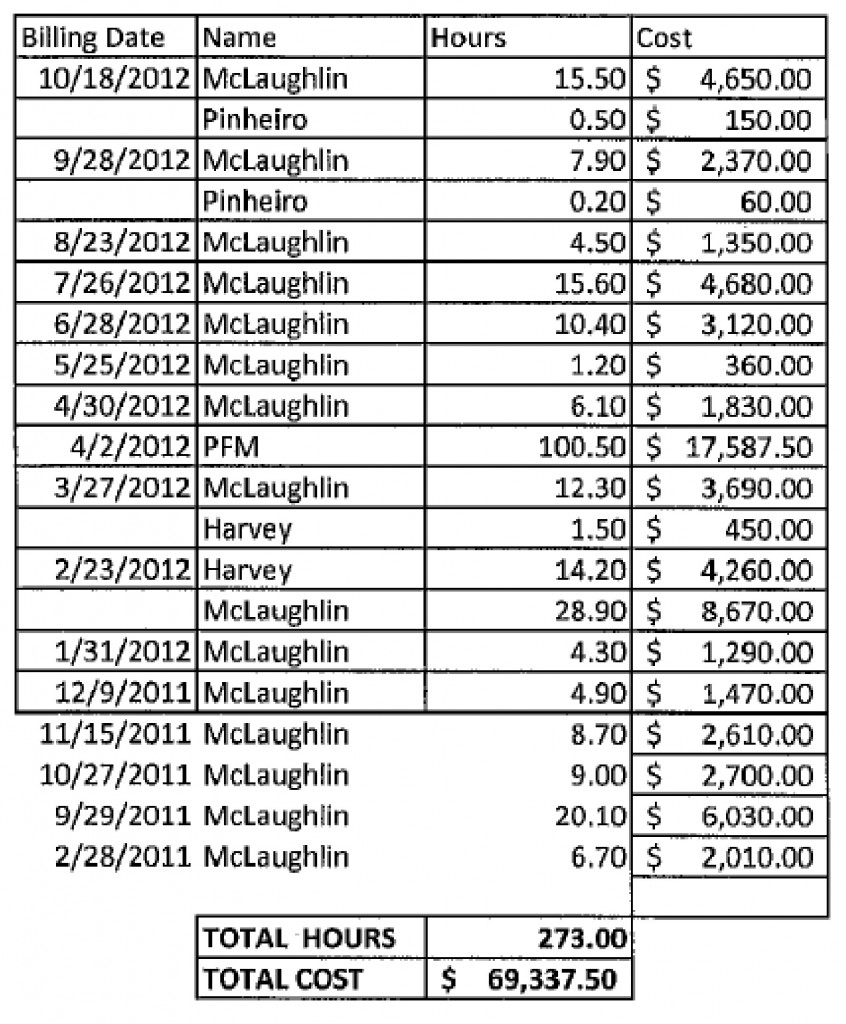
According to township manager Bill Martin, the arbitration costs to the township (taxpayers) re the police contract is as follows – Michael Zobrak, impartial arbitrator $14,136.46 and township arbitrators John McLaughlin, Patrick Harvey, Brian Pinheiro, etc. billed 273 hours for $69,337.50. If my math is correct, the taxpayers paid $83,473.96 for the arbitration of the police contract.

Below are the details that Bill Martin sent for the township arbitrator costs. John McLaughlin, Patrick Harvey and Brian Pinheiro are all partners in the Philadelphia law firm of Ballard Spahr. The law firm billed the township 273 hours for a total of $69,337.50 which equates to $254/hr on the average. On April 3, 2012 there are 100+ hours billed to the township under the name, ‘PFM’ — I am clueless as to what that means but I will contact the township manager for clarification.

I am struggling to understand these billable hours from Ballard Spahr. It was my understanding that there was little (if any?) movement from the township’s initial position going into the arbitration process. If that is the case, how is it that the total number of hours in 2012 (setting aside the hours from 2011) are so substantially higher than the total billable hours of Michael Zobrak, the impartial arbitrator.

Something else I should point out is that on my right-to-know request in which I asked for ‘costs to date’ was dated January 1, 2013 and Martin’s response was dated January 4th. If you look at the last billing date from Ballard Spahr (below) it was back on Oct. 18, over 2 months prior to the signing of the arbitration agreement on December 23, 2012. It stands to reason that there are additional billable hours yet to be received from Ballard Spahr for those 2+ months, including the review of the arbitration award before its release. I would maintain that the township has not seen the end of the costs — $83K may not be the entire costs.

TT Arbitrator Costs

I would suggest that we should also add the ICMA (International City/County Management Association) police department consulting fee of $49K to the total cost of the police contract negotiations. Much of ICMA’s report was boilerplate language and their specific, cost-savings suggestions would require collective bargaining changes. The way I see it, the township has already spent approximately $133K trying to lower police department expenses. Based on the arbitration award, we know that the police department retained most of their prior contract benefits.

What bearing is the Act 111 arbitration award going to have on the township’s 2013 budget? The supervisors and the finance director Tim Klarich did not have the benefit of a crystal ball in regards to the arbitration award when they calculated the 2013 budget. In addition, we still have the issue that there were 47 uniformed police in the 2012 township budget and the 2013 budget has the number reduced to 42. The 42 uniformed police officers is two more officers than are currently in the department. Now that the police contract is settled, will the supervisors OK the hiring of those two additional officers?

Why Tredyffrin’s Arbitration Award Wasn’t ‘In the Middle’

In the addendum to my previous post, “Tredyffrin Township Police Union Favored in Act 111 Arbitration Award”, I remarked that I had assumed that the independent arbitrator would make his award in the police contract arbitration ‘somewhere in the middle’. During the arbitration process, John Petersen had assured me that the arbitrator would favor the police union in his decision, and … we now know that my assumption was incorrect.

In response to my statement that a “further explanation of the arbitration process would be helpful”, John provided the following opinion for Community Matters:

We are where we are because of what was agreed upon in the past. An arbitrator’s role is to find the most “equitable” solution absent the parties agreeing to such. Normally, there is at least some level of negotiation prior to arbitration. It’s always best if the parties themselves can come to an amicable resolution. While there may be disagreement, when parties can mutually agree, it implies a certain level of functionality as to the working relationship. That doesn’t mean that arbitration itself implies dysfunction. Often, there are some points parties cannot resolve. Again, an arbitrator’s role is to resolve those points in contention – in the most equitable fashion possible.

When I learned that the township refused to negotiate, instead opting for arbitration, in hindsight, I was not surprised. It indicates a level of dysfunction that has become the hallmark of this government. As I have said before, the municipal government, like the school board, sought to claw back everything it has negotiated in the past 20-25 years.

There’s a legal concept in commercial law known as “Course of dealing.” In the absence of a written agreement, courts and arbitrators will look to how the parties dealt with one another in the past. In collective bargaining scenarios, there is of course, a written agreement and there is a clear record of past dealings. Going back to my first sentence – we are where we are because of what was agreed upon in the past. It may be, and actually is quite likely, the municipal government, like the school board, has buyer’s remorse.

Given current circumstances, the benefits conferred upon the union appear to be “too good.” Some will attempt to claim victim status by either blaming Harrisburg or by saying that their hands were tied.

Some here trot out the phrase “Labor peace” in terms of the cost. I like that phrase and I think in Tredyffrin, it applies. Once upon a time, there was a premium on labor peace. There was time that those in charge thought it unseemly that Tredyffrin would be the subject of a strike. Once upon a time, there was at the very least, a cordial working relationship with unions. That however, was a different time and the people were very different.

Other municipalities like Lower Merion apparently had the foresight to negotiate these things in a different way. This means that what is in the “Middle” for one group may not represent the middle for another group. The middle, relative to the facts and circumstances of each situation, is the same for all in that it represents the equitable mid-point for that agreement. When compared to other groups however, the specific data point that represents the mid-point, assuming there could be a normalized scale amongst disparate contracts, would be very different as between Radnor, Lower Merion and Tredyffrin. Nevertheless, arbitrators will look at those other situations as a barometer for what is reasonable.

This gets into another commercial legal concept known as “Trade usage.” All of this tends to put boundaries on where the result will end up.

When I heard about the time it was taking for this arbitration, the answer was very clear to me. It was interesting to note that some had questioned why the arbitrator in the police matter had not made a decision. I had posed to Pattye the following: “Perhaps the arbitrator is making a decision, by not making a decision.” Pattye asked me to clarify. I said, “It may be that the arbitrator sees as the most equitable resolution something that more closely matches the status quo.” Arbitrators, like judges, would prefer to have the parties themselves arrive at a resolution. In this case, there were two fundamental problems. 1 – The parties were miles apart and 2 – the township government, as I understand it, refused to negotiate and instead, leave its fate to an arbitrator.

Given the experience of the school board and given the general role of what arbitration is, the township’s stance in this matter was rather foolish and a bit disheartening. There’s a bigger problem here – one that cannot be solved with money. I have commented for years how this government does not work together, either as a board, or as to the entities, it has to deal with. We are now seeing this problem expand to other things like the Planning Commission. Governments are top-down organizations. They lead from the top and the top is what sets the example and moral tone for how the rest of the township government operates. The day isn’t long enough to count the problems incident to the staff, volunteer boards and elected officials. The only thing the township government excels at is dysfunction. If that is the “Gold standard” – then Tredyffrin is second to none.

At the end of the day, it was my contention that the Arbitrator was likely, a bit miffed at the township for what was a wholly unreasonable stance – both not willing to negotiate and its desire to end all post-retirement benefits. As sure as I was about the outcome of the negotiations between the school board and the teachers, I as more sure about the police matter. Why? Because of the facts and circumstances here made it clear where the most equitable solution was. Further, Tredyffrin’s situation is not that far out of whack with other jurisdictions. And where things may be better for the union in Tredyffrin, it’s only because the government agreed to such.

You don’t get t0 wipe away your bad business decisions at the expense of the other party. That’s not how the real world works. It’s not how judges and arbitrators will decide. Unless of course, it finds there was an unfair bargaining position – which in this matter was not the case. It is for those reasons I concluded as such. As to whether Michelle and the board already knew that or not, I don’t know. Speaking as a lawyer, I would have to think that any competent lawyer would know that refusing to negotiate is itself, an unreasonable thing and that an arbitrator may well find that such a position offends the system. I did see the meeting where she said to Pattye that she didn’t know why it was taking so long. Candidly, I chuckled at that response.

In this case, I think Tredyffrin was taken to the woodshed and made an example of. Other municipalities will or at least should think carefully about, following Tredyffrin’s folly strategy in a negotiating strategy that involves not negotiating.

As to the contention that the township’s unfunded liability should have anything to do with the arbitrator’s decision, that is pure nonsense. One has nothing to do with the other. That unfunded liability was an unfunded liability of choice. Those benefits were what were agreed to in the past. This is more evidence that the township sought to claw everything back in one shot – an unrealistic scenario. I’ve said it before and I’ll say it again, the township’s and school board’s legal guidance leaves a lot to be desired.

Tredyffrin Township Police Union Favored in Act 111 Arbitration Award

Addendum … In an earlier post I wrote about the extreme starting positions of the police union and the township, and it was my opinion that the “answer for the arbitrator must lie somewhere between these two positions.” In response to my statement, John Petersen assured me that the arbitration award would not be ‘somewhere in the middle’ but rather it would be much closer to the union’s status quo starting position. At the time, I argued with him, figuring that ‘cutting the difference’ between the opposing union/township positions would ‘make sense’ to the arbitrator. In reviewing the arbitration award, it is obvious my assumption was incorrect … further explanation of the arbitration process would be helpful.

—————————————————————————————————

According to the township website, there is there has been an ‘Act 111 Interest Arbitration Award’ issued for the collective bargaining agreement between the township and the police union, Tredyffrin Township Police Association (TTPA). Enacted in 1968, Act 111 is a state law that provides binding arbitration to police and fire fighters in exchange for a prohibition against strikes. If collective bargaining reaches an impasse and proceeds to the interest arbitration level, the determination reached by the arbitration board is final on the issues in dispute and binding on both parties

I am not sure who is responsible for the arbitration award appearing on the website – our new township manager Bill Martin or Board of Supervisor chair Michelle Kichline. But to whoever is responsible, thank you … it was a pleasant surprise to find the award pdf on the website, without necessitating a ‘right-to-know’ request.

Since January 2012, the contract between TTPA and the township has been in arbitration; the 3-year police contract expired December 31, 2011. The process has been held captive for nearly a year, waiting for a ruling from the Board of Arbitration, impartial chair Michael Zobrak, Esq. township arbitrator John P. McLaughlin, Esq. and union arbitrator Stuart W. Davidson, Esq.

The biggest roadblock in collective bargaining contract disputes these days is health care benefits (in addition to salaries) and the Tredyffrin Township/TTPA contract proved no different. In reviewing the arbitration award, please understand that I do not claim labor attorney status or an expertise in contract law. However, it would appear that the independent arbitrator favored the township police in his award. Some of the highlights of the arbitration award include –

A 4-year township-police contract, retroactive to January 1, 2012. The term of the contract is January 1, 2012 to December 31, 2015. The arbitration award includes salary increases to TTPA members as follows:

  • January 1, 2012: 3.5%
  • January 1, 2013: 3.5%
  • January 1, 2014: 3.75%
  • January 1, 2015: 4%

The previous TTPA contract included yearly salary increases of 3.5% for 2009, 2010 and 2011. As a reference point, this week the Lower Merion Township Police Association signed a new 4-year contract that includes 3.5% yearly increase for the first three years and then 3.75% in the final year. It is interesting to note that unlike Tredyffrin, Lower Merion Township and their police department were able to reach a new contract agreement prior to expiration of their current contract. The TTPA contract expired December 31, 2011 and has been in arbitration for over 11 months.

The healthcare changes contained in the arbitration award for TTPA members should save the township some money. Under the new agreement, the township will be able to change to medical coverage as soon as possible to a less costly plan (from Aetna PPO to IBC Personal Choice). Co-pays will be $5 generic and $20 brand. TTPA members will not contribute toward the cost of their health care insurance premium for 2013; township will analyze premium contributions annually starting in 2014.

Here is a twist in the health care coverage that could produce savings for the township but also some extra money for our police officers – an ‘Opt Out’ plan. By opting out, the Township will pay officers the following amounts on a yearly basis:

  • Officer drops single coverage: $3,500
  • Officer drops dependent coverage (officer still covered) $4,000
  • Officer drops dependent coverage (officer not covered) $4,500
  • Officer drops spouse (officer still covered) $4,500
  • Officer drops spouse coverage (officer not covered) $5,000
  • Officer drops family coverage (officer still covered) $5,500
  • Officer drops family coverage (officer not covered) $6,000.

I like this incentive based healthcare coverage idea. If police officers give back on their medical coverage, it will save the township money and in return, produce a financial incentive for TTPA members … a win-win for police officers and the township.

The arbitration award contains an adjustment in minimum payment upwards for officers’ appearance at non-District Justice Court to 4 hours (previous contract was 2 hours). The award contains a downward adjustment on clothing allowance – previously, the clothing allowance was $600/yr. but is now amended to $200/yr. The arbitrator dropped the clothing budget by 66% for TTPA members but Lower Merion police officers saw an increase in their clothing allowance in their new contract … $900 for 2013, $950 in 2014, $1000 in 2015 and $1050 in 2016.

Other than the above points, all terms and conditions of the collective bargaining agreement, which expired December 31, 2011, continue under this new agreement. If you recall, one of the sticking points during the contract negotiations had to do with the post-retirement benefits contained in the former police contract. According to the arbitration award, post-retirement health care coverage for TTPA members is included in the new 4-year contract.

As a reminder, the 2009-11 police contract stated that if an officer retired on or after 1/1/2009, the township may coordinate its obligation to provide post-retirement medical coverage with available Medicare coverage. “For those persons eligible for Medicare, the township shall reimburse them for any cost associated with acquiring Medicare, including the cost of Plan B coverage. In addition to being responsible for all costs associated with Medicare coverage, the township shall purchase supplement insurance and the township shall self-insure such as is necessary to provide the retired officer and spouse with the same level of insurance coverage they enjoyed before coverage was coordinated with Medicare.”

The contract further stated that, “… Officers who retired prior to 1/1/09, as well as their spouses and eligible dependents, shall be permanently vested with, and continue to enjoy, the same level of healthcare benefits being provided for them by the Township as of 12/31/2008 at no cost, except for co-payments and deductibles then in effect.”

Part of the problem with the wording of the contract is that although the township will pay for Part B once a retired police officer qualifies for Medicare; there is not an absolute requirement for the police officer to go on Medicare. However, the costlier issue for the township has to do with the years of service requirement. According to the contract, the requirement for retirement before 1/1/99 was only 15 years of service. After 1/1/99, it became 20 years of service. Conceivably, a police officer could retire many years in advance of Medicare qualifying age but continue to receive full healthcare benefits for him or herself plus spouse and dependents.

It would appear that the longevity bonus pay also remains intact for TTPA members as in the previous contract. The bonus is computed as follows:

  • After 4 years of service 2% of Basic Yearly Salary
  • After 8 years of service 4% of Basic Yearly Salary
  • After 12 years of service 6% of Basic Yearly Salary
  • After 16 years of service 8% of Basic Yearly Salary
  • After 20 years of service 10% of Basic Yearly Salary

It should come as no surprise that the township appointed arbitrator John McLaughlin included his dissent with the arbitration award, claiming a “lack of overall balance in the award.” McLaughlin states that the “neutral arbitrator [Michael Zobrak] issued an unbalanced award that fails to address the Township’s central issue of post-retirement health benefits and the unfunded liability that the Township is facing as a result of those benefits.”

For the record, the township’s unfunded liability is currently $40M. The township’s 2013 budget contains an annual contribution of $500K to begin to ‘buy down’ the debt, however the unfunded liability grows annually by about $2M. McLaughlin claims that Zobrak was fully aware of the township’s unfunded liability issue but that he inexplicably, “failed to address this issue in the award. Instead, he [Zobrak] cherry picked around this issue, and issued an award that is a disservice to the Township’s taxpayers and all involved with this proceeding.”

It also should come as no surprise that the union arbitrator, attorney Stuart Davidson, concurred with the arbitration award. So … how do you explain the arbitration award? Did Davidson do a better job of presenting the union’s position at the arbitration hearing than McLaughlin did for the township? Or is McLaughlin’s suggestion correct, that fault lies with Zobrak, for the ‘unbalanced award’? And what about Zobrak, the independent arbitrator? Why did it take him 11+ months for this award decision? My research has shown that it typically takes 3-4 months in arbitration. Perhaps a timelier award could have saved the taxpayers some legal fees and certainly would have made the 2013 budget planning easier.

Beyond the financial responsibilities to the township contained in the new police contract, exactly how much did this yearlong arbitration cost the taxpayers? Earlier in December, I asked township manager Bill Martin that very question in a right-to-know request. As of December 14, 2012, the township had paid McLaughlin of Ballard Spahr $57,067.50 for 2012 legal fees. (McLaughlin’s billing rate is $300/hr.).

According to Martin, Zobrak, the independent arbitrator is paid on a per diem basis and submits his bill at the conclusion of the arbitration. Martin stated “He [Zobrak] charges for hearing days, days when executive sessions were held and study days (when he reviews materials and drafts the award). He also might charge partial days when the parties have relatively short conversations.” I have received conflicting information as to who pays Zobrak’s bill – my understanding from the township manager is that the bill is split between the two sides but a police union representative told me that the township would pay the entire bill. Now that the arbitration award is public, I will submit a new right-to-know request and obtain the total costs. (** See Note)

Now that the police contract arbitration is settled, I have to wonder how quickly (or rather how slowly) the current police department staffing needs in the township will be met. There are currently 40 uniformed police officers, although there were 47 officers listed in the 2012 budget. The 2013 township budget approved the hiring of two additional police officers for a total of 42 officers, although the ICMA police operations and data analysis report indicated a minimum of three additional uniformed officers (total of 43 officers) were required to maintain the safety of the community. Police Supt Tony Giaimo’s request to reinstate 47 officers in the 2013 budget was denied.

Every time I think about that boilerplate consultant’s report that cost the taxpayers $49K I get angry – what a complete waste of money. I wonder if the intention of some supervisors (in hiring consultants to review the police department) was to intimidate the police union during the negotiation process. Based on the outcome of the arbitration award, if that was their strategy, I’d say that their plan failed miserably.

Here’s hoping that the police department gets their budgeted, additional officers quicker than the sidewalks have gone in at St. Davids Golf Club!

————————————————–

** Note: According to Allegheny Institute of Public Policy, under the conditions of Pennsylvania’s Act 111 law, “The employer has to pay the costs of its arbitrator as well as the costs of the neutral arbitrator.” In other words, there will be no ‘splitting’ of Zobrak’s arbitration fee with the union — the taxpayers will pay bill for the township arbitrator and the independent arbitrator.

To make it sting more, I was told by several officers, that the township did not spend much time negotiating with the union, opting to go straight to arbitration. It makes me wonder — could the township have saved a year’s worth of legal fees if they had tried reasonable negotiations with the union. Upper Merion Township was able to negotiate with their police union without arbitration; signing a new 4-year contract prior to the expiration of their last contract.
3.1% Tax Increase in Tredyffrin Township; Cuts to Police Department

As a taxpayer and an audience member at last night’s Board of Supervisors meeting, I expected to have a copy of the final 2013 budget prior to the vote. According to BOS Chair Michelle Kichline and Township Manager Bill Martin, they were working on the final budget until the last minutes and ran out of time to have copies available.

The proposed budget for 2013 had indicated a 5.5% tax increase – the final version brought the tax increase down to 3.1%. Without a copy of the revised budget, it was difficult to know where the changes had occurred. The Finance Director Tim Klarich explained that differences from the proposed to final budget was due to a variety of adjustments. Martin ran through the changes quickly, making it hard to follow without a copy of the budget. One adjustment in the 2013 budget has the elimination of one full-time library position. It was offered that the changes in the final budget were minor from the proposed budget – if they were ‘minor’, then I really do not understand why copies of the changes could not have been available.

Prior to casting their vote, each supervisor offered a statement. Mike Heaberg, Phil Donohue, Michelle Kichline and Kristen Mayock voted in favor of the budget with the tax increase, explaining that it was fiscally responsible. Although the average increase to taxpayers in the 2013 budget, according to Kichline, is about $16, EJ Richter stated the increase would be $35 and would not vote for the budget with a tax increase. Paul Olson also voted against the budget, citing the tax increase. John DiBuonaventuro’s vote against the budget but his reason was specific to the decreased staffing of the police department.

Tredyffrin Township Police Department currently has 40 uniformed police officers, although there were 47 officers listed in the 2012 budget. The police operations study by ICMA ($49K consulting contract) indicated a minimum of 43 uniformed officers were required maintain the safety of the community. At the December 3 BOS meeting, Police Superintendent Tony Giaimo had requested that the Board consider reinstating ‘47’ officers in the 2013 budget. However, there are only 42 uniformed officers listed in the 2013 budget.

Again, I have to ask, what was the value of the $49K consulting study? The most important element of the report would be how many officers are required to maintain safety in the community. According to the consultants report the absolute minimum is 43 uniformed officers to maintain current safety levels – actually the 43 number assumed scheduling changes. Without the scheduling changes, the consultants recommended 45 uniformed officers.

Bottom line, why spend $49K to have consultants do a study if you are not going to use the results? How much more per taxpayer would it cost to add a few more police? If the average tax increase is $16 for 2013, I think most of us would gladly pay a few more dollars to maintain the level of safety. In light of the Newtown, Connecticut tragedy, the last area of the budget that needs to be cut is the police department. I am all for being fiscally responsible, but the police department needs to be adequately staff. To be clear, the 2013 township budget cuts police staffing from 47 uniformed police officers to 42 officers. And just think, it wasn’t that long ago that Tredyffrin Township had 50+ uniformed officers!

It should also be noted that those two additional uniformed police officers in the 2013 budget will not be hired until there is a contract settlement between the township and the police union. As of now, the arbitration continues without any indication of a settlement date!

The Board of Supervisors passed the 2013 township budget, 4-3 with a 3.1% tax increase (and a decrease in the number of uniformed police officers.)

Tredyffrin Township Website Policy — Vote TONIGHT!

Although the agenda for tonight’s Board of Supervisors meeting does not include the policy for the use of the township website by supervisors — the policy will be presented and voted upon tonight by the supervisors. In response to my inquiry to Michelle Kichline, I received an email from Vince Donohue, township solicitor, stating that the agenda will be revised to include a vote on the policy.

It was my understanding that the Sunshine Law required the township to notify the public at least 24 hrs. in advance of a vote. I asked this question of the solicitor and his response was,“The Board intends to adopt a policy by resolution, which does not require any advertisement. “

How much will the public’s opinion matter with regards to the township website — shouldn’t we have a copy of the resolution in advance to review? For those that are just tuning in, the communication policy is a result of John DiBuonaventuro’s use of the township letterhead, township website and township resources for his September 5 letter to the citizens.

As a result of DiBuonaventuro’s letter and personal attack on me and Community Matters (in addition to traditional news sources, including Main Line Media News), my attorney, Sam Stretton, sent a letter to the members of the Board of Supervisors on October 25. Vince Donohue responded to Stretton on November 8 where he detailed the new township policy would include.

According to Donohue’s letter, the communications on the Township website would pertain to Township issues. He also states that the it would be clear about the source of the communication, whether it was from the entire board, a subset of supervisors or an individual supervisor. Donohue writes, “ … The purpose of the policy is not, however, to restrict any Supervisor’s ability to communicate with Township residents on matters each deems appropriate.” If this language is contained in the communication policy, it is problematic. There is nothing to keep any supervisor from using the government website (or any other township social media tool, i.e. twitter, Facebook, etc.) as their own personal ‘bully pulpit’ whenever the mood strikes.

What’s to keep a supervisor from labeling their communication to the citizen as ‘township business’ and then the website becomes theirs to use. Who has the oversight on what constitutes ‘township business’? Read DiBuonaventuro’s letter again — especially where he speaks of my 2009 supervisor race. Yes, I ran for the Board of Supervisors in 2009, three years ago — what in the world constitutes that as ‘township business’ in 2012? So … will this new ‘communication’ policy protect the rights of DiBuonaventuro (and the other 6 supervisors) to use the government website whenever feeling threatened by the local news media, Community Matters or the township citizens. If an individual supervisor is permitted to the use of the government website for whatever he/she feels is township business, how about next year, when three of the supervisors are up for re-election — what keeps them from the use of the website as a campaign platform? If you think the suggestion ridiculous, remember DiBuonaventuro used the government website a personal attack on a private citizen, including a thee-year old political campaign!

We learned in Richard Llgenfritz, Main Line Media article of November 8, Majority of Tredyffrin supervisors may not have approved DiBuonaventuro’s letter posted to website’, that several of DiBuonaventuro’s fellow supervisors had not seen nor approved his letter on the township website. I have subsequently heard that at least a couple of the supervisors would not have approved the letter, had then seen it in advance. So … will the communication policy of the township prohibit something similar in the future? Or will the policy force supervisors to ‘act alone’ without needing the ‘team’ behind them. From my vantage point, I hope that this communication policy contains strict guidelines and oversight or what’s the point?

Community Matters © 2025 Frontier Theme