Pattye Benson

Community Matters

Tredyffrin Easttown School District

T/E School Board Holds Public Informational Meeting Tonight on Earned Income Tax (EIT)

As the T/E School District begins the budget development process for 2011-2012, a budget balancing strategy from last year was to determine the effect an earned income tax (EIT) would have on the school district and its residents. Tonight (7:30 – 9:00 PM, Conestoga High School auditorium) is an informational presentation from a representative from the Pennsylvania Economy League.

The School Board will not make a decision tonight; in regards to an EIT; the session is strictly informational. Again, I applaud the efforts of the School Board in their willingness to disseminate the EIT information in a transparent, public manner. This public meeting tonight is a good first step — educating the School Board and the community on EIT so an informed decision can be made at a later date.

On the subject of the School Board, the following letter came across my desk today from the president-CEO of the nonprofit research and educational group, Commonwealth Foundation. There are some harsh words for the teacher unions. With many of the local teacher contracts up for negotiations, it is going to be interesting to see how wide-spread the negativity towards teacher unions is and how it will affect the process.

Dear Commonwealth Foundation Friends:

Support for school choice is becoming more and more bipartisan, as both sides of the ideological aisle begin to realize that maybe—just maybe—the teachers unions have their own agenda, and that ensuring the best possible education for our kids may not be their first priority.

In last Monday’s update, I mentioned that I was scheduled to testify that Wednesday before a Senate Education Committee hearing on the future of school choice and opportunity scholarships. It was quite an experience: an all-day free-for-all that included a remarkable exchange between Senator Andrew Dinniman, the Democratic Chairman of the committee, and a Pennsylvania State Education Association (PSEA) representative, whom Sen. Dinniman sharply criticized for frustrating committee efforts to meet to discuss reform measures. Sen. Dinniman event went so as to wonder alond whether PSEA’s commitment to students is just “window dressing.”

We’ve known all along that teacher union bosses care first and foremost about one thing: preserving their own taxpayer-funded perks and cushy pensions, while at the same time making sure that they are never made to justify any of it. Meanwhile, the poorest and most vulnerable of our kids are being warehoused in failing schools, while these well-paid union reps stand at the schoolhouse door, blocking any reform that might make a real difference in the lives and futures of these kids. It’s outrageous.

We know that whoever wins next month’s gubernatorial campaign, our next governor will be sympathetic to the issue of choice in education. Though we may be getting a friendlier and more receptive set of ears in the Governor’s Mansion come January, this debate is by no means over. Any measures to reform our schools will be seen as a threat to the teachers unions and to the entrenched bureaucrats whose very careers and livelihoods depend on maintaining the status quo. We’re going to keep up the good fight. Together, we will work to ensure that every child in the Commonwealth has access to a safe, top-notch education, regardless of his or her family income, or the zip code in which he or she happens to live!

Fighting for Your Freedom,

Matthew J. Brouillette
President & CEO
Sen. Dinniman Speaks out re State Teacher Union, Pennsylvania State Education Assocation (PSEA). . . Where’s the Cooperation . . . Is this an Indicator of the Future?

I think that we all agree that there is a looming pension funding problem in the Commonwealth. Knowing this, I read with interest of the Harrisburg meeting yesterday calling to attention ongoing issues between the Pennsylvania State Education Association (PSEA) and the State Education Committee. Sen. Dinniman is the minority chair of the Education Committee and is obviously frustrated and spoke out regarding the lack of cooperation on part of the teacher union. (Article on this subject appears in today’s PA Independent, see below).

For those that are interested, here is the link for the TESD teacher’s collective bargaining agreement, 2008-2012. I am not sure exactly when contract negotiations begin for the next contract but in review of the contract, I found the following which may indicate that discussions on the next contract would start in 2011. Is this correct? Tomorrow is the scheduled date for Methacton School District teacher’s strike . . . however, in an effort to ward off the strike there is a negotiation session scheduled for 8 PM tonight between the Methacton School District and teacher union representatives. I’m guessing that the Tredyffrin-Easttown teacher local president Peter DePiano will be closely watching Methacton.

MEMORANDUM OF UNDERSTANDING ON SALARY SCHEDULES
Understanding that the demographics of the District will impact the matrix, the parties agree to a joint labor-management committee which will convene in the 4th year of the agreement to discuss possible strategies to keep increment costs down.

With our own school district beginning to have serious discussions about funding next year’s school budget, the article is timely. We know that the funding deficit in the school district for 2011-12 may be as high as $8.5 million, based on this week’s Finance Committee meeting. Understanding ways to handle the school district deficit . . . increasing property taxes, cutting school district programs and staff or imposing an Earned Income Tax (EIT); the upcoming School District meeting on Monday is important. The School Board has arranged a public EIT presentation by the Pennsylvania Economy League at Conestoga HS auditorium, 7:30 – 9 PM, Monday, October 18.

Education reform debate foreshadowed in Pa. legislative meeting
October 14, 2010
By Eric Boehm PA Independent

HARRISBURG, Pa. — If Wednesday’s meeting of the Senate Education Committee is any indication, education reform could be an explosive issue in Harrisburg next year.

During a day-long hearing on the potential expansion of school choice options in Pennsylvania, state Sen. Andrew Dinniman (D-Chester), told representatives from the Pennsylvania State Education Association (PSEA) that reforms would only be possible with cooperation from the state’s largest teachers’ union.

Apparently, such cooperation has been difficult to come by. “We can’t engage in a dialogue with you guys,” said Dinniman, minority chairman of the committee. “Either we talk or we don’t talk. Because if we all pass in the night saying we care about kids, and we never come together to talk, then the kids of this commonwealth are going to suffer.”

Dinniman told PSEA Treasurer Jerry Oleksiak committee members were very frustrated at being stonewalled by the union for several months. He said repeated attempts to set up a meeting with union leaders have been cancelled or ignored, and lobbyists hired by PSEA have publically “made nasty comments” about himself and Senate Education Committee Chair Jeffrey Piccola (R-Dauphin), another supporter of school choice programs.

The PSEA opposes expanding school choice initiatives, including vouchers and charter schools, because the organization claims they put traditional public schools at a disadvantage for funding.

“We know what works,” said Oleksiak, who pointed to several successful public school districts in the state. “We need targeted, direct resources into what we know works. Long-term, bi-partisan commitment, put the ideology aside. We need to address public education as a key civil right for the students in our Commonwealth.”

Dinniman said it took him nine months to get a list of educational priorities from PSEA when he was working to craft legislation, which he said made him wonder if PSEA’s commitment to students was “only window dressing.”

Wednesday’s hearing was meant as a preview for what is likely to be a major policy issue next year. Both major gubernatorial candidates have signaled their intent to pursue school choice initiatives if elected. Piccola said the cost of public education has become too much for the state’s taxpayers to bear. On average, Pennsylvania taxpayers spend more than $13,000 per student in the state’s public schools, and funding has increased by 40 percent over the last eight years. Despite the increase in spending, Piccola said student achievement has been flat statewide.

“We have to figure out how to spend the money we do have more efficiently. And it is quite clear to me, and I think it is quite clear to Sen. Williams and Sen. Dinniman, that the systems we have created called public schools are not performing,” said Piccola.

Piccola, Dinniman and state Sen. Anthony Williams (D-Philadelphia) plan to introduce legislation in January to expand the number of charter schools in the state and create a voucher program to give more families access to alternative public schools.

Both major gubernatorial candidates in Pennsylvania have promised to make school choice a priority of their administrations.

Tredyffrin-Easttown School District’s Finance Committee . . . Notes from Ray Clarke

Last night’s TESD Finance Committee Meeting was important. We learned through the following notes of Ray Clarke that the district is facing as much as an $8.5 million funding gap for 2011-12. Much discussion on how to prepare for this looming budget gap . . . imposing an Earned Income Tax, increase in property taxes, educational program and staffing cuts? The meeting last night was the precursor to next week’s independent, public discussion of Earned Income Tax, what is it, how would it work, who will it affect – there is much misinformation on the subject of EIT and looking forward to the presentation of October 18.

I agree with Ray, wouldn’t we all like to know how our state house candidates would suggest funding the school district’s looming muli-million dollar funding gap? My guess is that Paul Drucker and Warren Kampf will remain mum on the subject . . . viewing that any ‘discussion’ of imposing an Earned Income Tax, an increase property taxes or cutting of programs would be the kiss of death 3 weeks before Election Day!

Here are Ray’s notes from last night – thank you Ray!

Update from last night’s TESD Finance Committee Meeting:

My own selection of highlights.

Next year’s $7 million gap looms large (this year seems under control). Expenses are pretty much locked in: contracted salary increases and no option to save costs through program changes unless through staff attrition. Administration is revisiting the strategies from last year, of course. On the Revenue side, there are a couple of built-in threats:

  • $1 million of investment earnings based on a 2% return when the current investments are earning less than 0.5%. Gap at least $0.5 million
  • $2.7 million of transfer taxes based on the rolling average formula, but the estimate for this year is $1 million less than that.

So, how to fill a gap that may be as high as $8.5 million? The Act 1 property tax increase is set at 1.4% ($1.2 million), and exceptions if approved would be roughly $1.6 million – a total property tax increase (unless a higher one was approved by voters) of 3.2%. Still $4 million short of today’s base projected expenses.

Key questions:

  • How much of the gap can be closed through another round of expense reductions? The administration believes that the well is running dry. A young teacher corps (no built in halving of salaries or program changes as older teachers retire), and items like supplies already cut back to 2008/9 levels.
  • Is an EIT an alternative on the revenue side? Bring back to T/E the $4 million (my guess) being paid to other townships? Maybe link that with a cap on property taxes?

There are many questions about the EIT, of course. Hopefully next Monday’s meeting (at Conestoga HS) will help answer them. The Finance Committee (rightly in my opinion) is designing this as an information session – with presentations about the tax, the financial impacts and the process – NOT an advocacy session. The place for that will be the Board Meeting the following week when the decision is made on whether to give non-binding notice to the Townships of the intention to put an EIT on next year’s ballot. Hopefully the process at the meeting will allow for questions of data clarification, but not opinions.

So if the EIT does get all the way to the ballot, the choices would get complicated. (That is hopefully what the session will explain). For example, voters may have to approve/reject a property tax increase of say 8%, approve/reject an EIT of say 1%, or if neither then we’ll get a property tax increase of 3.2% and withdrawal from the Fund Balance. As I have stated here before, I’m an advocate of the EIT solution (after rigorous examination of expense options), for many reasons.

For those who believe that these choices represent too little say on what is actually spent to educate our children, it was suggested that our state representatives have an important role to play.

  • Should a local district be able to adjust expenses to levels it can afford? How many state mandates are appropriate?
  • How can the pension problem be resolved?
  • Wouldn’t it be nice if Drucker and Kampf could debate these issues?

Important Tredyffrin-Easttown School District Meetings . . . Includes Earned Income Tax (EIT) Discussion

For many residents, the upcoming election on November 2nd has captured your attention but there is interesting news from the T/E School Board that should not be missed. A couple of important School Board meetings — tomorrow’s Finance Committee Meeting at 7:30 PM at the high school and the following Monday, October 18, an EIT Information session.

Topics included on the agenda for the Finance Committee Meeting:

  • Projection Model
  • Capital Sources and Uses
  • 2011-2012 Budget Calendar
  • Earned Income Tax
  • Print Shop and Printing Costs
  • Fund Balance Designation – information about the $6M accrual for untaken sick/vacation entitlement

The Finance Committee will be setting the stage for the following week’s special presentation on the EIT.

I applaud those School Board members responsible for the October 18th public Earned Income Tax presentation. The School Board is bringing in a third-party, a representative from the Pennsylvania Economy League to provide information about the implementation and effect of an EIT.

This is an important meeting because the School Board will make a decision at its October 25th meeting about whether to advise the Townships of its intent to place an EIT on next May’s ballot as a voter referendum. This notice is non-binding, and would allow the Board, the Townships and community time to fully consider the matter.

We understand that the School Board represents us, the residents. If you do not want the School Board members to make decisions in a vacuum, than I think more of the community needs to be engaged. There are hard decisions facing the school district in the 2011-12 school year. How do you want the Board to fund the ever-increasing deficit and the ballooning pension situation . . . increase your property taxes, cut educational programs in the district, impose an EIT? Leaving the situation as a ‘status quo’ is not an option. I am 100% supportive of exploring all options and democratically deciding on the best option. Before anyone jumps in and says no one wants an EIT — and that previously the public was overwhelmingly opposed to it, we need to recognize that our options are becoming increasingly more limited. Would you prefer a large property tax increase? If you take an EIT and property tax increase off the table, . . . what’s left? Educational program and staffing cuts? Is this the answer?

We may be seeing the tip of the iceberg as more and more of the school districts are facing similar economic challenges. Methacton School District is set to go on strike Friday, October 15. Teachers in that Montgomery County school district have been working without a contract for over a year (contract expired June 2009). Although wages is the main issue, other contract differences include medical premiums, the length of the work year, and the payment of postretirement medical benefits. Methacton’s School Board accepted the findings of a nonbinding fact-finder’s report this fall; but the Methacton Education Association, the teachers union, rejected it.

I think that the TESD teachers contract is up in 2012. (Please correct me if I’m wrong). It is going to be interesting to see if the teacher contract negotiations of Lower Merion, Radnor and Great Valley will influence our district. The current TESD teachers contract allows for a 5% yearly increase in wages, correct? With several School Board members terms up in 2011, it is going to be interesting to see who will decide to stay and seek re-election. With teacher contract negotiations and the pension situation, could be a challenging 2012 for School Board members.

Rainy Season for Old Lancaster Rd. Bump-Outs

If you recall, Old Lancaster Road has new bump-outs. Back on August 8, I wrote about the bump-outs and the burden placed on some of the residents. To review, here is the link:

https://pattyebenson.org/2010/08/08/stormwater-bump-outs-burden-on-old-lancaster-road-residents/

Old Lancaster Road residents were looking forward to the completion of the sidewalk project, replanting of trees, shrubs, etc on their property and seeding of the bump-outs.

Tonight I was watching the Board of Supervisor meeting and a resident from Old Lancaster Road spoke to the board under ‘new business’. During the summer, 3 houses located close to the middle school were taken down at the direction of the school administration in conjunction with the sidewalk project.

The resident described the empty house lots have not had their stormwater management plan completed as previously scheduled. Due to the slope of the property there has been major mud run-off issues on to the sidewalks and on to private property. Mud is also overflowing from the bump-outs on the road and sidewalks. The resident described her neighbors are now shoveling mud off the sidewalks and she wants to know who is responsible . . . is it the township or the school district? There seems a vagueness as to who is responsible.

Tredyffrin’s Financial Workshop . . . How to Close 2011 Budget Gaps

This Saturday, September 18, 8:30 AM at the township building, there will be a public Board of Supervisors financial workshop. The agenda includes:

  • 2010 Review
  • 2010 year-to-date revenue/expense review and end-of-year projection – Tim Klarich, Finance Director
  • Budget Advisory Working Group implementation update – Mimi Gleason, Township Manager
  • Five-Year Capital Plan (2011 – 2015) – Mimi Gleason, Township Manager
  • Public input about priorities for 2011 budget

We know from the TESD finance committee that the school board is planning a public meeting to discuss an EIT in October. How does the township intend to address what could be a looming 2011 financial deficit in the township budget? Hold the line on a tax increase because it’s election year? Or, as the supervisors did last year, will the decision be to continue to cut jobs and services.

Is it possible that the same supervisors who cut the fire funding in the 2010 budget will restore the fire funding in the 2011 budget? Can the township function with further cuts? Is it possible that the band-aid solutions of 2010 will continue to work in 2011? Perhaps the new finance director will offer some creative approaches to cost reduction. At least one of the newly elected supervisors ran on the platform not to raise taxes . . . the 2011 budget will be her first to review. I look forward to her budget analysis and recommendations.

Devon resident Bill Bellew offered the following letter to the supervisors that appears in this week’s Main Line Suburban newspaper:

Message for Tredyffrin board

To the Editor:

The following letter was delivered to the Tredyffrin Township Board of Supervisors.

Ladies and Gentlemen:

On Sept. 18 you are conducting an open meeting for financial planning as you put together the 2011 budget for Tredyffrin Township. I do not envy you the task at hand as more potential cuts appear to be coming.

The stepping-off point for 2011 is the removal from the Sewer Budget of anything to do with streetlights and signage. Before I go another word: this has a tax-increase impact, and some politicians do not like to say they raise taxes. Well, for a number of years this has worked and we who pay into the sewer fund have borne the brunt of “no tax increases.” Once you get the streetlights/signage line item out for all to see, then you can do real budget preparation.

I have paid into the sewer fund each year since it was first established. The fee hardly ever changed since the ’80s until recently because it was well planned up front. That changed “x” number of years ago, about the time the board decided to put streetlights and signage in the sewer-fund budget. It has gone up and down a few times this decade.

The change in the sewer budget is needed for two reasons: first, lights and street signs have absolutely nothing to do with sewers; and second, only those hooked up to the sewers are paying for lights and signs for every household in the township. For sure, everyone north of the turnpike is not hooked up and that is not of the residents’ doing but rather the BOS.

Our sewer fund stipulates that any dollars collected for the fund can’t be transferred to another budget item. The fund is meant to provide the reserves necessary to keep the sewer infrastructure strong year after year. This year’s Board of Supervisors needs to make a resolution to return the fund to its original state of sewer-related items only.

Start with this, and then deal with the consequences of a tax increase. Try this on: return the sewer fees to the original amount and offset it with a tax increase if necessary. You did the opposite last year, so why not make it right this year?

Sincerely

William F. Bellew, Devon

TESD School Board Member Kevin Mahoney Says District Budget Could be 15% Over Budget in 2 Years if Pension Contribution Rates Don’t Change

Interesting article in Daily Local newspaper by Dan Kristie (see below). TESD School Board Member Kevin Mahoney says the school budget could be 15% over budget in 2 years if the pension contributions rates don’t change. According to Mahoney, the only way to deal with the increasing pensions costs is to pass a large real estate tax increase! Comments . . .

Retirement System’s Cost to Rise Dramatically Soon

By DAN KRISTIE, Staff Writer

This is a dramatic increase, considering the district’s 2010-11 budget was $203 million and 60 to 70 percent of the district’s expenses are dedicated to salaries and benefits — a percentage that, because of contractual obligations, is difficult to reduce or change.

Schools across the state are facing similar increases in their retirement system contributions, and their budgets are similarly constrained.

School officials in Chester County expect the state Legislature will — somehow — adjust the retirement system so the increases will be less dramatic. But even if reforms are implemented, the retirement system remains dramatically underfunded. Local officials doubt any state-level solution to the PSERS crisis will save their own school districts from all the retirement system-related pain.

Officials are reluctant to speculate about what will be on the chopping block once the increased retirement system contributions come into effect. The consensus, however, is that if the increases are anywhere near as large as projected, educational programs will be affected.

Kevin Mahoney, the chairman of the Tredyffrin/Easttown School Board finance committee, said that if required PSERS contribution rates do not change, his school district in two years will be 15 percent over budget.

This will be the case, Mahoney said, even if Tredyffrin/Easttown sees no other cost increases except for a small increase in the cost of benefits. Mahoney added that the district is required by law to pass a balanced budget.

“You can only do that by increasing class size or eliminating curriculum choice,” Mahoney said. The other way for districts like Tredyffrin/Easttown to deal with the increased PSERS rates would be to pass a large real estate tax increase.

Act 1 is the state law that limits how much school districts can raise property taxes. Act 1, however, allows districts to exceed the limit in order to cover mandated pension contributions. Act 1 also allows districts to hold referendums if they seek to raise taxes beyond the limit.

Local school officials said Act 1 taxpayer referendums are extremely unlikely to pass in Chester County, given the economic climate and the mood of the electorate here. And, officials said, school districts would be unlikely to try to use Act 1 exemptions to pass the PSERS increase off to taxpayers.

“[The West Chester Area School] board has made it pretty clear we’re not taking exceptions,” said Jim Davison, the chairman of that school board’s finance committee. He added that the electorate in West Chester Area would never go for a referendum.

“I have no confidence in a referendum passing in this district,” Davison said. Davison, like Mahoney, said he believes his district’s educational programs could be in jeopardy if the state doesn’t reform the retirement system. He said, however, that West Chester Area will try to make other types of cuts — to facilities budgets and energy use, for example — and hope for the best from the state-level retirement system reform effort.

“But I don’t know if we can make enough of those types of cuts so we don’t impact the classroom,” Davison said. “That’s the million-dollar question. We may end up impacting the classroom — increasing class size, getting rid of programs.”

Bill Fagan, the chairman of the Downingtown Area School District finance committee, used the metaphor of a series of concentric circles to describe how the retirement system crisis might affect his district. “When you look at the concentric circle with the children in the middle, the farther out you get from that circle, those are the types of programs … more likely to be cut,” Fagan said.

Fagan said he was unwilling to speculate about precisely what type of programs would fall on the outer circles. But, he said, he hoped Downingtown Area could deal with the PSERS crisis without negatively impacting the classroom.

The state legislature in July voted to reduce the 2010-11 retirement system employer contribution rate from 8.22 percent to 5.64 percent, meaning school districts will be required to contribute less than expected this year to the fund.

Local officials said that, in the absence of other action, this only delays the retirement system crisis. “The state has been unwilling to change the benefit program,” Mahoney said. “We keep seeing this ski slope curve in front of us, and whenever we get close to it the state has changed the discount rate, which just makes the curb steeper but farther away.”

Residents on Old Lancaster Road Have New Concern . . . Raised Crosswalks

This is a cautionary tale . . .

I received an email from a Berwyn resident asking that I add a warning to drivers on Old Lancaster Road in regards to recently installed raised crosswalks. She indicated that there were 2 crosswalks; one in front of the Timothy School and the other much more elevated crosswalk was installed down by TE Middle School. She described a car losing its oil pan when the driver went over the elevated crosswalk — car had to be towed as a result!

Wondering why a crosswalk would be raised to the level that was causing car damage, I drove to Old Lancaster yesterday to see for myself. First I came to the Timothy School crosswalk and although there was no warning signs to indicate the elevated crosswalk, it didn’t seem to be out of line in scope of construction.

But then I drove down to the other crosswalk down by the middle school. All I can say is WOW . . . never saw this kind of walkway (nor apparently have the residents or the car drivers I spoke with on Old Lancaster). Not only is this crosswalk elevated at a higher level than usual, the angle of the elevation is a very steep incline for cars. And the width (or length) of the crosswalk seems very long . . . it must be a car and a half long.

There are no blinking signs, no flourescent stripes on the road, no warning whatsoever when you approach this elevated crosswalk. I spoke to one driver who said he had scraped the under part of his car and wanted warnings on the road immediately. One of the residents living next to the elevated crosswalk says that she is awaken at night by cars scraping the crosswalk. I had several people stop by and ask me who was responsible for the crosswalk . . . was it the township public works, PennDot, who? I assume that the crosswalks are part of the sidewalk project but I don’t know who installed the crosswalks. I would think there is a standard for elevated crosswalks, inspection and approval procedures — someone must have OK’d this crosswalk as safe, right?

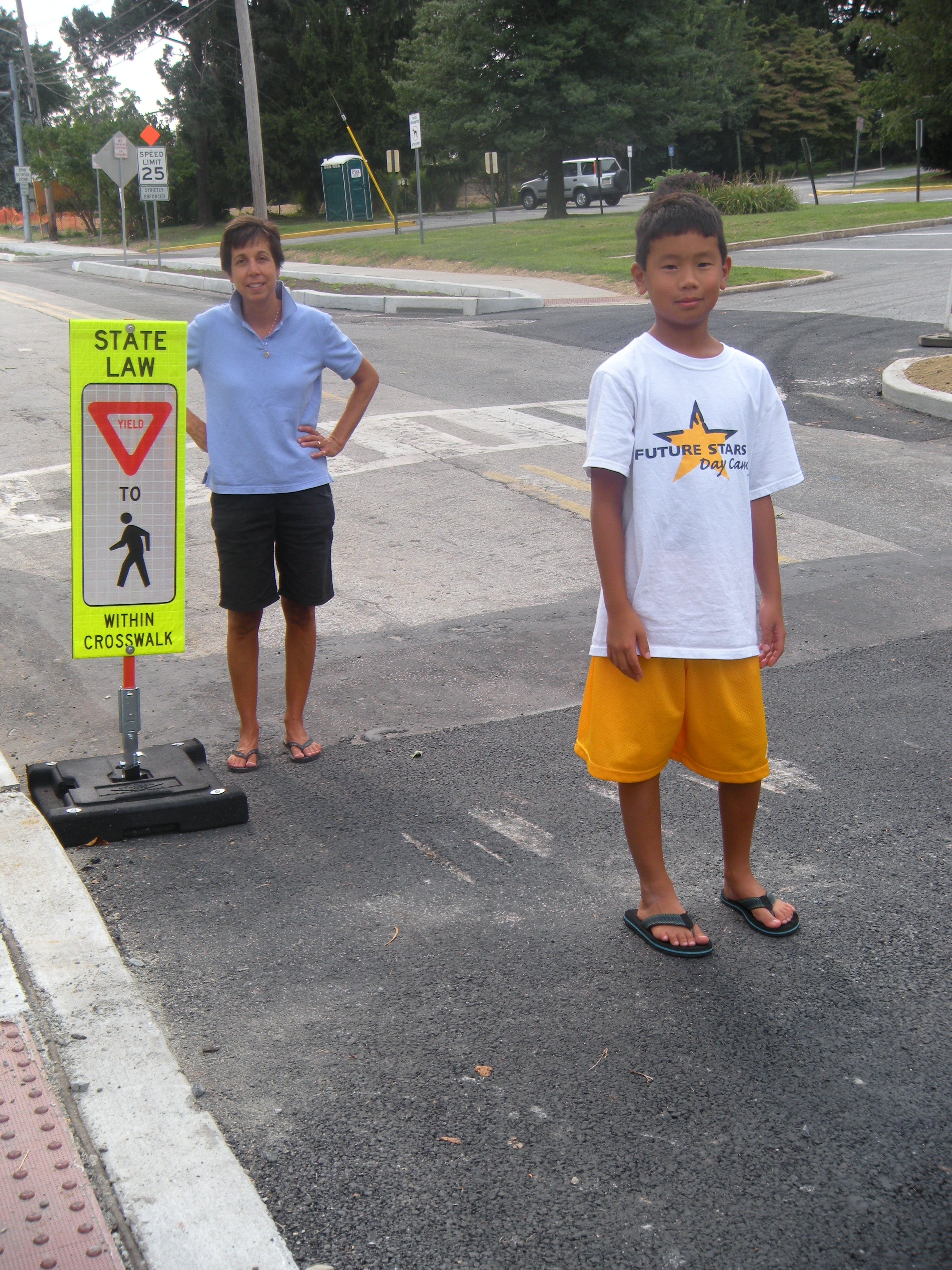
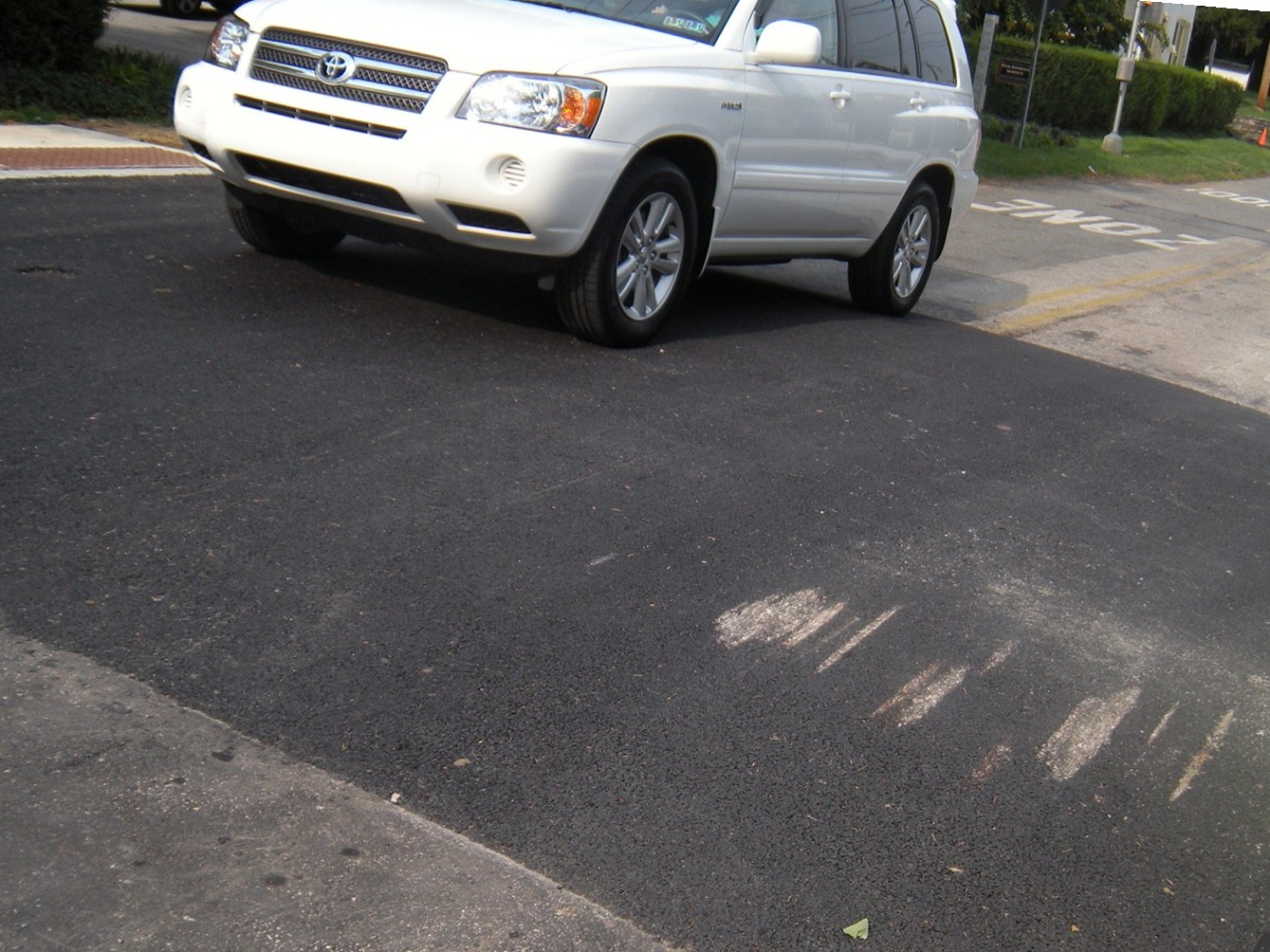
The photos really do not indicate the significance of the problem. One mother and her son who live nearby tried to stand in such a way on the elevated crosswalk so as to indicate the level of elevation. (photo on the left) Both sides of the road surface of the crosswalk already have deep gouges in the asphalt where the bottom of cars have scraped.

It was fascinating that local residents stopped to talk to me as I was taking my photos. All had much to say; one older couple in the white SUV kept backing up and down on the crosswalk so that I could get the severity of the incline. (But again, I don’t think the photos do the situation justice). Seriously, there needs to be warning lights, signs, some kind of notice for drivers . . . school is going to open soon and this situation is dangerous.

I do have a question — if the raised crosswalk was another form of traffic calming (as some suggest as the reason for the bump-outs) why is the TE Middle School crosswalk significantly more elevated, wider and with a steeper incline than Timothy School crosswalk? They are located minutes apart on the same road . . . very strange.

Bottom line . . . assuming that the crosswalks are standard and constructed to code, I contend that there needs to be some kind of warning or signage for drivers.

Pennsylvania Ranks #1 . . . but don’t know that residents want this distinction!

Sometimes it’s good to be #1 – to be at the ‘top of the class’, but I don’t know that the following is a distinction that will excite us. A report from the Pennsylvania School Board Association (PSBA) that was just released lists Pennsylvania as the national leader in public school teacher strikes for the 2009-10 school year – 6 strikes over the 501 school districts.

For those that are interested, these are the six districts in Pennsylvania where strikes occurred during the 2009-10 school year:

  • South Butler, strike from September 21 – October 6
  • Saucon Valley, strike from October 14 – October 30
  • Lackawanna, strike from October 29 – November 2
  • Penn Hills, strike from February 2 – February 9
  • McGuffey, strike from March 22 – March 23
  • North Penn, strike April 19 – 27

To give you a comparison, Ohio had no strikes with 612 school districts during last year’s school year. Pennsylvania is one of 13 states in the country which legalizes strike by state employees, including public school teachers.

There’s a state representative Paul Clymer (R – Bucks) who is the minority chair of the House Education Committee who has decided that to make it his priority to outlaw teacher strikes in Pennsylvania. There are currently 2 House Bills and a House Resolution that would either ban teacher strikes in Pennsylvania or further restrict them. State Rep Daryl Metcalfe (R – Butler) introduced HB 2092 which would amend the Pennsylvania Constitution to prohibit teacher strikes and lockouts. HB 1334 introduced by State Rep Doug Reichley (R – Berks) would not ban all strikes by teachers by would require more arbitration and fact-finding.

Rep.Clymer is arguing that the Commonwealth needs to stop teachers’ strikes in a tough economic year because Pennsylvanians cannot continue to pay the real estate taxes of previous years. “Taxpayers are really hard pressed to pay any increase in real estate taxes and we have to find different avenues to balance school budgets,” Mr. Clymer said. “When the teacher contracts become too onerous financially, too much of a burden for the taxpayers we have some serious problems. I’m sure the school boards do their best to come up with equity in the contract [but] everyone has to cut back, government included.” The Democrat majority chair of House Education did not respond to Clymer’s remarks.

Do we think that Paul Drucker and Warren Kampf would come down on party lines on this discussion? Would Kampf side with some of the outspoken Republicans who want to ban public school teacher strikes? And Drucker . . . would he support the right of state employees to strike? Interesting question.

Public Pension News Out of Harrisburg Today

Following up on the discussion from last night’s school board meeting, there was some interesting news out of Harrisburg today. The House lawmakers made a first stab at addressing the impending public pension crisis by voting to reduce pension benefits for future state and school district employees.

The House passed an amendment that, among other things, would raise the standard retirement age to 65 for both the Public School Employees’ Retirement System (PSERS) and the State Employees’ Retirement System (SERS). The retirement ages now are 62 and 60, respectively. It also extends the vesting period to be eligible for a pension from five years to 10 years. If I understand the components of the amendment correctly, it would offer the taxpayers short-term relief but also incorporate long-term reform.

The size of pensions for people who are hired in the future would be cut by one-fifth, unless the employees agree to have more money taken out of their paychecks. Retirees would no longer be able to withdraw their own contributions, plus interest, in a lump-sum cash payment upon retirement.

All the proposed changes would affect new employees only. The bill would have no effect on pension benefits for 200,000 current and retired state employees and 500,000 members of PSERS or change the format of both systems’ defined benefit pension plan, under which a retiree collects a percentage of his or her salary based on a formula that weighs age, years of employment and their own contributions. If enacted, the new pension rules would take effect January 1 for new state employees; July 2, 2011, for new school employees and December 1, 2011, for lawmakers who take office after the fall election.

The underlying bill — which could get a vote on final passage in the House as early as tomorrow — would add to the long-term cost of the pension systems by restructuring them financially but reduce the projected size of crippling payments due into both systems in two years. Should it pass, the bill would gradually limit the amount of a single year’s increase in costs to governments and school districts (taxpayers) to eventually reach no more than 4.5 percent of payroll.

It is my understanding that the prospects of passage in the House appear positive (given its wide support by both political parties). A positive vote will send it on to the state Senate.

Community Matters © 2025 Frontier Theme