Pattye Benson

Community Matters

Tredyffrin Easttown School District

Community Matters in Pittsburgh . . . Concerns about Pennsylvania’s budget and the fate of our teachers

I received the following email from Patricia Connelly of Pittsburgh. Rather than offering a personal response to Patricia, I thought it would be interesting for Community Matters readers to respond. Any thoughts or words of encouragement to offer . . . it is apparent that the budget and concern for public education spending cuts is not isolated to our part of the state.

Hello,

I just came across your site and want to ask a question about our State Legislators. Does Pennsylvania have what Wisconsin has and that is the right to repeal an elected official? If the Governor’s budget gets passed, and it will, as someone who has lived a lifetime (66 yrs) in Pa, I believe that budget will ruin our state.

Education, please, what education? No new taxes, except for voters who will pay higher property taxes and not be able to sell their homes because the taxes will go through the roof and their local schools will be overcrowded. Today’s teachers are treated horrible and get blamed for their state’s deficit. My son is a teacher.

Anyway, is there an answer to this or do we not live in a democracy any longer?

Sincerely,
Patricia Connelly
Patricia Connelly from the Pittsburgh Area

Looking at Local School Districts, Does the Buck Stop with Taxpayers?

As Tredyffrin-Easttown School District works through the 2011-12 budget, it is interesting to watch how other school districts are handling their budget shortfalls, particularly in light of the public education cuts in Gov. Corbett’s proposed budget.

This week the Radnor School District and the Radnor Township Education Association reached a tentative agreement for a new teacher contract. The collective bargaining negotiations between the school district and the teacher union have been going on for over a year. Details of the contract will not be released until after the teachers union presents the contract to its members for ratification early next week. As our school district neighbor, I wonder if their contract will have any influence on TESD teacher contract discussions.

Another neighbor to TESD, the Phoenixville Area School District (PASD) has major budget issues. As the dust settles from the cuts contained in Gov. Corbett’s proposed budget, a tax hike of 8.75% is needed to close the gap – twice as much as the district had anticipated. Previously, the school district budget included a 4.43% tax increase but with the loss of state funding, they will require an additional 4.32% . . . a tax hike of 8.75%!

At the Pottstown School District meeting this week, their school board took a stand with three interesting votes:

  1. The school board rejected the idea of “forward borrowing” of $23 million without voter approval. (The district has authorization for $28 million for work on the district’s elementary schools and the vote would have increased that borrowing amount by $23 million).
  2. The school board approved the extension of a contract for mid-level administrators and principals that freeze their salary for one-year. (Cost savings: $30K)
  3. The school board accepted an offer by the district’s three top administrators to freeze their salaries for one-year. (Cost savings: $15K)

Prior to the vote, the school district was considering a 4-year contract for administrators and principals to include a minimum 1.5% salary increase plus potential merit pay increases. According to the district superintendent, following the announced funding loss from the state was announced, these employees volunteered to take pay freezes for one-year. Gov. Corbett’s proposed budget will provide $3.1 million less state funding to the Pottstown School District.

For comparison sake, I checked on the salaries of administrators in the Pottstown School District. The top 10 highest paid administrators in the Pottstown School District earn in the range of $102K – $119K per year; their superintendent has a base salary of $152K.

The Pottstown school board hopes that the administration’s one-year pay freeze sends a message to the teacher union, Pottstown Federation of Teachers. According to Pottstown Mercury, www.pottstownmercury.com , Pottstown School District president thanked the administrators for the one-year salary freeze, “I want to thank you for pulling your belts a little tighter for us, I hope some of the other school districts around here see what you’re doing for us, how you lead by example.” There is an unresolved contract between the district and the teachers union. The teachers are currently without contract and last month rejected the independent fact-finders report that the school board accepted unanimously. Sound familiar . . . Unionville-Chadds Ford School District currently have a similar situation with their teachers union.

I guess TESD can take solace in knowing that we are not alone. With school districts facing looming deficits in their budgets and increasing expenses, Corbett’s proposed budget does not offer much hope for help from the state.

Corbett’s campaign promises included no tax increase but it seems to me that he has just pushed that job down to the local school districts. School districts are expected to balance their school budgets, but how? Not much in the way of choices . . . school boards are forced to make education cuts or they raise taxes. Does no responsibility lie in the shoulders of our elected officials in Harrisburg? How can they expect citizens to pay more in property taxes than they can afford?

Or . . . does the buck just stop with the taxpayers?

Just In . . . State Teacher Union Encourages Local PSEA Members to Consider One-Year Pay Freeze

Seemingly to show support for the severity of the state’s economic situation, the Pennsylvania State Education Association (PSEA) is encouraging its local teacher union members to consider Gov. Corbett’s request for a one-year pay freeze in the following press release. 

Could this be the answer to school district problems?  Whether it is the possibility of furlough and school voucher legislation or the current anti-union sentiment that is sweeping the country, I think we should view this as a positive message from PSEA.  Do we know how much revenue would be saved by with a one-year pay freeze in TESD?

PSEA President responds to Governor’s call for a one-year pay freeze

PSEA President Jim Testerman released a March 16 statement responding to Gov. Tom Corbett’s call for school employees to consider a one-year pay freeze.

Testerman released the following statement:

“The education professionals in the Pennsylvania State Education Association have been willing to be good public partners and tackle tough issues before, and we’re willing to do it again.

“We hope to prevent a $1 billion cut in state education funding, but we also realize that tough economic times have hit many of our public school districts.

“We have serious concerns about some of Gov. Corbett’s proposals, but we want to do our part to ensure that our students’ education does not suffer as a result of the worst recession since the Depression.

“As part of his budget proposal, the governor requested that education employees accept a one-year pay freeze. The governor stated that this decision is ‘determined at a local level and arrived at by contract and collective bargaining.’ As president of the Pennsylvania State Education Association, I concur.

“I encourage PSEA members to seriously consider this request.

“Today, I sent a letter to the presidents of all PSEA locals.  I encouraged them to enter into discussions with their school boards about a pay freeze or other cost-saving measures to maintain class sizes and academic programs.  In some communities our members have recently agreed to economic concessions to maintain class sizes and academic programs. Their contribution must also be recognized.

“Such cooperation can help to preserve the academic gains made in Pennsylvania’s public schools over the last decade.

“Our scores on National Assessment of Educational Progress, the ‘Nation’s Report Card,’ are among the country’s best.  Our students showed progress in all academic subjects and grade levels.  And seven of 10 graduates are going on to higher education.

“We need public partners to join us in our effort to advocate for our public schools.  PSEA calls on parents, caregivers, and community leaders to ask legislators to prevent the cuts to school funding.  A pay freeze alone will not be enough to preserve the programs our students need to succeed in the future.

“Despite the difficult economy, we must remember that students only get one chance at a quality education.  Pennsylvanians must not permit this recession to rob our children of the opportunity public education provides to prepare them for a better future.

“Pennsylvania’s schools are among the best in the nation.  PSEA remains steadfast in its commitment to provide a quality education to the 1.8 million children who attend our public schools.”

Some Pennsylvania School Districts Look at Early Retirement Incentive Plans to Help Budget Deficits . . . Could this be a less-painful option?

It is interesting to note how other school districts are exploring different options internally to reduce expenses.

Apparently, Tredyffrin Easttown School District joins the ranks of Bucks County’s Morrisville School District to consider outsourcing custodial services in addition to an early retirement plan to its teachers.

According to a recent article in www.phillyBurbs.com Morrisville School District’s school board suggests that these measures are required due to “out of control spending due to increases in salaries, benefits and pensions.”

Although Morrisville School District is ‘only’ facing a $2.5 million deficit, they are facing some of the same problems as TESD. This district is offering a special ‘early retirement incentive plan’ to teachers as a way to reduce costs. Teachers have until March 31 to decide whether to take this option.

Has TESD considered some form of an early retirement incentive plan for teachers? It is possible that I missed this discussion in school district. For those that have followed the school district closely, any information on this topic is appreciated. As school districts across the state are struggling to balance their budget deficits, I find it of interest to look at options that other school districts have explored.

Looking beyond Morrisville School District, I wondered if other school districts were exploring an early retirement incentive option as a cost-saving measure. Middletown Area School District (MASD) in Dauphine County, www.raiderweb.org (10 miles from Harrisburg) is also offering a retirement incentive plan to teachers in an effort to reduce their gaping deficit. For those teachers that qualify, they have until March 21 to decide on this option.

The MASD early retirement incentive is available to full-time employees covered by the teacher union collective bargaining agreement who have at least 30 years of district service by June 30, 2011 and incur no more than one additional year of service under the state employees retirement system (PSER) after retiring from the district. Employees 55 or older with 20 years of service by June 30 also can retire under the same conditions.

Benefits of MASD’s retirement incentive include a $20K one-time contribution into employees’ 403(b) accounts that won’t be included when computing their annual salaries for retirement benefits. Health care benefits under terms of their current teacher union contract which expires June 30, 2012 will also be made available if a “sufficient number” of eligible employees retire under the incentive.

Could an early retirement incentive plan be a ‘less-painful’ way of reductions of costs for school districts in budget crisis? In Morrisville School District and Middletown Area School District, their 2011-12 budgets will be ‘tweeked’ based on how many teachers take advantage of the retirement incentive. These kind of early retirement incentive plans are similar to models often seen in private industry for employees. Understandably, it is too late to enact an early retirement incentive plan for the 2011-12 school district budget in TESD, but what about for the following year’s budget?

Any discussion of an early retirement incentive plan would take cooperation between school districts and teacher unions. However, with talk swirling in Harrisburg of teacher furlough legislation, I would think the conversation of early retirement incentive plans would be a conversation that teacher union leaders might welcome.

Outsourcing of Custodial Services Would Save T/E School District Almost $1 Million . . . Should this Cost-Cutting Measure be Considered?

Last night was the T/E School District’s Finance Committee Meeting. One of the solutions offered to help close the looming deficit for the 2011-12 school district budget is the outsourcing of the custodial services. Outsourcing of the custodial service is expected to save the school district an estimated $950K in the budget. Last night, several members of the district’s custodial union (many of whom are township residents) attended the meeting to make the case to preserve the current custodial arrangement.

From Pete Bannan’s article in today’s Main Line Suburban newspaper on TESD Finance Committee Meeting, Pete reports:

” . . . All the school-board members were present for the meeting and the pleas during the public comments did not fall on deaf ears. Finance chair Kevin Mahoney said the school board wasn’t doing this to save money but is required by state law to balance the budget.
“The options are evaporating,” said Mahoney. “The governor’s budget turned a $2.2-million shortfall into a $3.6-million shortfall. It’s simply a matter of economics.”
Mahoney said no decisions had been made. The proposal is due April 4 and the board has 120 days to review it. Mahoney also said the school board is open to ideas and constructive ways to reach its goals. He suggested the public contact elected state officials, such as State Rep. Warren Kampf, State Sen. Andrew Dinniman and Gov. Tom Corbett, and ask for real pension reform. . . “

Ray Clarke attended the Finance Committee meeting and offers the following notes for Community Matters readers. As always, I am grateful for Ray’s attendance at school district meetings, his analysis and then for sharing them with us!

Monday’s Finance committee meeting vividly illustrated the problem TESD finds itself in.

Very many TENIG (Tredyffrin Easttown Non-Instructional Group) members and others spoke about the value of the current system with experienced, stable, professional and flexible staff, compared to the risks of a possibly cheaper, but high turnover, less trustworthy, and less committed external provider. There was also commentary about the impact on diversity. There was much talk about membership in the T/E Family, and a wise – but unfortunately innocent – CHS student suggested that a family would sit down and work out a fair solution for all its members, rather than focusing on one group. (No prizes for guessing the elephant in this particular family room!)

The out-sourcing analysis does offer a glimmer of hope, though. The district has issued an RFP, responses due May 4, which then must be given to TENIG by May 11. TENIG is allowed 120 days to respond. Let’s assume that out-sourcing would really save the $950,000 estimate. Now, the district has already identified overtime and substitute strategies that would save $150,000 with the existing staff. Is it wishful thinking that the staff could use their professional experience to identify further cost-saving practices, and offer compensation roll-backs and benefits adjustments that could move the impact over 50% towards the expected cost savings? Taxpayers might be very willing to pay a premium for service assurance.

After 90 minutes the committee got down to a review of budget projections. The $1.3 million impact of the PA budget was confirmed, with the $1.1 million reduction in Social Security reimbursement to the 15% “aid ratio” being the real surprise. Apparently it has been at 50% for as long as anyone in the room could remember. I would think that this might be subject to lobbying: where is Kampf on this one? It apparently squarely targets districts like TE that have a low aid ratio.

There was agreement to move ahead to crystallize a number of strategies listed with low or moderate impact on the education program. The biggest ones:

– Change the prescription provider: Impact $250,000
– Eliminate raises for all non-union staff: $395,000
– Integrate Applied Technology into Elementary Core: $300,000
– Plan for a 5% increase in medical costs (vs previous 10%): $412,500
– Fees for extra-curricular activities: $80,000

The result of all of this is $2.3 million of fairly solid strategies (including all the above except the last) and $0.45 million of more speculative ones (including the last). The current scenario assumes $0.15 million of the specualtive ones, for a total of $2.4 million of strategies. Add in Act 1 and Exception tax increases of $3.2 million (3.8%), subtract the $1.3 million state cuts, the $8.9 million deficit comes down to – a mere – $4.6 million.

Board policy does place some limits on use of the Fund Balance, but one obvious use is to pre-fund approved programs implementation-limited by contractual attrition rules. There was an example presented of how $1.1 million could be designated in this way in 2011/12. (I worry that there might be a little double counting with the above $300,000 AT elimination – does that need attrition?).

It’s fairly clear that the $29 million Fund Balance could absorb the $4.6 million draw down, but beyond that the picture is bleak. Annual deficit projections of $10 million or more (after Act 1 tax increases, driven by benefits) show that the district can not afford even flat TEEA salaries without the fund balance being wiped out in 2 years.

Here’s where the State House Bill to allow teacher furloughs to balance the budget comes into play. According to Dr Waters, that would allow action even with a CBA in place. However, Dr Brake reported that although the bill was up for Committee hearings, those hearings were abruptly cancelled (!). But the legislative process does continue, apparently.

We know that there are some actions involving furloughs that are already approved as having minimal educational impact. Others, like modest increases in class sizes, might be similarly low impact. Getting to $10 million can hardly be done without real impact, though. When it comes down to students and jobs versus union compensation, we might find out who is really part of the TE Family.

Gov. Corbett’s Proposed Budget Indicates -9.69% Change in State Public Education Funding for T/E School District

The dust has begun to settle on Gov. Corbett’s proposed budget. Although most areas of government were not exempt from cuts, the decrease state funding to higher education and school districts may have the greatest effect on local residents.

In reviewing the governor’s budget proposal for public school funding, Sen. Andy Dinniman offered the school districts current state funding vs the proposed funding.

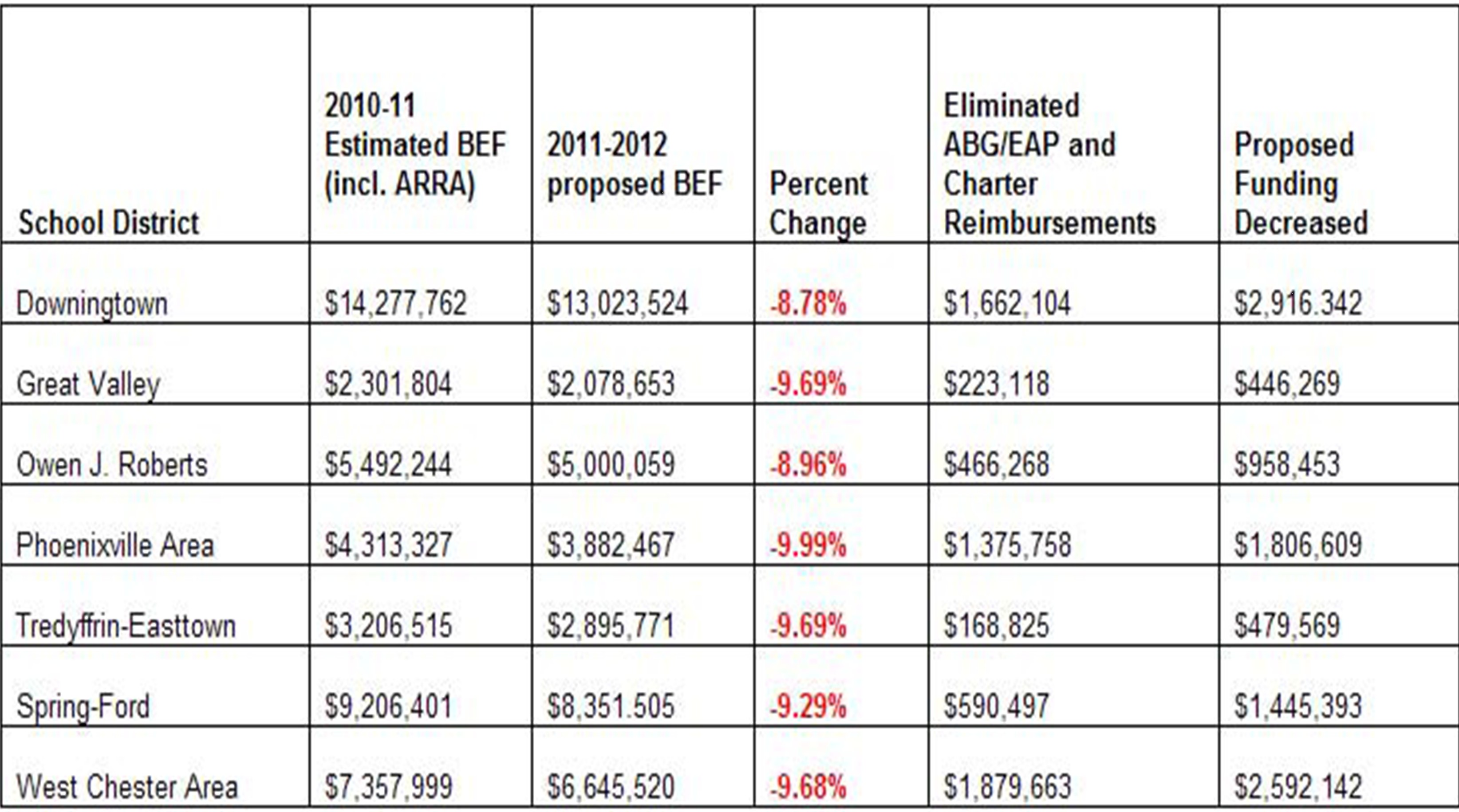
The table below from Dinniman’s website (www.senatordinniman.com) is interesting because it focuses specifically on the state funding to our local school districts, including TESD. The statistics indicate the current funding for public education versus the funding contained in the governor’s proposed budget. The decrease in state funding ranges from $446,269 in the Great Valley School District to Downingtown School District’s $2.9 million. The funding loss is due to Corbett’s proposed elimination of the Accountability Block Grant and Education Assistance programs.

Although Tredyffrin Easttown School District is grateful not to be in the $2 million + budget cut category of West Chester and Downingtown school districts, we are far from exempt. According to the table below, TESD proposed decrease in state funding equates to an approximate -9.69% change or $479,569.

“Governor Corbett’s proposal for basic education will be disastrous for our Commonwealth’s public schools,” Dinniman said. “Full-day kindergarten classes, reduced class sizes and after school tutoring programs are at risk of elimination.”

“The difficulty is that while the governor can wave the flag and say, ‘We’re not raising taxes,’ he has written a script that will mean significant local property tax increases and much heavier burden on local taxpayers, and that is indeed troubling,” Dinniman said.

It will be curious to see if Corbett’s significant budget cuts to public education enters in to the discussion at tonight’s TESD Finance Committee meeting. The Finance Committee is at 7:30 PM in the Tredyffrin/Easttown Administration Office (TEAO) at 940 West Valley Road, Suite 1700 in Wayne. Click here for the Finance Committee agenda.

How to be Smarter about School Reform . . . in the words of Bill Gates

Here is an interesting op-ed school article which appeared in this week’s Washington Post. The opinion article was written by one of the country’s famous billionaires, Bill Gates and addresses school reform. In his remarks, Gates takes on teacher seniority, suggesting that longevity and advanced degrees of teachers does not necessarily equate to an increase in student achievement.

How to be smarter about school reform
Bill Gates, co-chair of the Bill and Melinda Gates Foundation.
This column appeared in The Washington Post, Feb 27, 2011

As the nation’s governors gathered in Washington for their annual meeting, they were grappling with more than state budget deficits. They’re confronting deep education deficits as well.

Over the past four decades, the per-student cost of running our K-12 schools has more than doubled, while our student achievement has remained virtually flat. Meanwhile, other countries have raced ahead. The same pattern holds for higher education. Spending has climbed, but our percentage of college graduates has dropped compared with other countries.

To build a dynamic 21st century economy and offer every American a high-quality education, we need to flip the curve. For more than 30 years, spending has risen while performance stayed relatively flat. Now we need to raise performance without spending a lot more.

When you need more achievement for less money, you have to change the way you spend. This year, the governors are launching “Complete to Compete,” a program to help colleges get more value for the money they spend. It will develop metrics to show which colleges graduate more students for less money, so we can see what works and what doesn’t. In K-12, we know more about what works.

We know that of all the variables under a school’s control, the single most decisive factor in student achievement is excellent teaching. It is astonishing what great teachers can do for their students.

Yet compared with the countries that outperform us in education, we do very little to measure, develop and reward excellent teaching. We have been expecting teachers to be effective without giving them feedback and training.

To flip the curve, we have to identify great teachers, find out what makes them so effective, and transfer those skills to others so more students can enjoy top teachers and high achievement.

To this end, our foundation is working with nearly 3,000 teachers in seven urban school districts to develop fair and reliable measures of teacher effectiveness that are tied to gains in student achievement. Research teams are analyzing videos of more than 13,000 lessons — focusing on classes that showed big student gains so it can be understood how the teachers did it. At the same time, teachers are watching their own videos to see what they need to do to improve their practice.

Our goal is a new approach to development and evaluation that teachers endorse and that helps all teachers improve. The value of measuring effectiveness is clear when you compare teachers to members of other professions — farmers, engineers, computer programmers, even athletes. These professionals are more advanced than their predecessors because they have clear indicators of excellence, their success depends on performance, and they eagerly learn from the best.

The same advances haven’t been made in teaching because we haven’t built a system to measure and promote excellence. The United States spends $50 billion a year on automatic salary increases based on teacher seniority. It’s reasonable to suppose that teachers who have served longer are more effective, but the evidence says that’s not true. After the first few years, seniority seems to have no effect on student achievement.

Another standard feature of school budgets is a bump in pay for advanced degrees. Such raises have almost no impact on achievement, but every year they cost $15 billion that would help students more if spent in other ways.

Perhaps the most expensive assumption embedded in school budgets is the view that reducing class size is the best way to improve student achievement. This belief has driven school budget increases for more than 50 years. U.S. schools have almost twice as many teachers per student as they did in 1960, yet achievement is roughly the same.

What should policymakers do? One approach is to get more students in front of top teachers by identifying the top 25 percent of teachers and asking them to take on four or five more students. Part of the savings could then be used to give the top teachers a raise. (In a 2008 survey funded by the Gates Foundation, 83 percent of teachers said they would be happy to teach more students for more pay.) The rest of the savings could go toward improving teacher support and evaluation systems, to help more teachers become great.

Compared with other countries, America has spent more and achieved less. If there’s any good news in that, it’s that we’ve had a chance to see what works and what doesn’t. That sets the stage for a big change that everyone knows we need: building exceptional teacher personnel systems that identify great teaching, reward it and help every teacher get better.

It’s the thing we’ve been missing, and it can turn our schools around.
Red-Hot State Voucher Program Clears Initial Hurdle

Teacher unions and school board members must be lining up across the state this morning in opposition to the latest Senate Education Committee vote.

Calling the proposed school voucher bill, an ‘opportunity scholarship’, the committee voted 8-2 yesterday in favor of the proposed legislation. The bill intended to help the state’s poorest children from the lowest-performing schools by providing options of attending other public, private or parochial schools, did not pass the committee without debate. The troubling issues that many of us have discussed, including constitutionality, religious freedom and the cost to public schools were sticking points for two members of the committee.

The Senate Education Committee is composed of six Republicans and four Democrats. Co-sponsoring the proposed legislation is Democratic Sen. Anthony Williams and Senate Education Committee Chair Jeffrey Piccola (R-Dauphin). All six Republicans supported the bill, as did two Democrats, Williams and Sen. Andy Dinniman. If you recall Dinniman had some suggested amendments to the bill, including testing and accountability from the non-public schools. The opposing school voucher bill members of the committee were Democrats Jim Ferlo and Daylin Leach.

Leach debated the proposed legislation on the grounds that the bill is not constitutional. Ferlo and Leach are concerned that the voucher system could erode public schools whereas the others feel that the legislation actually offers a lifeline to those children trapped in the low-performing schools. The opposing sides present two distinctly different ways of looking at the same situation. Piccola suggests that Leach’s argument that the school voucher legislation is unconstitutional is an erroneous interpretation of the Pennsylvania Constitution. The chair of the Senate Education Committee also dismissed the argument that the bill is in conflict with the state constitution in regards to support of religious schools with public money.

With all the questions swirling around this legislation, why did the Senate Education Committee seemingly just push it along through the system? Usually, I would be complaining about the slowness of government process, but it is amazing the way this school voucher bill is bulldozing its way through Harrisburg.

Aside from the many questions, concerns and debates swirling around this voucher bill, why don’t we hear much about the cost of this ‘opportunity scholarship’? Gov. Corbett swept into the Governor’s office under the umbrella of austerity and budget constraints, so can someone please explain to me how the estimated $860 million in taxpayer costs by the end of the third-year phase of the voucher program, meets that mission? And the $860 million does not take in to consideration the dollars the bill will siphon from the public schools.

Help me understand . . . what am I missing?

Community Matters – in and around Tredyffrin

Community Matters . . . in and around Tredyffrin

In one of the biggest property deals since the start of the global financial crisis, the Australian company Centro Properties Groups has agreed to sell its 588 US shopping malls to private equity giant Blackstone Group for $9.4 billion.

The local connection – Centro owns Chesterbrook Shopping Center and Valley Fair Shopping Center! I assume the existing retail leases in these shopping centers will pass with the transfer of sale. Many folks are looking forward to McKenzies Brew House restaurant plans for the old Charlie Brown location at Valley Fair Shopping Center. Here’s hoping that Blackstone will breathe new life into Chesterbrook Shopping Center and find a tenant for the empty Genuardi’s grocery store. And let’s not forget that this corporate sale could mean significant transfer tax revenue to the school district and the township!

In case you missed this one . . . in order to make shelf room for new products, the Pennsylvania State liquor stores is having special discount sale, starting today. Approximately 400 items have been marked down to clearance prices until they are gone.

Last night was the Board of Supervisors Meeting. Notes of the evening included Mike Heaberg’s swearing in as new supervisor by Judge Jeremy Blackburn; recognition of the 300th anniversary of the historic Baptist Church in the Great Valley and certificates of appreciation for volunteer service to Grace Keffer, Bob Haver and Molly Duffy.

By Board of Supervisors appointment, a Sidewalk Subcommittee was formed in March 2010 to look at resident’s wants and needs of sidewalks in the community. The process included public meetings, resident sidewalk survey, observations and discussion and Sidewalks Subcommittee chair Tory Snyder presented the findings and recommendations last night at the Board of Supervisors Meeting. (Here is a link to the recommendations). Surprising some of us in the audience, supervisor Phil Donahue made a motion for the board to accept the Sidewalk Subcommittee recommendations and move it to the Planning Commission to create a draft ordinance. Michelle Kichline seconded the motion and it passed unanimously. Hat’s off to the supervisors for this progressive, proactive show of support for the community! (As an aside, the Sidewalk Subcommittee Green Routes Network recommendation includes St. Davids Golf Club sidewalk in the plan.)

In addition to crafting a draft ordinance in regards to the Sidewalk Subcommittee recommendations, the Planning Commissioners is drafting an amendment to the Subdivision and Land Development Ordinance to give the Board of Supervisors final land development authority. Although there is a Public Hearing on land development authority scheduled for March 21, it was agreed there would be no final decision on that matter until after the sidewalk ordinance is resolved.

I was notified of a an updated ‘Best High School in Pennsylvania’ list and am pleased to report that Conestoga High School continues to receive high marks. Each year, “Newsweek” magazine ranks the nation’s top 1,600 high schools–that’s only six percent of all public high schools in the country. This ranking helps parents and educators set standards for themselves. In 2010, 33 high schools from Pennsylvania, including Conestoga High School, made the list. These schools received high marks from both “Newsweek” and “U.S. News & World Report.”

According to the eHow.com 2011 update, “Conestoga High School is ranked as the No. 502 high school in the nation by “Newsweek” and as No. 79 by “U.S. News & World Report.” It offers more Advanced Placement courses than any other high school, public or private, in Pennsylvania, and had 37 National Merit semifinalists in 2010. . . “ Congratulations Conestoga High School and Tredyffrin-Easttown School District!

Speaking of Conestoga High School . . . the curtains go up tonight on the student production of Phantom of the Opera. The show will run March 1 – 6, click here for ticket information. Phantom is one of my all-time favorite musicals – best wishes to the cast & break a leg!

That is it for now. I look forward to your thoughtful comments and please email me at tredyffrincommunitymatters@gmail.com if you have news or thoughts to share.

Looking at Unionville-Chadds Ford School District, is the ‘Handwriting on the Wall’ for T/E?

A Community Matters reader suggested it would be interesting to compare the Unionville-Chadds Ford School District (UCF) with Tredyffrin-Easttown School District (TESD).

TESD has approximately 6300 students and the UCF school district approximately 4100 students. The 2011-12 TESD budget is $112M with approximately $17.7K per student spending. The proposed tax increase is 4.2% with expenditures exceeding revenues by approximately $8.9M. The budget gap is narrowed with the Act 1 tax increase and the Act 1 exception to $5.3M. Using suggested Level 1 budget strategies, the deficit is further reduced by $1M and the imbalance drops to $4.3M.

The proposed 2011-12 UCF budget is $71.4M with approximately $17K per student spending. The UCF school district intends to hold their tax increase at or below the Act 1 limit of 1.4%. Of the $71.4M, almost 72% of the budget goes to personnel costs (salaries and benefits).

Students from the UCF and TESD school districts enjoy similar academic performance; both top performing school districts. On Scholastic Aptitude Test (SAT) and Pennsylvania System of School Assessment (PSSA) performance, both school districts score in the top 1% statewide. Tredyffrin-Easttown School District ranks #2 for SAT scores and Unionville-Chadds Ford School District is ranked at #5 on the SAT.

The PSSA is an assessment-testing tool given to every Pennsylvania student in grades 3 through 8 and grade 11 in reading and math. Every Pennsylvania student in grades 5, 8 and 11 is assessed in writing and all students in grades 4, 8 and 11 are assessed in science. Checking the 11th grade statewide assessment, finds that TESD is #2 and UCF #3.

The Unionville-Chadds Ford School District teacher’s contract expired June 30, 2010; talks between the school board and the teachers union, Unionville-Chadds Ford Education Association have continued. In late December, the Pennsylvania Labor Relations Board appointed attorney Mariann E. Schick to help resolve the bargaining impasse through a Fact-Finder report. (This is a formal process where a neutral arbitrator is appointed to review the respective bargaining positions of both parties and recommend provisions for a possible settlement. The process is non-binding and either side can accept or reject the final report.)

The results of the fact-finding report on the UCF district were released last week. The UCF School Board voted unanimously to accept the findings of the report whereas the teachers union rejected the report. There were two major suggestions contained in the report. There is a provision for each member of the union to receive a one-time, nonrecurring payment in lieu of a raise in year one and an increase in the final two years of the contract and secondly, the suggestion that all union members move to a new, cost-saving healthcare plan, Keystone Direct, in the second year of the contract.

The UCF school board argues that its proposals look to maintain quality health care at a reduced rate and compensation for its teachers. They suggest that the economic times are hard and that the teacher union has benefited greatly when times were good but they must now share in the sacrifice as the others. However, the teacher union rejected the independent report and recommendations.

What’s that saying about the ‘handwriting on the wall’? In the UCF school district, the school board and the union have been working for more than a year to reach a new contract without success. The parents and students are frustrated because the gap between the two sides has not changed dramatically since the talks began.

The T/E school district has one year remaining in the teacher contract . . . can we expect similar conflict with the teacher union? Should residents accept bigger tax increases to ward off teacher union conflict? Is there a relationship between teachers working without a contract and the academic performance of the school district?

Looking ahead to next year, as the TESD school board begins to discuss the teacher contract, will demand negotiating skills and expertise from our elected officials. The terms of five of the nine TESD school board members are up this year . . . Karen Cruickshank, Pete Motel, Debbie Bookstaber, Jim Bruce and Kevin Mahoney. It is my understanding that Cruickshank will see re-election. Unfortunately, for the taxpayers, Bookstaber and Mahoney will not seek to be re-elected. I do not have information on the plans of Motel and Bruce. We hope that all school board candidates do their homework and come prepared to meet the enormous challenges ahead.

Community Matters © 2025 Frontier Theme