Pattye Benson

Community Matters

Tredyffrin Easttown School District

Tredyffrin Teachers Union Accepts Fact Finder Report, T/E School Board Rejects

The results from last night’s special meeting of the T/E School Board were anticlimactic and expected. Tredyffrin Easttown Education Association, the teachers union, voted to accept the fact finder’s report from the PA Labor Relations Board. With a vote of 7-2, the School Board voted to reject the report. Kris Graham and Anne Crowley provided the two dissenting votes in support of the fact finder’s report. The recommendations in the fact finder’s report must be accepted or rejected in its entirety.

According to Jeffrey Sultanik, TESD contract negotiator, no public discussion of the fact finder’s report is permitted until the report is published. It is expected that the PA Labor Relations Board will release the report today. During the next 10 days, the public can weigh in on the report and on then at a second special meeting on Monday, August 20, the school board will take another vote on the report. If the school board votes again to reject the report, traditional negotiations will resume between TEEA and TESD.

T/E School District Teacher Contract Update … Special Meetings to Consider Fact Finder’s Report

Back on June 19, the contract negotiations between the T/E School District and the teachers union, Tredyffrin Easttown Education Association (TEEA) reached an impasse and both sides requested that the PA Labor Relations Board (PLRB) assign it to a ‘Fact Finder’. The neutral third-party was to review the proposals of TESD and TEEA and then make a recommendation.

On June 30, the contract deadline for the T/E teachers came and went with no new contract signed. As of July 1, the school district and the teachers union, TEEA entered the ‘status quo period. Status quo freezes the teacher’s salary at the 2011/12 salary until a new contract is signed. The teachers continue to receive their salary at the current rate until either (1) a strike or lockout within the terms the 1992 Act 88 or (2) they enter into a new contract. The teachers health care benefit plan remains intact (based on the expired contract term) during the status quo period.

The Fact Finder’s report was issued on July 30 and TESD and TEEA has 10 days to notify PLRB as to whether they accept or reject the report. The School Board and Administration are expressly prohibited from making any statements about the Fact Finder report until after PLRB releases it for publication. But PLRB will only release it for publication after either or both sides formally inform the PLRB that they are rejecting the report.

Here’s what I don’t understand – the School Board is holding two special meetings (August 9 and August 23) to consider the Fact Finder’s report. If the School Board is prohibited from making statements until the report is released and they only release it if one or both sides reject the report, how is it then possible that the School Board can now have special meetings to consider the report? Jeez, I must be missing something here on this process. Another question … is TEEA likewise prohibited from discussing the Fact Finder’s report. Keith Knauss, if you are reading Community Matters, can you help me understand how this process works.

I am curious, so I will attend this week’s special meeting on Thursday at 8 PM in the Tredyffrin Easttown Administration Office, 940 W. Valley Road, Wayne, PA.

T/E School District and Teacher’s Union … ‘Status Quo’

The June 30, 2012 contract deadline for the T/E teachers came and went with no new contract signed. Therefore, as of July 1, the School District and the teachers union, TEEA are now in status quo. This means that the T/E teachers’ salaries will be frozen at their salary level based on their 2011-12 salary until a new contract is signed.

According to the School District website, “… the teachers will continue to receive their salary at the current rate until the earlier of (1) a strike or lockout within the terms of Act 88 of 1992; or (2) the entry into a new contract.”

Also during the status quo period, the teachers health care benefit plan remains intact based on the expired contract, until a new contract is signed between the School Board and TEEA.

The School Board passed the 2012-13 TESD budget in June, which includes a property tax increase of 3.3%, or .6154 mills – equating to approx. $3 million revenue. The 3% tax increase will translate to an annual increase to homeowners in T/E of about $155.

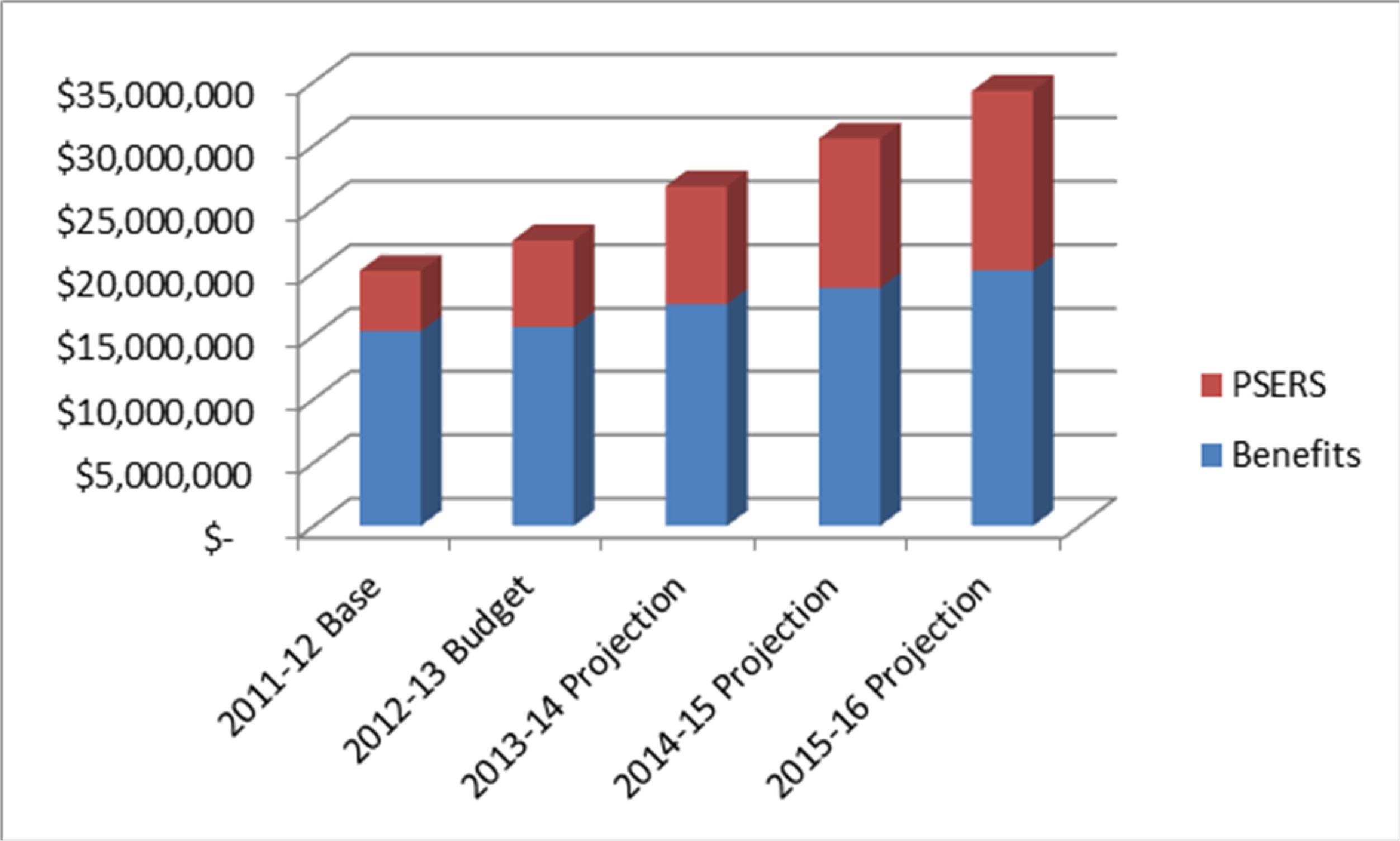
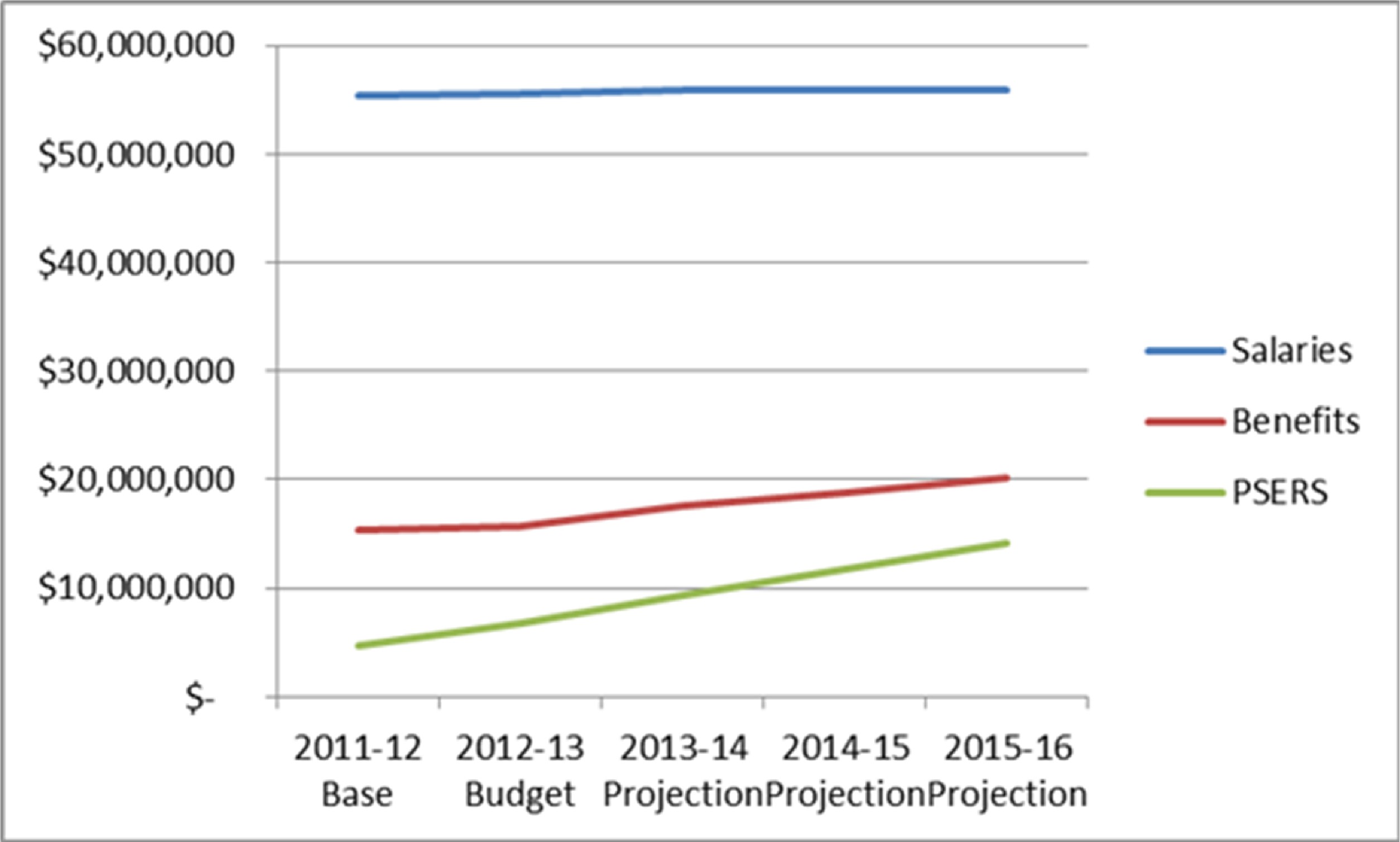
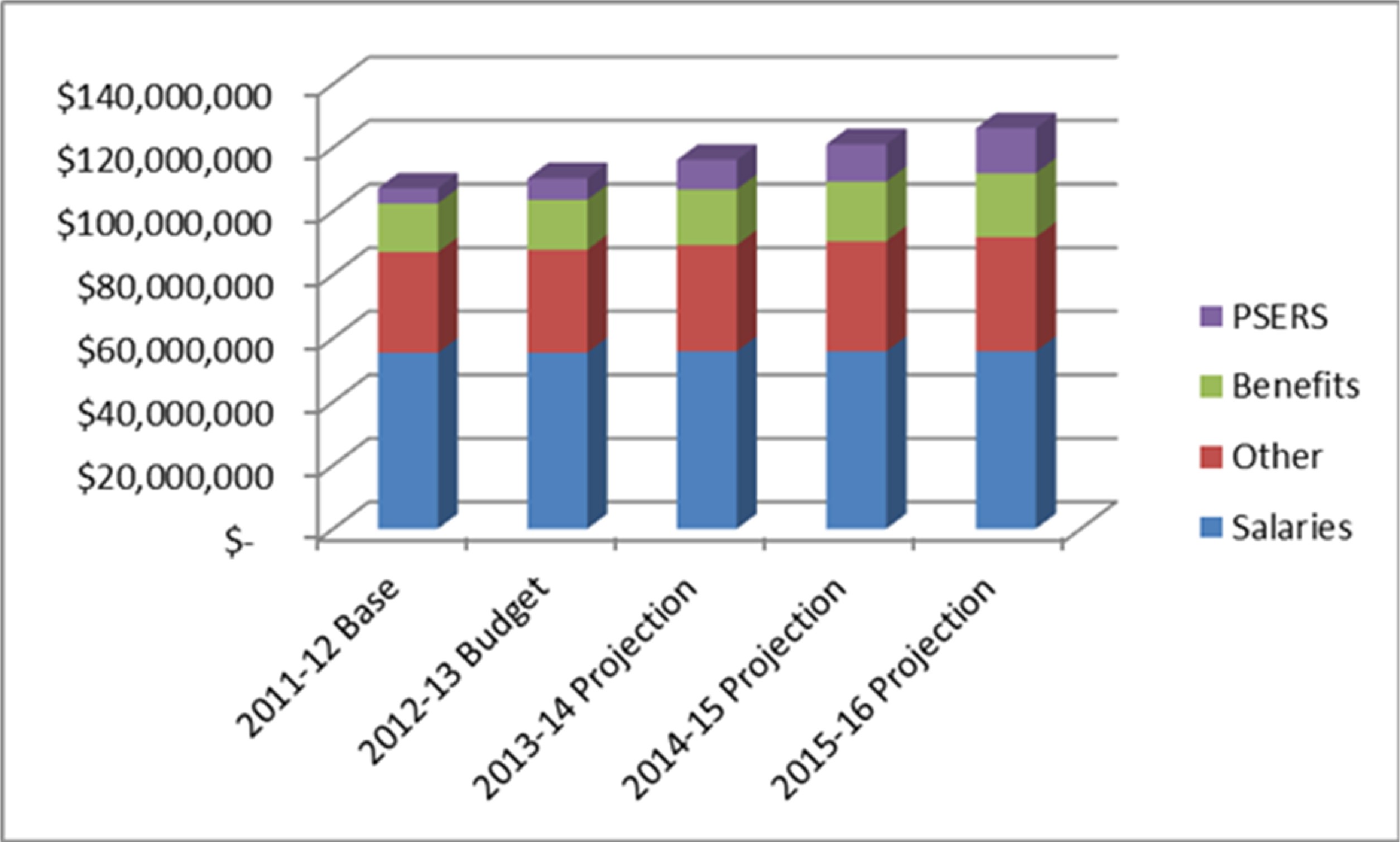
Former T/E School Board member Andrea Felkins created the following graphs with descriptions below each graph for Community Matters readers. When we discuss the benefits, salary and pension costs of the District, it is difficult for some (myself included) to fully grasp the magnitude of the situation. Through the use of the graphs, the data is more organized and easier to understand. When you view the data through Andrea’s graphs, it is much clearer the role that each of the three components play in the budget, especially as the School District moves forward. It should be noted that these graphs assume no salary increases.

Based on the final budget presentation, this is just a depiction of the PSERS and the BENEFITS numbers for the next few years. It’s why I advocate a major change in the benefit plan – knocking $5M off the expenditures annually.


Based on holding salaries constant, while PSERS is climbing, benefits stay well ahead of the PSERS contribution.


Each piece of the budget deserves scrutiny. This graph shows that PSERS takes a bigger piece each year, but the other components dwarf the PSERS costs.

TE School District … Teacher Contract Costing

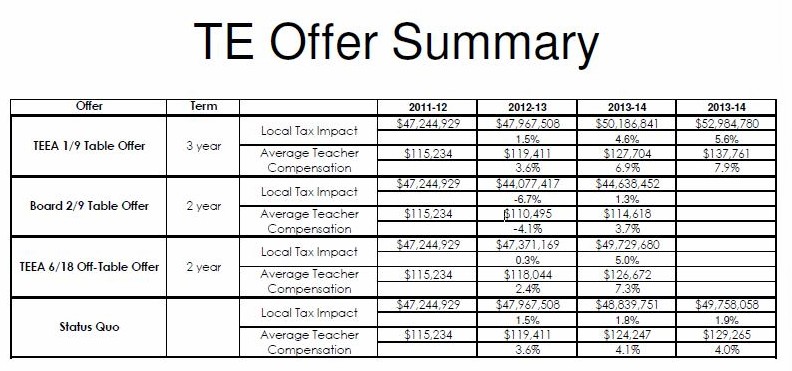
Keith Knauss, Unionville-Chadds Ford School District school board member, and regular contributor to Community Matters, has written ‘TE Contract Costing’ that may help us all better understand the teacher-school board contract negotiations process and the reasons for certain decisions. I thank Keith for his research and for sharing the information with us. I have provided an overview below along with my comments. (If you have a problem reading the numbers in the tables, click on the graphic and a larger version will open in a new window.)

In his opening remarks, Knauss states …

“ … Understanding contracts has taken on new importance since Act 1 of 2006. Previous to Act 1, school boards could negotiate contracts and raise taxes to whatever level was necessary to balance the budget. Since Act 1, many districts have had to, with great reluctance, reduce staff and programs to keep budgets within the limits of the ‘cap’.”

Employee compensation is the major factor determining the size of a school district budget and, subsequently the real estate tax rate increase. If the District budget is to be balanced under the restrictions of Act 1, close attention must be paid to the terms of the contracts.

In the following table, Knauss presents the TE offer summary – the initial 1/9/12 offer by TEEA, the TE School Board 2/9/12 offer and TEEA 6/18/12 offer. The table indicates the average teacher compensation and taxpayer impact. According to Knauss, “The percentage increase in Average Teacher Compensation is more than the percentage increase of Local Tax Impact for 2 reasons … state subsidies and attrition.”

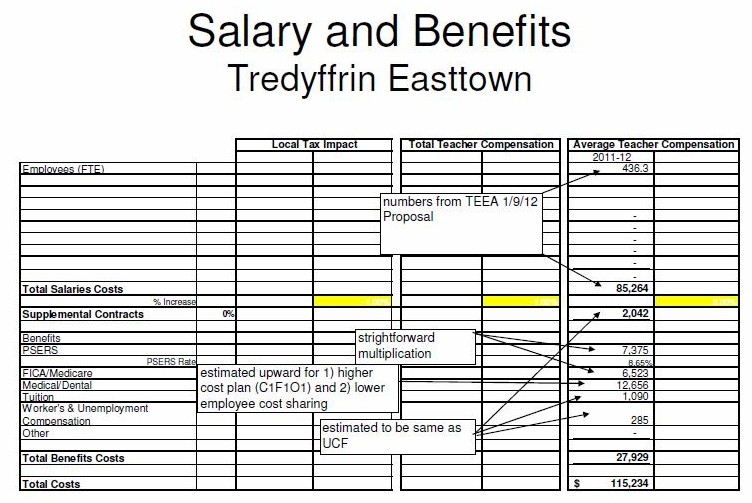
The following table reviews the salary and benefit packages of TE teachers. Krauss provides the approximate compensation (salary and benefits) for the average T/E teacher using the current teachers contract. The numbers are supplied by the District or are multiplications of the salary and the appropriate rate (PSERS and FICA).

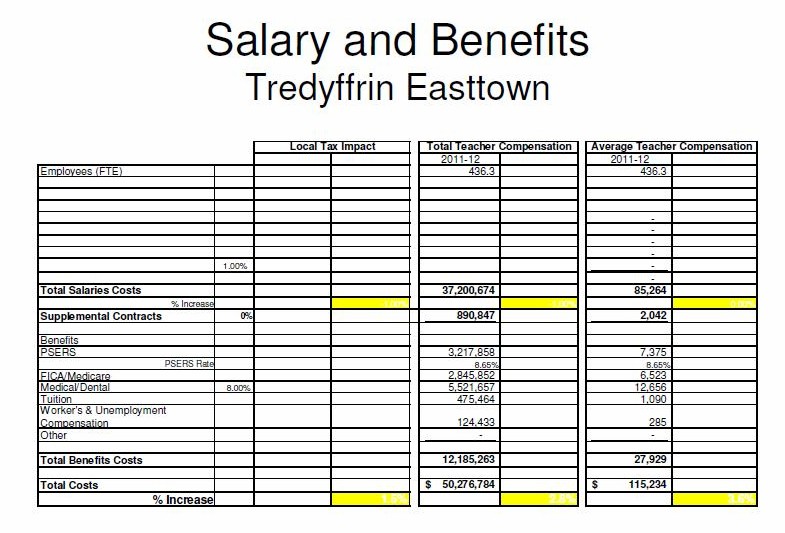
Knauss presents the following Salary and Benefit table, offering that the “… Total Teacher Compensation is a straightforward multiplication of the Average Teacher Compensation and the number of Employees. Total Teacher Compensation is the money taken from the taxpayers (local and statewide) for the services provided by TE teachers.”

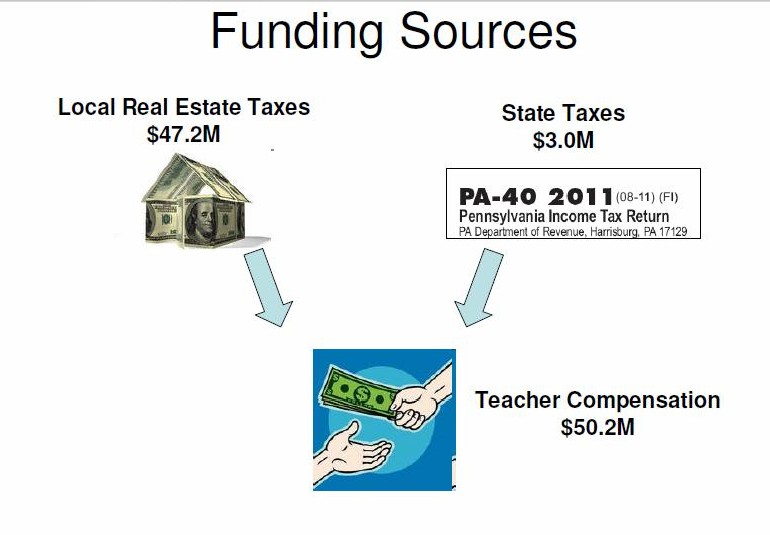
Here is an interesting graphic from Knauss, indicating the funding sources for teacher compensation. The major source of funding – local taxes and a secondary source of funding is from state and sales tax for half of PSERS and half of FICA.

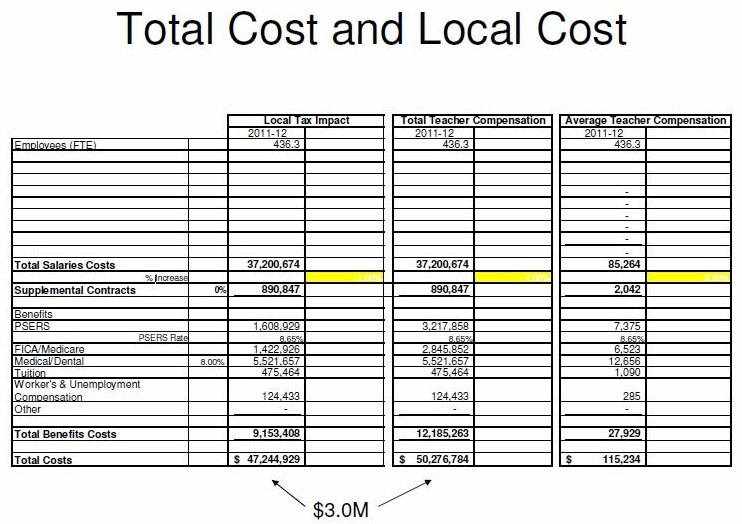
Krauss looks at the effect of any contract settlement on the T/E taxpayers, and whether it can be financed within the Act 1 limits. He looks at two different costing methods – “One method looks at the total cost of the contract to all taxpayers, local and statewide; the other method looks at the cost of the contract to the local taxpayers to reflect the local tax impact of any other offer by ‘backing out’ the statement reimbursement for PSERS and FICA.”

The Local Tax Impact is calculated by “backing out” the state contributions to FICA and PSERS. Notice that the state contributes $3.0M in subsidies to lessen the Local Tax Impact.

————————————————————————————————-

When reviewing a teacher contract offer, Knauss supports the use of the following criteria:

  • Is the offer economically sustainable under Act 1 limits?
  • Are the compensation increases of the offer in line with the current economic climate?
  • Is the compensation appropriate to attract and retain employees of quality?

Knauss answers a question that many have wondered … what happens if the teachers and the school board cannot reach a settlement? Due to substantial differences between TEEA and TE School Board, the union requested fact-finding by the PA Labor Relations Board. The independent fact finder will review both TEEA and TESD proposals and then make recommendations … however, remember the recommendations are non-binding.

The current teachers’ contract ends on Saturday, June 30. If an agreement is not reached, the teachers enter the “status quo” period, meaning that they continue to teach … to the expired contract. The teacher’s benefits and salary remain the same as in the expired contract. It is obvious that the School Board would not want an extended ‘status quo’ status for the teachers because it precludes any change to heath care benefits, compensation, etc. Knauss points out, that although the teacher compensation is frozen at its current level in ‘status quo’, legally the District must absorb any increases due to PSERS contributions or healthcare.

However, the situation is different from the teachers’ standpoint. During better economic times, the teachers would not want their contract settlement in ‘status quo’ state because working under the expired contract would mean that they would receive no additional compensation for years of service increase. But what choice do the teachers have?

According to TEEA website, the teacher’s last offer included a reduction in health care benefits and salary freeze for the first year. In their rejection of the union’s offer, the School Board instead asked the teachers to take a compensation reduction of $8,000 per teacher – which equates to as much as 13% for some teachers. There is little surprise that TEEA rejected that District’s offer, opting instead to go to the PA Labor Board. Why would the teachers want a new contract … status quo also keeps their current salary intact and preserves their current benefit package intact.

Knauss provides a multi-year analysis, assuming status quo and average compensation. He presents his analysis in several slides, giving us an idea of what certain scenarios would mean to the average taxpayer. To read Keith’s full report, click here.

T/E School Board Passes 3.3% Tax Increase; Highest Percent Increase in the Area

The T/E School Board meeting on Thursday night was rather anticlimactic. Most of us who have been following the budget process were not surprised by the 3.3% tax increase (1.7% Act 1 Index, 1.6% referendum exceptions) for the 2012-13 school year. Based on the District’s average residential assessment of $252,601, this translates to an average increase of $155 per homeowner in their tax bill.

The Act 1 Index increase will produce projected revenue of $1.5 million and the exceptions increase projected revenue of $1,498,916. The total revenue produced by the 3.3% tax increase is $2,998,916. The 2012-13 tax will be levied at the rate of 19.2628 mills, on the assessed valuation at a rate of $19.2628 per $1,000 assessment; an increase of .6154 mills from the 2011-12 tax rate.

How does TESD tax increase of 3.3% increase for 2012-13 school year stack up against neighboring school districts? The following local school districts have approved their budgets for 2012-13 and needed to include the following tax increases:

  • Radnor School District: 3.21% tax increase
  • Great Valley School District: 3% tax increase
  • Haverford School District: 2.73% tax increase
  • Lower Merion School District: 1.99% tax increase
  • West Chester School District: 1.7% tax increase
  • Downingtown Area School District: 1.7% tax increase
  • Phoenixville School District: 1.66% tax increase
  • Unionville-Chadds Ford School District: proposed 2.65% tax increase in Chester County and a 1.74% decrease in Delaware County (the difference comes changes in the gross property valuation of the two counties) to be approved at UCFSD meeting on Monday, June 18.

Following the final budget summary, discussion and resident commentary, the school board members were presented the opportunity to weigh-in on why they were voted for or against the 2012-13 budget. The 2012-13 budget passed 7-2 with school board members Liz Mercogliano and Rich Brake providing the dissenting votes. Brake provided a lengthy 30-minute oration, which offered historical details of what brings the District to this point and his reasoning for voting against the 2012-13 budget.

Ray Clarke also attended the school board meeting and offers his thoughts on last night’s School Board meeting. Thanks Ray!

Comments from Ray Clarke …

1. Karen Cruickshank reported that the tone in the TEEA negotiations is “increasingly positive”. One small signal of this is the memorandum of understanding that removes the requirement for the district to pay for “advanced studies assistance”, in return for dropping the demotion idea for 2012/13. Amazingly, this saves $360,000 – and it’s not even all the tuition that is paid! (Payments are continuing for those on the lowest Bachelors steps).

2. The General Fund Balance debacle continues. At its root is the fact that the Board treats this as a completely discretionary slush fund, with absolutely no rules about how it is to be used. I believe that it is completely unacceptable for $30 million of taxpayer money be be treated so cavalierly. Just one example: last year the “commitment” for PSERS “stabilization” was $15.4 million, this year it’s $3.6 million. It’s not that the difference has been used to stabilize PSERS, it’s just that the number is a plug for when other things have been accounted for. Ridiculous. Why even have that item in the first place – we plan to raise taxes for it anyway.

Having said that, the changes in this year’s commitments do move us in the right direction. $10.4 million will be moved into the Capital Fund, where it will be used for the one time expenses that we’ve discussed here are the appropriate uses for the Fund Balance.

Also worthy of mention is the commitment for the liability for vested employee services. This went up by $0.8 million. The actual payment was $0.3 million; It’s interesting that the actual employment expense was therefore $0.5 million higher than was recognized in the operating statement, another problem deferred for future taxpayers.

3. Which gets me to Dr Brake. He treated us to a half hour analysis of the school district’s finances and the changes over the last decade or so, with desktop slides. I encourage all to look for the video. He voted against the tax increase, and argued for “an entirely new status quo” for the school employees. Here are some notes I took with my commentary:

– The drop in revenues from assessment appeals offsets the increase from increasing the tax rate for the exceptions. He used this to suggest we have reached taxing capacity.

– Special education is a “ticking time bomb” and the increased costs of autism “threaten public education”. Relatedly, we heard in the Policy Committee how parents of non-residents, shopping for schools, want the right to come into classrooms to observe TE”s special education programs.

– All entities (governments/households, US/Europe, etc) have a “pathological addiction to spending beyond our means”. [An OT comment: In a long run he’s right that this is unsustainable, but in the short run, national governments able to determine monetary policy can have a stabilizing role when consumers all of a sudden come to that unsustainable realization. The problem in the US is that the political actors cannot agree on the long run plan to get the house in order, and in Europe, they have a completely crazy monetary union without a fiscal union].

– For TE routinely taxing to the max is unsustainable and not the solution. I note that the agreed 3.3% tax increase this year, and the subsequent annual 3% increases in the 4 year projection model accumulate to an increased tax bill of $600 per year for the average residential assessment. And there’s still a $4 million deficit in 2016/16.

– He is now going to pay more attention to the Fund Balance. Good!

Is T/E School District the next Neshaminy?

Today marks the first day for teachers striking in the Neshaminy School District. Over in Neshaminy, the teachers are starting the week on the picket line; also marking the second strike of the year. If you recall, in January the Neshaminy teachers were on strike for 8 days. The Neshaminy teachers and the school district have been locked in a vicious contract debate for 4 years with neither side willing to budge – sticking points in the bitter contract dispute is healthcare and salary. It is my understanding that the teachers want a 5% salary increase retroactively for the last 4 years. Additionally, the teachers healthcare package is completely funded by the taxpayers. The Neshaminy teachers have said that they will contribute to their healthcare costs going forward. However, it should be noted that I can find reference to the teacher’s offer to help with healthcare expenses but I am unable to find anything in writing to that effect.

As I wrote in January of this year, the teachers in the Neshaminy School District are the highest paid in the state but if we look at PSSA results, the Neshaminy School District doesn’t even make the top 50 in the state, coming in at number 245 among Pennsylvania’s 500 districts. Over half of the Commonwealth’s school districts have outperformed Neshaminy on PSSA tests for the last 10 years. Compare that to Tredyffrin Easttown School District and the ranking of third in the state. If the highest paid teachers, working in a school district that underperforms 50% of all other school districts in the state, are willing to strike twice in 6 months … what does that mean for other districts with teacher contracts pending?

Should the reward for the excellent education students receive in Tredyffrin Easttown School District be the threat to our teachers of demotion? Some readers have suggested on Community Matters, that the school district has nothing left as a contract negotiating tool but the threat of demotion and the increase in class size. The teacher’s contract is up in less than 30 days, June 30. As a community, are we prepared for a similar battleground as Neshaminy School District has experienced for the last 4 years? Isn’t there a better way?

I used to think a teacher’s strike was not possible in T/E – my Pollyanna view of the world believed that both sides would somehow just ‘work it out’, agree on the contract and everyone would be happy. I no longer think that outcome is likely to happen. If, … the T/E school board decides to demote any of the seasoned, senior members of T/E teaching staff (for economic reasons), I truly believe that the road ahead may well lead to a District teachers strike. I don’t claim to have a crystal ball so here’s hoping that my hunch is wrong and that there is still hope for peaceful resolution in the days to come.

Should School Districts (TESD) Use Fund Balances Instead of Educational Cuts and Teacher Demotions?

Should school districts, such as TESD use fund balances instead of educational cuts and teacher demotions? The answer according to Governor Corbett and some other Pennsylvania lawmakers, is yes.

Tredyffrin Easttown School District has amassed an enviable fund balance – $32 million; one of the largest in the state. There are those in the community that support the school board holding on to the “rainy day” reserve funds; primarily because of the dramatically increasing PSERS contributions over the next few years. We understand that the traditional package of retirement benefits for state employees and teachers has become unaffordable and pension reform is sorely needed (and sooner rather than later). I support the state switching to a defined-contribution model (401(k) type model) for new hires but that only prevents the underfunded-pension liability problem from worsening … the state has a current multi-billion dollar hole. But unlike T/E, the state has no “rainy day” fund. Trying to manage their budgets, the state’s pension crisis has pushed school districts across the state to the edge of the cliff. There are those that praise T/E for the good job they have done in holding onto their fund balance in spite of the pension crisis.

But not everyone in our school district supports T/E holding onto the $30+ million fund balance; suggesting that this money represents past overtaxing and belongs to the taxpayers and should be returned. Then there is the teacher union’s position that the fund balance should be used before utilizing budget strategies such as demotion or increasing class size. Some residents fear that as school district’s budget woes push them over the cliff, the state will look to Districts (such as T/E) to bail out their fellow school districts.

Governor Corbett has sent a message to Pennsylvania’s school districts; he believes that they should tap into their reserves instead of cutting programs or laying off teachers and staff. During a recent radio interview with Dom Giordana on CBS channel WPHT, Corbett said if school boards want to cut programs instead of spending more of their financial reserves, than the public should blame them – not his budget. According to Corbett, “Well, I look at the reserves as – it’s a rainy day fund. And this is a rainy day – we are in a rainy day.” If you are a supporter of our governor, then the message to T/E school board would be no educational cuts, spend the fund balance.

Taking Gov. Corbett’s message for school district’s to use their fund balances, a step further are State Rep. Mike Vereb (R-Montgomery County) and Mario Scavello (R-Monroe County). These two Republican lawmakers are developing legislation that would force school districts to use their reserve funds to balance their budget before they would be allowed to raise taxes. Vereb and Scavello want to either limit the amount of money that districts can hold in their “rainy day” reserves or ban the school districts from raising taxes if the money needed to balance the budget is available (in the fund balance).

In an article on Watchdog.org , “Pennsylvania School Districts have Tripled Savings in 15 Years”, it was stated that Pennsylvania school districts have more than $3.2 billion in reserve funds. Data from the PA Department of Education indicates that the reserve accounts have nearly tripled from $1.1 billion in 1996-97 to more than $3.2 billion last year.

The article included an interesting table listing the largest reserve fund increases in Pennsylvania since 1996-97; Tredyffrin Easttown School District has the distinction of coming in 7th in the state. In 1996-97, T/E had $4,333,661 and in fifteen years increased by more than $26 million to a current total of approximately $32 million. Amazing.

Largest Reserve Fund Increases Since 1996-97
Rank District 1996-97 2010-11 Increase
  1 Pittsburgh $47,013,209 $148,871,185 $101,857,976
  2 Downingtown $183,005 $50,803,447 $50,620,442
  3 Abington $1,509,021 $45,937,675 $44,428,654
  4 Lower Merion $6,584,556 $43,405,136 $36,820,580
  5 Altoona $1,509,021 $45,937,675 $44,428,654
  6 Bensalem $1,674,721 $28,564,360 $26,889,639
  7 Tredyffrin-Easttown $4,333,551 $31,026,455 $26,692,904


Vereb is “furious to find that many of the state’s school districts that are crying poor and blaming the state for their fiscal problems are sitting on surpluses, including one that totals $148 million.” Although Vereb supports school districts having an emergency reserve, he feels that the taxpayer is deserved an explanation as to why school districts with large fund balances are cutting programs and teachers and raising property taxes but refusing to use fund balances. That’s the reasoning behind the legislation that he and Scavello are working on — forcing the hand of school boards to use their fund balances before raising taxes.

T/E Teachers Union Turns on the Transparency Lights in Contract Negotiations

The teachers union in T/E school district, Tredyffrin Easttown Education Association (TEEA), provided an update on the negotiation process late last night. The basis for the union’s email was to deliver what the community members have been asking for from TEEA and the school board — transparency.

This latest press release from TEEA is comprehensive … and offers us ‘personal and up close’ information from the union’s perspective on the contract negotiation process. (Something that many of us have asked for, but told was not possible during the ongoing contract negotiations). With this latest communication, TEEA is laying the gauntlet down, providing us with documents that range from copies of their initial contract proposal, the District’s response to an explanation of the grievances.

On April 25, I wrote a post titled, ‘Seeking Transparency in TESD Teacher Contract Negotiations’ in which I called for transparency in the negotiations, suggesting that both sides ‘open the door’ and let the sunlight shine in. Because of the secrecy surrounding the negotiations, even the discussion on Community Matters has turned to conjecture; a world of ‘he said, she said’, which is never good. Some will suggest that this latest attempt on the part of TEEA to be more transparent and inform the public is nothing more than a ‘tactic’ to win favorable support from the parents, students and taxpayers. I will respectfully disagree.

Regardless if you agree or disagree with the contents of the teacher’s proposal, clearly TEEA now sees the merits of the community hearing the facts. To date, misinformation was perpetuated and the line between fact and fiction blurred, with the public left to fill in the gaps between the partial or half-truths from either side. The teachers’ contract accounts for a significant part of the District’s budget and strongly influences the financial ‘bottom line’.

To read TEEA’s latest press release, ‘T/E Teachers, Counselors, and Nurses Offer Opinion on the Negotiation Process’, click here.

Click here to read the teacher’s union initial proposal dated January 9, which TEEA believed to be a starting point for discussion. Their offer contained a one-year salary freeze for all teachers, second year freeze for those at master level. According to the union, they also ‘made repeated verbal commitments to discuss changes to healthcare benefits’.

The School Board rejected the teacher’s initial proposal on February 9. Click here to read the District’s 113-page counter-offer to TEEA. According to TEEA, this is the only offer to date made by the Board. If you recall, several teachers had commented on Community Matters regarding the District’s offer, claiming that family health coverage was not included in the District’s offer. Many readers questioned whether the elimination of family health coverage was in the counter-proposal; suggesting that unless the public saw it ‘in writing’, the information may not be accurate.

We can now read the District’s counter-proposal and it appears clear to me that option for teachers to insure their spouses and/or children is indeed eliminated, as is dental and vision coverage. I do not see how it can be interpreted differently – there appears this offer has no option for teachers to have family health insurance coverage through their employment in TESD. In addition, to be clear, the District’s counter-proposal includes no option for the teachers ‘to buy’ health insurance for their families.

In their latest press release, TEEA goes on to detail other areas the District counter-proposal seeks to eliminate or reduce, some of which could be viewed as reasonable given the economic climate and the severity of the budget situation – example, reducing the teacher’s stipend rates on mentor programs and homebound instruction. The District in their counter-offer seeks to freeze teacher salaries indefinitely – given the economics, although not satisfactory, the school board probably feels they have little option.

TEEA revised their initial proposal (click here) and presented it to the District on February 29. The District responded that they were unwilling to discuss the health care benefits. According to TEEA, it was shortly afterward that the ‘demotions of professional staff for economic reasons’ became a viable budget strategy option. As a result, the public has watched the circus-like atmosphere that now ensues at school board and finance committee meetings which has included students, parents, teachers and taxpayers. Additionally, the last couple of meetings have included the District releasing information that TEEA has filed two grievances, leaving some of us with questions. The union addresses the grievance issue in a FAQ, click here to read.

As I have repeatedly stated in other posts, making the teacher contract negotiation process transparent for the public would help the community understand how our children will be taught and how our tax dollars will be invested. The relationship between teachers and school administrators is an important element in what shapes this school district. There is no better way to understand this relationship than to observe the contract negotiation process. However, based on the way this process has worked to date, to suggest that the current relationship between the teachers, administrators and school board is ‘strained’ would be quite an understatement!

With the release of this information from the teachers union, I believe that TEEA is attempting to shine light and bring transparency to the contract negotiation process. However, for the transparency process to be successful, requires open dialogue from both sides.

Is it possible that the District and TEEA can put the needs of the students and families first and at the same time, honor the public investment of taxpayers? Can both sides be more open about the negotiation process – talk truths to each other and to the public?

Fund Balance Transfer, Another TEEA Grievance & Demotion Remains an Option in T/E!

I attended last night’s marathon Board of Supervisors meeting and public hearing continuation on the Trout Creek Overlay district. For the first 20 minutes, Keene Hall was overflowing with a standing room only crowd to witness the swearing-in of Tredyffrin’s new Superintendent of Police Tony Giaimo. Family, friends, co-workers and elected officials from the community and beyond, enthusiastically supported the appointment. I also add my ‘Congratulations Tony’!

Three-fourths of the audience left following the ceremony and then it was back to ‘business as usual.’ Comments from the Trout Creek Overlay working group, a developer update and discussion from supervisors and residents took the public hearing to 11 PM. I’ll offer my remarks in another post. The T/E School Board meeting was held at the same time as the supervisors meeting and Ray Clarke kindly provided his notes on that meeting.

As I understand it, the teachers union, TEEA has filed two grievances against the District. At the last District finance meeting, we were told of the one filing ($1 million expense), which pertained to the additional high school teaching period not covered in their contract. Since September, the teachers have had 6 teaching periods rather than 5 periods. However, the community learned last night that those teachers affected by the additional teaching period are seeking a one-time payment of $2.2 million, as compensation for this extra period of work.

Although the school board unanimously approved using some of the District’s fund balance for 2012-13 budget gap, the three budget strategies remain under consideration – (1) soliciting tax exempt property owners in lieu of taxes, (2) increasing class size and (3) demotion of professional staff for economic reasons.

Here are Ray’s notes from last night’s school board meeting:

There were two you-better-be-paying-attention moments in tonight’s drawn-out meeting, marked otherwise by earnest students delving at length into school funding and opportunities for tax increases and donations, restrained only by the Solicitor waving placards announcing that their time was up.

First, in a discussion about risks to the “Proposed Final Budget”, we were reminded about the $1.4 million of revenue risk from commercial appeals and the $1 million of expense risk from the union appeal of having to teach 6 periods. Then the solicitor was asked to report on another grievance just filed by the TEEA. As last time, much incoherent mumbling, but it appears that the new grievance covers the same issue as the first one, but it goes back to the current year, adds some kind of multiplier and that’s worth another $2.2 million.

Fast forward to the very end of the meeting, Karen Cruickshank reads a statement about the negotiations that essentially says:

  • It’s a new world
  • The district has nothing for salary, wages and benefits (SW&B) increases
  • All other employee groups have made concessions or had salaries frozen
  • The Board does not like asking people to work more for less, but that’s reality for many taxpayers
  • The next steps would be to revisit demotions and then all non-mandated programs
  • “Everyone has to give up something”, and if so, there can be a solution
  • In response to resident questions: a) Both sides are represented by professional negotiators because the stakes are high, and b) if the Board talked directly to teachers they would open themselves up to potential Unfair Labor Practice charges
  • The next negotiation session is on June 7th

You would think that the Board position would be straightforward: here’s how much money we have (assume tax increases of index plus exceptions; at some point PSERS and maybe even Special Ed increases will begin to tail off), work with us to figure out how it should be allocated. The Projection Model for combined SW&B would be pretty much the line in the sand, you would think.

It appears as though the TEEA strategy is set up an extreme position for possible arbitration, and to seize as much as possible from the fund balance while it’s there, and keep the pressure on the citizenry to support new funding sources (sales or income taxes, or some change in the Act 1 index?). The $1 million from the original grievance would be an ongoing expense, but – if I understood it right – the $2.2 million would be one time.

The budget with the $1.55 million fund balance contribution was approved 9-0, but it’s clearly not final. They still have not updated the compensation costs for the retirements/replacements, which will bring a material saving. And the class size and demotion issues are still on the table. The next Finance Committee on June 11th (still at the TEAO) will hopefully bring us some decisions and accurate numbers. (But not likely a negotiations breakthrough from June 7th – what are the negotiators doing for the next three weeks, anyway?)

If anyone wants to weigh in on the donations issue, it will be discussed at the Policy Committee on May 23rd at 6:30pm in the TEAO. The June 14th Board meeting for Final Budget adoption will be in the CHS cafeteria.

$1.5 Million Budget Deficit … Will T/E Use Fund Balance in Lieu of Demotion or Increasing Class Size?

Click here to see the draft on the 2012-13 final budget of TESD to be presented at tonight’s school board meeting – 7:30 PM, TESD administration office, 940 West Valley Road, Suite 1700, Wayne. Click here for the agenda. Thanks to Community Matters reader Roberta Hotinski for providing the updated information and link from the District.

The draft budget reflects a proposed tax increase of 3.3% … 1.7% from Act 1 Index ($1.5 million) and 1.6% from Act 1 Exceptions ($1,498,916). Based on an average residential assessment of $252,601, the average tax increase proposed by the budget is $155 to the taxpayer.

Applying the previously accepted strategies, the District’s budget deficit for 2012-13 is $1,547,888. Now here is the curious part … you will note on page 3 of the proposed final budget (see below) that next to the $1.5 million+ deficit are the words “Satisfied with Fund Balance Contribution”. At both the last school board meeting and the finance committee meeting, when various residents asked school board members about using some of the $32 million fund balance for the budget shortfall, that option was quickly dismissed (with little discussion). School board members were unwilling to discuss using the fund balance to bridge the budget gap but rather focused attention on the remaining strategies of (1) soliciting tax exempt property owners in lieu of taxes, (2) increasing class size and (3) demotion of professional staff for economic reasons.

For the record, page 7 of the proposed final budget continues to list strategies, N-14, Solicit Tax Exempt Property Owners in Lieu of Taxes, N-16, Demotion/Attrition of Professional Staff for Economic Reasons – $640,328 and N-19, Increase Class Size by One at Each Level – $607,500. However, based on the proposed fund balance transfer listed on page 3 of the budget, it would appear that the school board might have changed their mind in regards to demotion and increased class size as budget strategies.

If I am interpreting the District budget proposal correctly in regards to the fund transfer, this could be good news for those supporting the District teachers most in risk of demotion. Additionally, maybe this new information will begin to move the teacher contract negotiations forward towards a peaceful resolution. Here’s hoping!


Community Matters © 2025 Frontier Theme