Pattye Benson

Community Matters

TESD

Kudos to Unionville-Chadds Ford School District . . . For Openness & Transparency on Teacher Contract Negotiations

I have previously written about Unionville-Chadds Ford School District (UCFSD) and the ongoing contract negotiations between their school board and the teachers’ union, Unionville-Chadds Ford Education Association (UCFEA). Although there has not been a definite agreement, both sides continue to meet and discuss.

A wide economic gap exists between what the UCFSD School Board is willing to offer and what the teachers union is willing to accept. The last round of discussion centered on an independent Fact-Finders Report from early February, which the UCFSD voted to accept, and the union rejected. The union’s rejection of the report ultimately derailed the proposed settlement and the three-year contract remained ‘up in the air’. The school district has spent thousands of dollars in legal fees and administrators time in the contract negotiation process.

However, post-Fact Finders Report, Gov. Corbett’s proposed budget cuts to public education has now forced UCFSD to reconsider and take their original offer “off the table” and replace it with a more affordable contract. However, since UCFEA had already rejected the Fact-Finders Report and UCFSD’s offer, it would seem highly unlikely that the teachers will accept the reduced contract offer from the district.

In my opinion, UCFSD School Board receives high marks on their openness and transparency in their contract negotiations with the teachers union and their willingness to share the process with the taxpayers. The UCFSD School Board has provided an updated contract negotiation statement, which presents an easy-to-understand 5-page document that includes a ‘Frequently Asked Questions’ section. An interesting fact – the entry-level salary for a teacher in UCFSD is $47,743; average teacher’s salary is $75,798 and maximum teacher’s salary is $101,427. Approximately 70 of the 330 teachers earn the maximum salary. If you add in the compensation package, the average teacher’s salary jumps to $97,092 and the highest paid teacher’s salary rises to $125K a year.

The UCFSD School Board believes that they have to protect the taxpayer’s money and object to the union’s contract requests for the following reasons:

1) The request is out-of-line due to the economic conditions – the teachers union is requesting a compensation increase of 4% -7%.

2) The requested contract is not economically sustainable due to Act 1 restrictions.

3) The district does not believe that they have to increase the contract to the level requested to attract excellent teachers.

The school board has determined that they cannot ignore these three objections because taxes will not sufficiently cover the contract. They do not think that given the economic climate, a special voter referendum would pass with voter support.

Interesting, that the UCFSD update includes TESD in their budget and teacher union contract discussion:

“One only need look a few miles north to Tredyffrin / Easttown School District (TESD) to see what happens when an economically unsustainable teacher contract is signed. The preliminary budget submitted by TESD reflects a 4.2% tax increase, which is the maximum they are allowed by law, and will result in drastic educational program cuts and still leave a budget shortfall of more that $8 million. The UCFSD School Board will not put our district in that predicament with an unaffordable contract.”

The current offer from UCFSD to the UCFEA for a three-year contract includes a salary freeze for Year 1, 1% increase, full step movement mid-year for Year 2 plus a 10% employee contribution for health care, 1% increase, full step movement mid-year for Year 3 plus a 15% employee contribution for health care. The gap between USCFSD and USFEA is obvious.

What impresses me about the USFSD School Board is their willingness to keep the community involved in the contract negotiation process. Because taxpayers are updated on the contract negotiations, there appears to be greater public dialogue during the process. I know in the past, contract negotiations have always occurred behind closed doors; I am hopeful that TESD School Board will similarly keep our community informed as the calendar moves ever closer to contract negotiation season.

Property Values are Falling & Real Estate Taxes are Soaring Across the US . . . What’s the answer?

Here’s an interesting read in Bloomberg Business Week – thanks to a reader for supplying the link.

The article, “Property Taxes Reach the Breaking Point . . . Local governments are raising property taxes to plug budget gaps as home values fall – and voters are getting sick of it” discusses rising property taxes and decreasing real estate values throughout the country. According to the article, because about one in four of residents mortgages are ‘under water’ across the country, many local governments and school districts are forced into increasing property taxes to meet budget deficits. However, the problem as we are acutely aware is that much of the country’s home values have fallen dramatically.

Historically, local governments have depended on property taxes as a stable revenue source. Nationally, approximately 50% of property tax revenue goes to fund school districts. How does a school district provide adequate school funding without raising property taxes beyond the scope of an individual’s ability to pay? The article looked at specific states and their property taxes – and how local governments are balancing the needs of school budgets (and deficits) with the increase in property taxes issues.

In 2010, New Jersey residents received the distinction of paying the highest average property tax in the US – an average of $7.576 (an increase of 78.7% since 1999!). Surveying all 3,100 counties in the US, residents in Hunterdon County, New Jersey paid the highest median real estate taxes per year — $8,216. As a direct result of increasing property taxes, in 2010, New Jersey capped the property tax increase by local governments at 2 percent.

Can you guess which county in Pennsylvania has the highest median real taxes paid by its residents . . . Chester County! Below is the real estate property tax information provided from Business Week for Pennsylvania:

  • Most property tax paid in Pennsylvania: Chester County
  • Median Property Taxes Paid on Homes: $4,011
  • Median Home Value: $328,900
  • Taxes as Percent of Income: 4.12%

The property tax problem is interrelated with the local school districts and includes an inequity and inadequacy inherent in real estate property taxing; and therefore filters into the problems funding public education. And today funding public education is the central problem. For years, property tax has provided the major funding source for public education but is that the solution for the 21st century?

Is a property tax capable of adequately or fairly funding the school districts, especially given the current declining real estate values? To offset Corbett’s proposed budget, which includes major funding to public education, what is going to be the answer? The bottom lines for budget deficits require school districts to either lower expenses (or rely on fund balance) or continue to raise property taxes. And as we read in the BusinessWeek article, Chester County currently has the distinction of the highest property taxes of all counties in Pennsylvania.

Discussions on the T/E School District budget will continue on Monday, March 28, 7:30 PM at Conestoga HS. The Budget Workshop will update on the current status of the 2011-12 school district budget. The meeting will focus on the budget process and discuss remaining potential budget strategies to close the budget deficit. Click here for the agenda.

Gov. Corbett’s Proposed Budget Indicates -9.69% Change in State Public Education Funding for T/E School District

The dust has begun to settle on Gov. Corbett’s proposed budget. Although most areas of government were not exempt from cuts, the decrease state funding to higher education and school districts may have the greatest effect on local residents.

In reviewing the governor’s budget proposal for public school funding, Sen. Andy Dinniman offered the school districts current state funding vs the proposed funding.

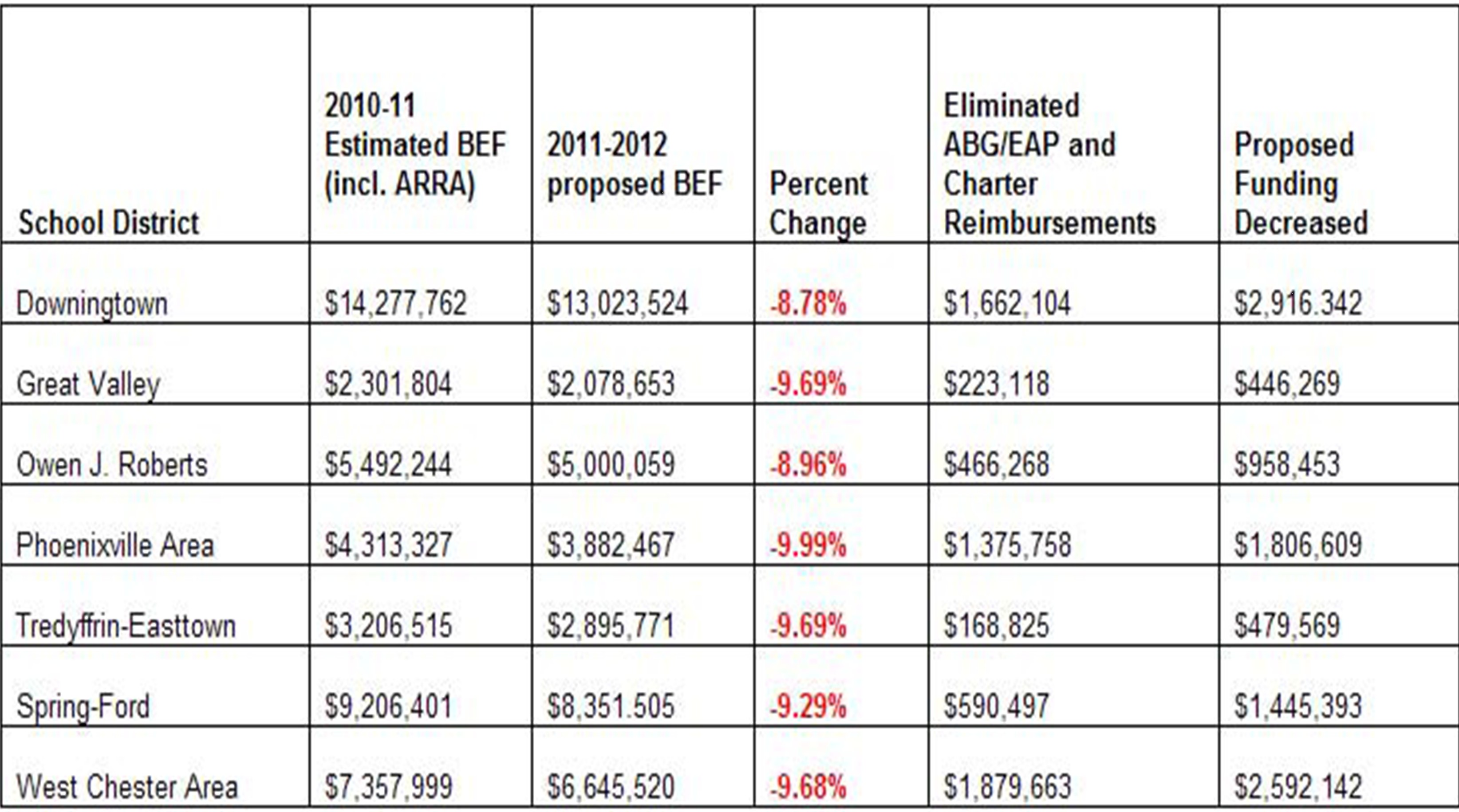
The table below from Dinniman’s website (www.senatordinniman.com) is interesting because it focuses specifically on the state funding to our local school districts, including TESD. The statistics indicate the current funding for public education versus the funding contained in the governor’s proposed budget. The decrease in state funding ranges from $446,269 in the Great Valley School District to Downingtown School District’s $2.9 million. The funding loss is due to Corbett’s proposed elimination of the Accountability Block Grant and Education Assistance programs.

Although Tredyffrin Easttown School District is grateful not to be in the $2 million + budget cut category of West Chester and Downingtown school districts, we are far from exempt. According to the table below, TESD proposed decrease in state funding equates to an approximate -9.69% change or $479,569.

“Governor Corbett’s proposal for basic education will be disastrous for our Commonwealth’s public schools,” Dinniman said. “Full-day kindergarten classes, reduced class sizes and after school tutoring programs are at risk of elimination.”

“The difficulty is that while the governor can wave the flag and say, ‘We’re not raising taxes,’ he has written a script that will mean significant local property tax increases and much heavier burden on local taxpayers, and that is indeed troubling,” Dinniman said.

It will be curious to see if Corbett’s significant budget cuts to public education enters in to the discussion at tonight’s TESD Finance Committee meeting. The Finance Committee is at 7:30 PM in the Tredyffrin/Easttown Administration Office (TEAO) at 940 West Valley Road, Suite 1700 in Wayne. Click here for the Finance Committee agenda.

Looking at Unionville-Chadds Ford School District, is the ‘Handwriting on the Wall’ for T/E?

A Community Matters reader suggested it would be interesting to compare the Unionville-Chadds Ford School District (UCF) with Tredyffrin-Easttown School District (TESD).

TESD has approximately 6300 students and the UCF school district approximately 4100 students. The 2011-12 TESD budget is $112M with approximately $17.7K per student spending. The proposed tax increase is 4.2% with expenditures exceeding revenues by approximately $8.9M. The budget gap is narrowed with the Act 1 tax increase and the Act 1 exception to $5.3M. Using suggested Level 1 budget strategies, the deficit is further reduced by $1M and the imbalance drops to $4.3M.

The proposed 2011-12 UCF budget is $71.4M with approximately $17K per student spending. The UCF school district intends to hold their tax increase at or below the Act 1 limit of 1.4%. Of the $71.4M, almost 72% of the budget goes to personnel costs (salaries and benefits).

Students from the UCF and TESD school districts enjoy similar academic performance; both top performing school districts. On Scholastic Aptitude Test (SAT) and Pennsylvania System of School Assessment (PSSA) performance, both school districts score in the top 1% statewide. Tredyffrin-Easttown School District ranks #2 for SAT scores and Unionville-Chadds Ford School District is ranked at #5 on the SAT.

The PSSA is an assessment-testing tool given to every Pennsylvania student in grades 3 through 8 and grade 11 in reading and math. Every Pennsylvania student in grades 5, 8 and 11 is assessed in writing and all students in grades 4, 8 and 11 are assessed in science. Checking the 11th grade statewide assessment, finds that TESD is #2 and UCF #3.

The Unionville-Chadds Ford School District teacher’s contract expired June 30, 2010; talks between the school board and the teachers union, Unionville-Chadds Ford Education Association have continued. In late December, the Pennsylvania Labor Relations Board appointed attorney Mariann E. Schick to help resolve the bargaining impasse through a Fact-Finder report. (This is a formal process where a neutral arbitrator is appointed to review the respective bargaining positions of both parties and recommend provisions for a possible settlement. The process is non-binding and either side can accept or reject the final report.)

The results of the fact-finding report on the UCF district were released last week. The UCF School Board voted unanimously to accept the findings of the report whereas the teachers union rejected the report. There were two major suggestions contained in the report. There is a provision for each member of the union to receive a one-time, nonrecurring payment in lieu of a raise in year one and an increase in the final two years of the contract and secondly, the suggestion that all union members move to a new, cost-saving healthcare plan, Keystone Direct, in the second year of the contract.

The UCF school board argues that its proposals look to maintain quality health care at a reduced rate and compensation for its teachers. They suggest that the economic times are hard and that the teacher union has benefited greatly when times were good but they must now share in the sacrifice as the others. However, the teacher union rejected the independent report and recommendations.

What’s that saying about the ‘handwriting on the wall’? In the UCF school district, the school board and the union have been working for more than a year to reach a new contract without success. The parents and students are frustrated because the gap between the two sides has not changed dramatically since the talks began.

The T/E school district has one year remaining in the teacher contract . . . can we expect similar conflict with the teacher union? Should residents accept bigger tax increases to ward off teacher union conflict? Is there a relationship between teachers working without a contract and the academic performance of the school district?

Looking ahead to next year, as the TESD school board begins to discuss the teacher contract, will demand negotiating skills and expertise from our elected officials. The terms of five of the nine TESD school board members are up this year . . . Karen Cruickshank, Pete Motel, Debbie Bookstaber, Jim Bruce and Kevin Mahoney. It is my understanding that Cruickshank will see re-election. Unfortunately, for the taxpayers, Bookstaber and Mahoney will not seek to be re-elected. I do not have information on the plans of Motel and Bruce. We hope that all school board candidates do their homework and come prepared to meet the enormous challenges ahead.

How Will T/E School District Close the $5.3 Million 2011-12 Budget Gap?

The Finance Committee meeting is Monday, February 14, 7:30 PM at the T/E Administration Office, West Valley Business Center, 940 West Valley Road, Suite 1700, Wayne. Click here for the meeting agenda and 2011-12 Budget Development Plan.

At the onset of this 2011-12 budget discussion, I want to give tremendous credit to the school board members who serve on the Finance Committee – Chair Kevin Mahoney, Debbie Bookstaber, Jim Bruce and Kevin Buraks. Their task is overwhelming and the 148-page 2011-12 budget document attests to their hard work, especially given the challenging economic situation of school districts. As a taxpayer, I am grateful and thank them for their diligence on our behalf.

Increased pension costs are the biggest hurdle in the coming years to school districts across the state. The challenge is how to balance the defined benefit plan of the teachers with the rising costs to maintain. How will school districts fund the pension plans, provide the same quality of education and not place the burden on the taxpayer . . . ?

Although I took time to review the budget documents provided for Monday’s meeting, I admit that my eyes glazed over on some of the details. If any of my assumptions are incorrect or if I have misinterpreted the information, here is hoping that someone will provide clarification.

As presented, the 2011-12 budget has projected revenue of $107M, which includes $1.2M revenue from Act 1 tax increase (1.4%) and $2.4M revenue from Act 1 exceptions (2.8%). Projected expenses are $112M, which leaves an imbalance of (-$5.3M). Without the $1.2M revenue from Act 1 tax increase and the $2.4M in revenue from Act 1 exceptions, the imbalance would be (-$8.9M) versus the (-$5.3M).

Although the 2011-12 budget gap is narrowed with the Act 1 tax increase and the Act 1 exception; there remains a deficit in the 2011-12 budget of (-$5.3M). If all strategies of Level 1 are instituted (as outlined on pg. 107 of the budget development plan), the deficit is reduced by $1M and the imbalance drops to (-$4.3). Under this plan, the remaining $4.3M of the budget deficit is to come from the district’s fund balance. The school district has a Moody’s AAA bond rating . . . is that rating jeopardized by using $4.3M in fund balance dollars for the 2011-12 budget? Understanding that the fund balance is taxpayers money; how much reserve is required to maintain the district’s bond rating?

All Level 1 strategies suggested under this budget development plan appear straightforward and practical ways to cut expenses. I did note two secretarial positions to be eliminated at a combined cost savings of $135K are included on the Level 1 list.

The more interesting and/or surprising strategy suggestions are included in Level 2 and Level 3. Level 3 requires attrition for implementation. It is interesting to note that the Level 2 strategies, should they all be implemented, would provide a cost savings to the district of $6.7M +. I would expect the dollar amount savings from Level 2 strategies would be substantially greater than $6.7M, probably closer to $10M, maybe more. Why? Because Level 2 includes the selling of TESD property including (1) the 16 acres on Jefferson Lane in Chesterbrook (earlier discussion on Community Matters questioned the feasibility of selling that property); (2) 738 First Ave, Berwyn; this is a 10 acre parcel where the ECS building sits. (As an aside, it was my understanding that the ESC building was contracted for demolition but it is still standing) and (3) 945 Conestoga Road, 0.33 acre of residential property next to Teamer Field.

In further review of Level 2 strategies, a few suggestions caught my attention; such as outsourcing of custodial services . . . could result in a savings of $950K. I believe that the custodians (along with the bus drivers, lunchroom staff and possibly some secretarial employees) are unionized which could make the change to outsourcing more difficult. However, with nearly a million dollar savings involved in custodial outsourcing, it could be worth further exploration.

On the Level 2 list, is a suggested $2M savings to the school district with the elimination of all non-mandated student transportation. The remaining transportation would be what is required by the state. Combining the outsourcing of custodial services and the elimination of the non-mandated bus transport, would provide almost $3M in savings.

Another Level 2 strategy that has an associated savings tag of $1.5M, (but a suggestion that probably is not practical and should be removed from consideration) is to require athletic and extra-curricular activities to become completely self-supporting. Families would be required to underwrite the cost of student participation or if unable financially, seek help from FLITE.

Contained in the Level 3 list are several staff reductions, many of which would affect the elementary grades. Here are those specific strategies and associated savings:

  • Eliminate Literacy Intervention Program $111,000
  • Eliminate Elementary Math Support Positions $350,000
  • Eliminate Four Elementary Reading Specialist Positions $300,000
  • Eliminate Elementary Strings Specialist Position $75,000
  • Eliminate Middle School Reading Specialists $300,000
  • Eliminate Middle School Math Support Positions $125,000
  • Reduce each High School Department by One Teacher $375,000
  • Eliminate Elementary Applied Tech Program $300,000

If my math is correct, the above listed eight cost-savings equate to approximately $2M. However, I have to believe that some of these staff reductions could directly influence the quality of TESD education. Remember, these are Level 3 strategies not Level 1. However, just the fact that they appear on any list, makes them a possibility.

The last Level 3 strategy listed is interesting and apparently was discussed at Friday’s Facilities Committee meeting – the redistricting of the elementary schools. According to district enrollment patterns predicted for the next 5 years, there is a need to consider redistricting. Devon Elementary is at 100% capacity and has become the largest elementary school. The savings is ‘to be determined’ because it is possible that redistricting could keep eliminate the need for additional space at Devon Elementary. However, this would impact those families living on the redistricted streets.

Ray Clarke attended the Facilities Committee meeting on Friday and offered the following notes from the meeting. It would seem that storage and maintenance facilities continues to be discussed but with no clear solution. I know that the ECS building was slated for demolition but would it be possible (at a far lesser cost) that the ECS building could be retrofitted as a storage facility – not for use by staff or students which could be affected by the building’s environmental issues – but for use as storage. It is obviously too simplistic a solution so there must be a reason that it is not possible.

Ray Clarke’s Notes from Facilities Committee meeting, 2/11/11

Some interesting and worthwhile discussions at the TESD Facilities Committee meeting on Friday, with many financial implications that are likely to be further explored on Monday’s Finance Committee. It’s good to report that the tone is very cost conscious – almost as if all the money that the Committee is spending is its own!

The first hour or more was consumed with a couple of items relating to use of the district sports facilities. (Perhaps these could/should have actually been on the published Agenda?). An adult soccer league would like to use Teamer Field; that would require a change in district policy and reversal of an understanding given to neighbors when the field was built. The revenue being discussed is material, and I believe that this warrants thorough consideration on Monday in the context of revenue strategies. A travel softball team has offered to redo the barely used and poor condition baseball field at the ESC site (one of four fields there) at their own expense. They have already done this for a field at Devon Elementary, and there seems to be no downside. The Committee was just about able to make a decision on this one! (Subject to a final check with the school athletics people). Larger issues that arose: a) the amounts the district charges seem to be low (another revenue strategy) and b) maybe as use gets more widespread the district will need to improve the scheduling system to ensure fairness and utilization.

The Committee revisited the issue of facilities for storage and maintenance, starting with the question: what do we actually need? The discussion was a little disjointed and difficult to follow, but it seems to boil down to: we need warm storage for snow clearing equipment (so it works on cold mornings!) that doesn’t involve sharing space with the carpentry shop, plus we need at the least to fix maintenance issues with the current building. The architect had come back with new plans for spending $2 million, taking about $0.75 million out of the first draft from a month ago. However, Dr Motel did not let the Committee even get to those plans. The majority of the Committee seems very conscious of the need to rigorously question all spending, although Betsy Fadem spoke for this project being part of the original plan for the non-educational facilities (but not the budget??). There is a good opportunity here to consider the full cost of in-house functions: for example, loading the carpentry shop with an incremental facilities cost changes the out-sourcing equation considerably. The administration is to come back at the next meeting with a full costing out of the options, from Do Nothing (but essential maintenance), through Add Temporary Space, Build New Facilities, to Restructure (some?) Operations. (It would be great if at least one of the Committee could have an on site review of the facilities and issues). Another topic relating to budget strategies at the Finance Committee.

Perhaps a good time to make the point that Bond Money is still Taxpayer Money. Bondholders are just not giving their money to the district because they like to see us have nice facilities! Although there may be no short run impact on the millage rate or the operating budget, and we can perhaps keep on borrowing, that money has to be repaid in the long run. The latest bond has to be spent on capital within a certain period, but there seems to be no problem with that! Again, relevant to Monday’s discussion.

Finally, interesting early data from just one week of kindergarten registration. Four of the five elementary schools are at an average of 75% of projected kindergarten enrollment, but Devon is already at 100% of the projection – and already enrolls over 100 students more than the average of the others (522 vs 420). The district as a whole has plenty of elementary capacity, but Devon is an exception. There is a facilities plan if an extra class is needed there next year, but the longer term may require other solutions.

Despite the Agenda, no discussion of the IT plan – the consultant had a sudden conflict.

Should T/E School District Join Others in Increasing Public Meeting Security?

In December, I think we all watched with disbelief the footage of Clay Duke, the disgruntled husband of a former school employee who opened fire on school board members in Panama City, Florida. Duke’s wife had been fired from her special ed teaching job in the Florida school district. The school board video showed Duke complaining about taxes and his wife’s firing before shooting at close range as the superintendent begged, “Please don’t.” There were several rounds exchanged with a school security officer, who wounded him, before he took his own life. Amazingly, no one else was injured during the shooting.

The Florida shooting was a wake-up call for many school districts around the country; many of which are considering increasing security at public meetings. Various security options considered include security guards, police presence, or requiring all meeting attendees to pass through some type metal detector or the use of a handheld detector. Protection at school board meetings is not just for the elected officials. As the discussion on our school district’s budget deficits increases, with discussion of property tax increases, programming cuts and possible staff reductions, there are more parents, teachers, staff, citizens, press, and sometimes students attending the meetings. As schools nationwide face this financial education crunch, heated moments and frustrated community members cannot be far behind.

Unlike Tredyffrin’s township meetings, which are held in the same building as the township police department, the T/E School Board meetings are held at the high school or the school district office. The Downingtown School District has made the decision to increase security at their school board meetings. Their decision to have security at regularly scheduled school board meetings was based on the Florida school board shooting as well as the recent shooting in Tucson, Arizona of Rep. Gabrielle Gifford. Starting this week, Downingtown School District has contracted with their police department for security at their meetings.

Although I am certain that T/E School District has an emergency management plan, I wonder if there is anything specific to public board meetings. You cannot predict or prepare for random acts of violence. However, circumstances that have happened nationwide in recent memory and given the time of which we live, unfortunately require this type of discussion.

Should school boards assess and appropriately upgrade awareness, along with security and preparedness measures, for their board meetings? Certainly. School districts need to be proactive (rather than reactive) in examining prevention, security and preparedness practices. We understand that no school district has a blank check for security or any other support service. School districts everywhere are under unprecedented financial crunches. But it is during a time when society is under intense economic pressure that violence and related security risks will likely increase.

I am curious, has T/E School District reviewed its public meeting security policies?

Is Pennsylvania Ready for a School Voucher Plan? Would you use school vouchers for your kids if you could?

Is Pennsylvania Ready for a School Voucher Plan? Would you use school vouchers for your kids if you could?

I wonder if the school voucher discussion is going to threaten the position of teacher unions, especially during contract negotiations. Gov. Tom Corbett is planning to make good on his campaign promise to move forward toward school vouchers for Pennsylvania parents. Contained in his inaugural address were the words, “Our education system must contend with other nations and so we must embrace innovation, competition, and choice in our education system.” Corbett issued a commitment to a voucher program, stating “Today’s Pennsylvania’s tradition of character and courage carries on in the single mother who works an extra job so she can send her children to a better school.”

However, pushing a school voucher program is not strictly a Republican initiative. Senators Anthony Williams, a Philadelphia Democrat and Republican Jeffrey Piccola from Daphin County have co-sponsored legislation that would give state money to poor students who want to transfer to a private school or another public school. In its current design, the Senate Bill 1 initially will only affect the 144 poorest-performing Pennsylvania schools. (101 of the schools are located in either Philadelphia or Delaware counties.) After two years, the program would expand to include all low-income students in the state. In the current budget year, the state is spending more than $9 billion on education, with more than $5.1 billion on basic education alone. This year the state is spending more than $14,000 per student in the public school system, though the amount per student fluctuates from district to district.

Sen. Williams believes that school choice is a civil rights issue. In a statement accompanying the introduction of the voucher bill, he states “Standing in the way of school choice for needy kids is like Gov. George Wallace standing in the doorway of a classroom to continue to the segregation of the ’60s. Why would we block access to great schools for children in need? … Let’s open the doors to freedom and opportunity.”

Not surprising, the powerful state teacher unions and their supporters are not fans of a school voucher plan, claiming that this type of legislation amounts to abandonment of public school education. Can one argue that this type of school voucher plan actually removes financial support from the public school that need more support rather than less? Teacher unions worry about accountability for private and religious schools, which are not held to the same governance standard as public schools. What happens if school choice passes and a student leaves a failing school and does not improve at a charter or private school? Whose fault is it then?

Former Gov. Tom Ridge failed with his school choice initiative in the 1990s. Is there significant change in the political climate in 2011 to support a voucher initiative? If Philadelphia is any indicator, there seems to be a movement among parents in big cities wanting better (and safer) schools for their children. Historically, there has been support for unions in the big cities, but parents are tired of waiting for the public schools to improve. To succeed, Corbett and his legislative supporters will need to balance the interests of urban parents who want better schools for their children with the suburban parents (like those in the T/E school district) who believe that public school may not need to change.

I support the right of all children to attend ‘safe’ schools but as we know from news reports, that is not always possible in Philadelphia. Is a school voucher plan the only option for parents to keep their children safe from violence, gangs, drugs in some of Philadelphia’s inner city schools? Unsafe public school must change, but how?

Does anyone share my uneasiness that a school voucher program may potentially violate Article III, the separation of church and state, contained in the state’s constitution? A voucher system cannot regulate where the money goes . . . I would think that using state tax money for religious schools would violate the constitution.

Would you use school vouchers for your kids if you could? I’m curious to hear what others think about a school voucher plan. Do you think that the school voucher discussion is going to affect the teacher contract negotiations, one way or the other?

Will T/E School Board Include an Activity Fee in the 2011-12 Budget?

On the eve of the Special T/E School Board meeting, there is much discussion on the $8.8 million deficit for the district’s 2011-12 school year and its challenge. Over the last couple of weeks, I do not recall much discussion about the possibility of adding an activities fee to the 2011-12 budget. If you recall, the T/E School Board passed the 2010-11 school year budget without the inclusion of an activity fee. The estimated $80K in activity fee revenue was removed before the passage of the final budget. The consensus at the time was there was not enough time to look at the details required for such an assessment. However, it was thought that some form of an activity fee should be discussed for inclusion in the 2011-12 budget.

Every year, students of all ages opt for extra-curricular activities. The activity may not be high-profile football or some other “major” high school sports. The involvement may be in the performing arts or any variety of positive clubs or organizations that contribute to making school kids better citizens. Depending on the activity, the kids and their parents may spend a lot of personal money on extra-curricular expenses (sports workout clothing, voice or instrumental music lessons, club-related materials, etc.). In addition, along with time spent on their studies, these students spend inordinate amounts of time practicing to become better performers or working for the good of the club. It’s also not uncommon for them to devote many hours of added time with fund-raisers to defray organizational expenses. Parents are not to be spared, either. Any parent of an “involved kid” at school will tell you about driving kids to and from practice, helping with fundraisers, etc. So how do we feel about imposing an activity fee on the T/E students and their families? Do you think that an activity fee will impact participation?

Checking other school districts, Lower Merion, Coatesville, Phoenixville, Owen J. Roberts and Kennett school districts currently have no additional activity fees. (I was not able to verify that Radnor School District imposes an activity fee – maybe a reader knows the answer.) Great Valley and West Chester school districts do not currently have an activity fee but are considering such a fee for the 2011-12 school year. The Downingtown school district charges their activity fee at a flat rate of $25 per sport.

Unionville-Chadds Ford School District currently has an activity fee but is considering an increase for next year’s budget. Their suggested approach is a creative four level-tiered schedule – $10, $25, $50 and $75 depending on the type of sports and student activity. The fees will cover many kinds of activities from math and academic clubs to participation on sports teams, like football and basketball. With the increase, the activity fees will generate an annual income of $133.00. The calculation of fees was based on total cost of the activity, an amount not to exceed 20% of the total cost. Using football fees as an example, the proposed increase is 200%, from a current $25 fee to $75; the increase would still be under the 20% of total cost.

If T/E adds an activities fee to the 2011-12 budget, how would the assessment be applied . . . per activity, per sports involvement? Would the charge be an annual assessment per student or per family? Will the assessment be a flat rate or a creative multi-tiered approach? Where does the T/E school board stand on the activity fee subject? I will be curious to see if the activity fee subject is discussed at tomorrow night’s special School Board meeting.

TESD Finance Committee Meeting . . . Raise School Taxes vs Eliminating School Buses or Support for Athletics? Notes from Ray Clarke

In the midst of packing to leave for a family holiday, Ray Clarke was still able to attend last night’s School Board’s Finance Committee meeting. We are all grateful that Ray attends the meetings and then kindly supplies his notes. Thank you my friend and happy travel! Below are Ray’s notes and I think you find them interesting! With the looming deficit, we are not surprised at the direction of our school taxes . . . but tax increase vs. elimination of school buses or support for athletics? Don’t think those options are likely to be approved.

There was a well-attended meeting of the TESD Finance Committee on Monday night. There was much material to cover, though, and not much time for input from the 30 or so community members present. Since the size of the problem and contentiousness-level (sorry!) of some of the ideas is off the charts, all the Finance Committee could really do was kick the can down the road.

No surprise, the Committee voted to recommend that the full board vote on January 3rd to apply to the state for Exceptions to be able to increase property taxes by 2.8% on top of the Act 1 increase of 1.4% – total 4.2% increase. This would also involve publishing a preliminary budget at that time that shows a budget deficit (after the tax increases) of somewhere in the $4-5 million range (depending on whether any expense reductions are included).

Important to note: this recommendation keeps options open. On the revenue front, the Board could 1) still ask for a higher tax increase through a voter referendum (but could not now ask for an EIT), 2) ask voters to approve any tax increase beyond 1.4% (and not apply for Exceptions), 3) hold the increase to zero or 1.4%. On expenses, there seem to be $1-2 million of “Level 1” and other strategies that could reasonably be implemented for 2011/12. The gap between revenues and expenses that results from the final choices on the above dimensions would be met from the fund balance. Kevin Mahoney and Debbie Bookstaber seemed to be favoring revenue option (2).

A few numbers that caught my eye:

1. This year’s operating statement is being strongly fortified by delinquent tax collections and by reduced PSERS contributions that are each projected to be ~$750,000 favorable to budget, resulting (with other puts and takes) in a reduction of the expected contribution from the fund balance from $1.5 to $2 million.

2. The district is finally publishing and using figures that reflect TEEA increases closer to the effect of the actual salary matrix. The aggregate salary increase for 2011/12 is projected to be 7.33%, and may go higher with more movement across the matrix.

3. The projections use historical rates of increase for medical and prescription costs (10-15% per year); it seems possible that current experience will turn out to be more favorable.

4. The “base case” used for starting points includes the Act 1 tax increase of 1.4%. This is different from other years when the base case is the current tax rate. With no tax increase and no additional expense reductions, next year’s gap would be $8.8 million. This includes $470,000 add back of “one-time” strategies used last year.

5. Options to close the close the gap with no tax increase include things like: elimination of school buses ($2 million) and of support for athletics ($1.5 million), outsourcing custodial services ($0.95 million), further reducing aides ($0.8 million). There was no indication that the Board would seriously consider these, although there was commentary about transportation inefficiencies observed by some Board members. Interesting that the option to hold administration salaries flat (impact $150,000) was included with these “Level 2” strategies. There is also a set of strategies to eliminate teaching positions that if approved by the Education Committee/Board and if staff attrition occurs would eventually save $3 million/year ($525,000 of this will be up for approval at the 1/32011 Board meeting).

6. Going forward, the problem compounds – even with a model that includes no TEEA compensation increases (none!). The issues are flat assessed values, healthcare costs, and PSERS (no, Harrisburg didn’t fix it!). One audience member cited research that predicts that property values and employment don’t reset and resume growth until 2016. That ~$5 million in earned income taxes paid to other jurisdictions seems pretty important, as do healthcare benefit cost-sharing programs and index-linked compensation in future union contracts. Maybe we will continue to look to the state for PSERS help, but there is clearly a lot that can be done at the local level.

There was much talk of the educational value delivered by the T/E program. Dan Waters compared Lower Merion expenditures and Kevin Buraks asked for comparisons of tax rates of neighboring districts (but this blog knows we need to look at rate times assessed value too).

Finally, there was an interesting aside that the Great Valley School district has asked for support for a County-wide property reassessment. Not sure what that means, except at the least a correction of imbalances that have built up over the years.

Hopefully, there were other CM readers at the meeting who can amplify and raise things I’ve missed here.

Tredyffrin Easttown School Board Meeting . . . Notes from Ray Clarke

We are very fortunate to have Ray Clarke not only attending the Tredyffrin Easttown School Board meetings but so generously willing to share his notes and thoughts with all us. Last night was no exception — and below are Ray’s notes from the meeting.

I am curious about the IT upgrade proposal. The School Board accepted the proposal from Teranet Consulting Services for Phase I – Part 1 of the IT upgrade, not to exceed $11,625. According to the information on the TESD website, “The consulting services are to survey the network, develop a project plan and establish specs for support and services needed to implement the upgrades recommended by the administration.”

Last week the 4 page proposal from Teranet Consulting Services was part of the agenda package but after last night’s school board meeting the proposal letter is no longer available online. I wish the proposal letter from regarding Teranet was not removed, as I was trying to track down the company ‘Teranet’ and could not find it — only a company out of Chicago. No conspiracy theory on my part, . . . just trying to get further information on this consulting group. If someone from the School Board is reading Community Matters, perhaps they could provide a link to the proposal or a copy of the proposal to me at tredyffrincommunitymatters@gmail.com . Thank you.

Here are some items that caught my eye and ear in Monday’s School Board meeting.

1. The administration reported on proposed changes to the high school schedule and staffing, to implement a 42 period cap for students and to increase teaching classes for teachers.

The cap would be subject to a few exceptions; for example, for co-curricular classes like orchestra and chorus that also meet outside the school day, and for academic support. Much discussion by the Board of whether studio art classes should also be exempt, although these seem to be just like music classes which would be in the cap. Reportedly the cap is highly favored by students. The middle school “advisory period” has proved really popular.

Eliminating the “professional period” for teachers would bring the number of teaching periods for T/E in line with neighboring districts, at the expense of activities that teachers elect to undertake, like “office hours”, club oversight, mentoring, etc.

Note that both these changes will in the long run bring financial benefit to the district, but only after the staff has reduced through attrition.

2. The high school musical will be Phantom of the Opera, for which the rights have just been released to schools. If this comes close to matching the stunning Les Miserables production of five or so years ago, tickets will be hard to come by. Big vocal and technical demands, though, especially for the radio-controlled boat….

3. Under Education, there was discussion of increasing the Highway Safety class size to 60 – maybe not so bad – and teaching AP World History in 9th Grade – a big stretch, it seems to me. Also the changes in World Languages look to be enabling deeper immersion in core languages like Spanish and French. A good development.

4. Under Facilities, the Board was presented with, and approved, only the first part of the consultant proposal for work on the data network upgrade. To me, this constraint is a step in the right direction. It would be nice to see an IT project that is actually driven by user/education requirements and a real business case rather than by the technical/facilities people! We should watch future Facilities Committee meetings closely for the justification of the likely multi-million dollar expenditure.

5. And the Committee to be watched most closely, of course, is the Finance Committee. Kevin Mahoney previewed the December 13th meeting, which will set the stage for the Board’s big tax decision on January 3rd. That next meeting will unveil near term projections including:

  • Updated PSERS costs from Harrisburg’s parting “gift” of HB2497, (a slight reduction over the expected increase for 2011/12 and much bigger benefit for the following few years, as discussed here previously)
  • New estimates for key budget variables (eg interest rates, price increases, compensation increases)
  • Presumably some guess at the attrition-enabled impact of the Education programs
  • Any other budget strategies

An important date for anyone concerned with tax increases.

Community Matters © 2025 Frontier Theme